
I Married Him for His Security Clearance. He Gave Me a Smiley Face.
In D.C., love is resource allocation—until a manila envelope lands on your desk and forces you to choose between the campaign and the person who knows how you take your tea.
Margaret Chen set her coffee cup on the conference table. There was still half a mouthful left.
Monday morning meeting. Hoffman, the campaign's pollster, was flipping through the latest numbers. His index finger jabbed at the approval curve on the whiteboard as he opened his mouth and said—
"We need to seize every single—"
He caught himself. Too late. A dozen pairs of eyes in the conference room swiveled toward him. Margaret couldn't help it. A warm laugh leaked through her nose, like a faucet not quite shut.
Hoffman's face went blank. "Ms. Chen. Repeat that sentence aloud. Ten times."
She did. Ten rounds of "seize every single opportunity," crisp and unsmiling. She was the senator's press secretary. She'd handled public gaffes a hundred times more humiliating than this.
That evening she got home, tossed her keys into the ceramic bowl by the entryway, and found Callum Shaw kneeling on the living room carpet. Folded an ashmere throw under his knees. Cuffs unbuttoned, sleeves rolled up two turns. Eyes lowered.
Margaret stepped out of her heels, walked barefoot across the floor, planted her hands on her hips, and peeled a Post-it off the refrigerator door. She slapped it onto the coffee table.
"Mr. Shaw. Appendix B of the prenuptial agreement. Copy it ten times. By hand."
Callum lifted his eyes. Gray-green, pale under the lamp light, like watered-down crème de menthe. He didn't ask a single question. He pulled a fountain pen from under the coffee table and set the nib to paper. The scratching sound was like a match striking sandpaper.
They'd been married five months. The Shaws ran private security contracting; the Chens ran political consulting. One provided the hard shell, the other the soft power. In the Washington marriage market, that was called resource allocation. At the wedding, he'd blocked a bourbon for her; she'd straightened the flag pin on his lapel. The whole ceremony had felt like a bipartisan press conference.
Margaret's original plan had been clean: marry, use Shaw's overseas security networks to crack the defense contracts, then maintain a civilized distance. The defense contracts cleared the hearing last month. The utilitarian portion was mostly used up. She discovered she'd started noticing where he kept the coffee beans.
That hadn't been part of the plan.
Tuesday afternoon, she sneezed. Five in a row. Sophie, the intern, handed her a tissue and mentioned, offhand, that Mr. Shaw had called earlier. Asked about something, but didn't want to be put through. Margaret returned to her desk. There was a hot cup of black tea waiting for her, the cup wrapped in two tissues folded into squares. Beneath the cup, a Post-it with no words, just a crooked smiley face. Callum never drew smiley faces when he wrote. She picked up the cup and just stood there, thumb pressed against the tissues, a long moment passing before she took the first sip.
Wednesday, she worked late. When she got home, the hallway light was on. On the dining table sat a covered plate with a small bottle of antacids beside it. She'd never mentioned her stomach was upset. He'd never asked. Callum was on the couch, reading a tablet. He heard the door, his eyes stayed on the screen, but he pushed the throw blanket on the armrest half an inch in her direction. The TV was on, muted, tuned to the Weather Channel. The forecaster was pointing at a white cold front mass on the satellite map. Margaret sat down beside him, pulled the throw over her legs, and let it cover one of his feet. He didn't pull away. She didn't look.
Saturday is a campaign fundraising gala. The two of them were stationed side by side at the terrace entrance, functioning as live props. She wore a backless gown. The night wind raised a fine grain of goosebumps between her shoulder blades. Callum slipped off his suit jacket and draped it over her shoulders, his movements quick, like he was defusing a bomb. Then he dipped his head, and his breath touched the loose hair behind her ear. Margaret turned. The tip of her nose nearly grazed his chin. She saw his Adam's apple move.
The terrace door slammed open. Drunk Hoffman burst through, a champagne flute in each hand, shouting about getting a photo with the two VIPs. Callum's hand left her waist and went into his own trouser pocket. Margaret pulled the jacket tighter around herself and smelled cedar and laundry detergent.
The thing that happened three weeks after the gala.
A manila envelope appeared on Margaret's desk. No return address. Postmark local. Inside: Callum Shaw's private travel records. Three years ago, a forty-eight-hour layover in Istanbul, at a hotel less than two hundred meters from the Iranian consulate. Attached were several telephoto shots of him sitting at a café with a man in a dark suit. The photos were grainy, but the timeline was clean—those forty-eight hours fell precisely inside a window he'd declared on his security contracts as "personal leave."
The thing itself proved nothing. Callum's company operated in six countries. Istanbul was a transit hub. He could have met anyone there for any legitimate reason. But the file wasn't sent to her alone. The CC line on the internal routing slip listed the campaign office's compliance department fax number. The slip had merely been "inadvertently" leaked to her as well. Which meant someone wanted this out, and was letting her decide whether to handle it herself or wait for compliance to handle it for her.
Margaret stared at the photos for a long time. The Callum in them was younger than the one she knew. Same sharp jawline, but the eyes were emptier, like someone waiting for an order that hadn't arrived yet.
She had a hundred ways to check this out. She knew people at the National Security Council, people at State, people in at least three agencies who could pull customs records through unofficial channels. But every single method would leave a trail. The moment she started digging, a second person would know she was digging. The moment a second person knew, it stopped being a private matter between her and her husband and became a story about a press secretary investigating her own spouse.
She locked the file in her office drawer. For three days.
The fourth evening, she was pouring water in the kitchen. Callum sat at the dining table, looking at his tablet. The TV was on. The forecaster said a low-pressure system was moving inland from the Atlantic.
Margaret held her water glass. She didn't turn around. Her voice was level, the way she read press releases aloud.
"Who did you meet in Istanbul?"
Three seconds of silence behind her. The tablet screen clicked off.
"What?"
"Three years ago. Istanbul. The two days you filed as personal leave."
Callum stood. The chair leg scraped against the floor, one short, sharp sound. She didn't turn. But she heard him take a step toward her, then stop.
"Who gave it to you?"
"That doesn't matter." Margaret turned. The glass was still in her hand. The surface of the water didn't tremble. "Who did you meet?"
Callum looked at her. In the cold kitchen light, his gray-green eyes had gone very pale, the color of ice just before it melts. He looked at her for so long she thought he wouldn't answer.
"Someone I can't name to you."
She gave a single nod, set the water glass down on the counter, and walked out of the kitchen.
She didn't leave the apartment. She walked into the bedroom, shut the door, sat down on the edge of the bed, and stared at the old scar on her knee from a childhood swing-set fall. Her mother had given up her law partnership at thirty-four for her father's promises. At thirty-nine, she'd signed the divorce papers at the kitchen table, biting her lip. Her father had never cheated, never been violent, never lied to her mother about any single concrete fact. He just never told her things. Work things, stress things, happy things, unhappy things. It took her mother fourteen years to realize she'd married a man she didn't know at all. At fifteen, Margaret had sworn she would never, ever let anyone protect her with silence.
She sat on the bed for forty minutes. Then she stood, walked to the nightstand, and opened the bottom drawer on Callum's side.
No files. No passport. No photographs. Just a small metal box. Not locked.
She opened it.
Inside were ten photocopies of Appendix B of their prenuptial agreement. Every copy was filled with handwriting. "Independent"—the "ind" was circled and crossed out, and beside it was written "together." There were the marks of his copying—the first sheet precise, the fifth beginning to slant, the tenth pressed so hard she could feel the grooves on the reverse. On the last line, he had written: "Tell me what I should do."
At the bottom of the box lay an old photograph. Callum, in a military uniform, standing on sandy ground, crouching beside a small boy holding a paper airplane. On the back, written in ink: "Mosul, 2016. Hadi, age 8. Says he wants to be a pilot."
Margaret turned the photo over and looked at the boy with the paper airplane, her finger resting lightly on the paper. Hadi. A name she had never heard Callum speak.
She sat on the floor, surrounded by scattered agreements and the photograph of the soldier. Through the door crack, the Weather Channel's voice drifted in. The forecaster said the cold front would pass through around midnight, accompanied by heavy rainfall.
Callum stood outside the door for a long time. She could hear his breathing through the wood, even and controlled, like someone counting measures. He didn't knock. He didn't call her name. He didn't offer a single word of explanation. He just stood there, one door between them.
At midnight, the doorknob turned softly. He didn't come in. He pushed the door open a crack and placed a new Post-it on the floor just inside.
Margaret got up and picked it up. One sentence, the handwriting so heavy she could feel the grooves on the back: "My name is Callum William Shaw. Service number E-782-44. No aliases. No hidden identity. The name I can't tell you isn't my secret. It's someone else's."
She held the note. Her fingers creased the edge.
Then she opened the door.
Callum was leaning against the wall across from the doorframe, two shirt buttons undone, a bruised color under his eyes that she'd never seen before. When he saw her step out, he straightened up.
"That boy." Margaret held up the photograph. "What happened to him afterward?"
Callum's Adam's apple moved.
"Died. 2017. Car bomb. He and his older sister. Together."
Margaret turned the photo over and looked at the crooked signature on the back. An eight-year-old writing his own name, the strokes still drifting.
"You're protecting his family."
It wasn't a question. Callum said nothing. But silence, here, was an answer.
Margaret placed the photograph back in the box, closed the lid, and put the box back in the drawer. Then she walked over to Callum, reached up, and began buttoning his open shirt. One button, then the next. When her fingers brushed his collarbone, his whole body went still, like a target locked.
"Next time someone sends something like this," she said, her fingertips still resting against his collar, "you tell me first. Not my secretary. Not compliance. Me."
Callum looked down at her. His gray-green eyes were threaded with red, damp at the edges, but mostly holding something she hadn't seen before—the look of a man who'd been on guard for a very long time and had just been relieved of his post.
"Understood," he said.
Margaret nodded, fastened the last button, and stepped back.
"What do you want for breakfast tomorrow?"
He blinked.
"What?"
"Waffles," she said. "You're making them."
Callum stared at her. His Adam's apple moved again. Then the corner of his mouth bent, a tiny shift, but it bent.
"Okay."
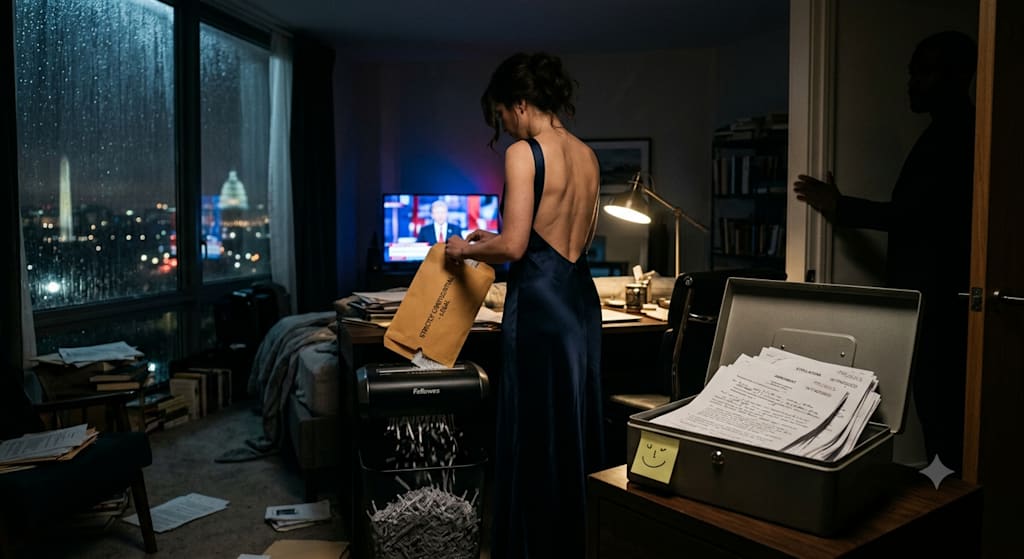
Outside, it started raining. The Weather Channel had said the cold front was arriving early. Rain hit the window glass, sounding like a lot of people clapping from very far away. Margaret went back into the bedroom, pulled the envelope she had not yet returned to compliance from her bag, tore it in half, and fed it into the shredder.
The shredder was louder than the rain.
Epilogue
Three months later, the senator won reelection.
The night of the victory speech, Margaret stood beneath the stage, her gown pocket holding an old Post-it whose smiley face had worn nearly smooth. Callum stood half a step behind her, one hand hovering at the small of her back—not quite touching, but not withdrawn.
The speech ended. The crowd surged forward. Margaret was swept toward the stage. Callum was cut off by the crush of bodies. She glanced back and caught only his shoulders and half his jaw.
Her phone buzzed. A text from him: "I'll wait at the back entrance."
She stared at the screen for two seconds, then typed back: "Front entrance. I'll come to you."
She hit send, turned around, and pushed against the current. The crowd was flowing toward the stage; she was one person moving the opposite way, the hem of her gown getting stepped on. By the time she reached the front entrance, her hair had come loose, and one earring was hanging crooked on her shoulder.
Callum saw her emerge. His expression shifted.
"Why did you—"
"You said back entrance, I came to the back entrance." Margaret pulled the crooked earring off and tucked it into his suit pocket. "I don't need you to accommodate my position. I accommodate yours."
He looked down at the pearl earring poking halfway out of his pocket. He was quiet for a moment. Then he reached out, lifted her hair off her shoulder, and put the earring back on her. The motion was gentle, like suturing a wound.
"Front entrance," he said.
"What?"
"Next time. Front entrance." He withdrew his hand and slid it into his trouser pocket. "Together."
Margaret looked at him. The corner of her mouth slowly curved upward. Not her press-secretary smile, not the calibrated public-facing expression. A real, ungoverned arc.
She reached out, caught his cuff, and tugged.
"Waffles. Remember?"
"I remember."
"Then let's go."
They walked into the parking lot side by side. The rain had just stopped. The pavement was wet, reflecting a single streetlamp overhead. The light pulled their shadows long, the two shapes merging on the ground—impossible to tell who had stepped first, impossible to tell who was waiting for whom.
About the Creator
Jin
Writer of reamstories
https://reamstories.com/jin
Enjoyed the story? Support the Creator.
Subscribe for free to receive all their stories in your feed. You could also become a paid subscriber, letting them know you appreciate their work.
Comments
There are no comments for this story
Be the first to respond and start the conversation.