
He Left His Entire Fortune to His Second Wife. His Daughter Is Suing for Her Mother’s Share.
A notarized will, an Alzheimer’s diagnosis, and an oxygen tube: inside a 600 million yuan inheritance fight.
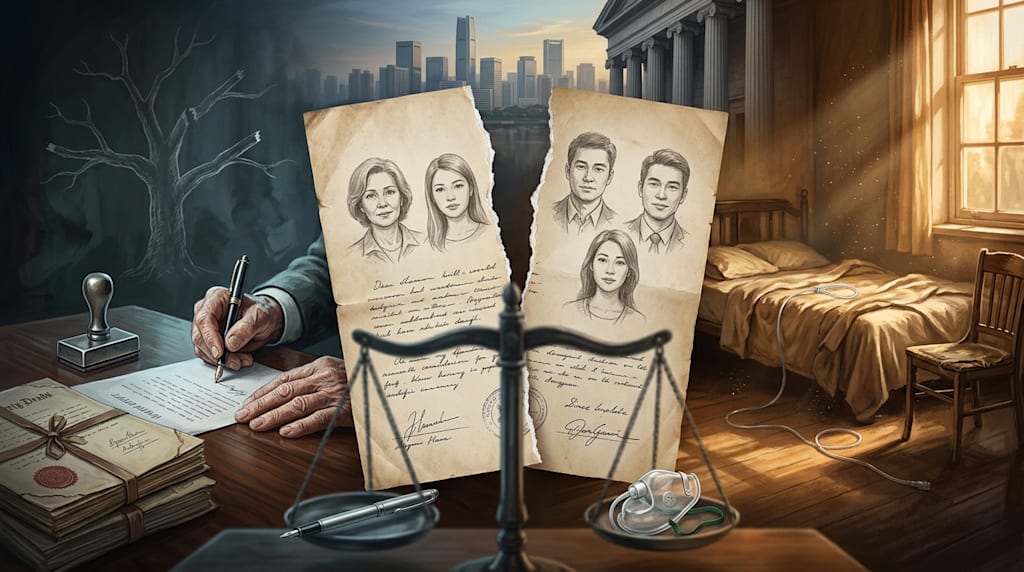
On April 18, 2024, Wu Mouli signed a will at the Dongguan Notary Office. Article 2 left all his property to Deng Moumou. The list included real estate, company shares, bank deposits, wealth management products, and any share of undivided property he was entitled to inherit.
Wu Mouli was 81. He had built a business worth about 600 million yuan, with holdings in Zhongtang Town and Dongcheng Subdistrict in Dongguan. He had two marriages. His first wife died in a car accident in December 1988, leaving three children: Wu Moujia and her two siblings. Six months later, Deng Moumou became his second wife. They had a daughter, Wu Mouyi.
The will gave nothing to the three children from his first marriage.
On July 23, 2025, Wu Mouli left the hospital and returned to his old house in Zhongtang Town. Wu Moujia later said that about half an hour after he arrived, his oxygen tube was removed. He died of hypoxia. Deng Moumou and Wu Mouyi made the decision to remove the tube.
In early 2026, Wu Moujia sued Deng Moumou and Wu Mouyi. She asked for 57.34 million yuan of the 600 million yuan estate. She challenged the will on three grounds: her father had Alzheimer’s disease when he signed it; the will disposed of property that belonged to her mother; and the removal of the oxygen tube may have been abandonment.
Deng Moumou told a reporter, “Don’t ask me.” Wu Mouyi hung up.
The police case
On May 13, 2026, Wu Moujia’s younger sister reported the removal of the oxygen tube. A month later, police opened an investigation into Wu Mouli’s abandonment. On September 11, 2026, police withdrew the case. The decision said that under the Criminal Law, no criminal responsibility would be pursued. The family said it would appeal.
The legal effect of that withdrawal depends on the provision police used.
Article 186 of the Provisions on Procedures for Handling Criminal Cases by Public Security Organs lists six reasons to withdraw a case. They fall into two groups. One: there was no criminal fact at all. Two: there was an unlawful act, but a legal reason prevents criminal punishment. The second group includes cases where the circumstances are obviously minor, the harm is not great, and the act is not considered a crime.
Police first opened the case, then withdrew it. Opening a case means they believed a criminal fact might exist and criminal responsibility might apply. Withdrawal means that after investigation, the circumstances did not meet the threshold for prosecution. That is not the same as saying no abandonment occurred. It means the act was not considered the crime of abandonment.
That distinction matters for the civil inheritance case.
Article 1125 of the Civil Code says an heir loses inheritance rights if the heir “abandons the decedent, or maltreats the decedent with serious circumstances.” Abandonment here is a civil law concept. Its standard is not the same as the criminal crime of abandonment. In civil law, the question is whether an heir who owed support refused to provide it, and whether that caused substantial neglect or harm. A finding of no criminal responsibility does not decide the civil question.
Even if police found that Deng Moumou and Wu Mouyi did not commit the crime of abandonment, a civil court can still examine whether their conduct was abandonment under the Civil Code. If the court finds it was, Deng Moumou loses her inheritance rights. If she loses those rights, the will’s instruction to leave her everything has no legal basis.
The notarized will
Wu Mouli left a notarized will. In inheritance disputes, a notarized will usually has strong probative value. Article 36 of the Notary Law says a notarized civil juristic act is a basis for establishing facts, “unless there is contrary evidence sufficient to overturn the notarization.”
Notarization gives the will a rebuttable presumption. It does not make the will untouchable. A notary checks the form of the will, the identity of the testator, and whether the expression of intent is clear. The notary does not investigate who owns all the property in the will. Notarization guarantees that the will was made by this person at this time. It does not guarantee that every part of the will is legally valid.
Wu Moujia is looking for contrary evidence in two areas: her father’s mental capacity when he signed, and the ownership of the property the will disposed of.
The Alzheimer’s diagnosis
Wu Mouli signed the will on April 18, 2024. His medical records show the first diagnosis of “Alzheimer’s disease” on October 22, 2024. Earlier admission and discharge records do not mention it.
That time gap is the main problem for Wu Moujia’s capacity argument.
Courts do not decide capacity from one diagnosis before or after the will. In Beijing Xicheng District Court case (2019) Jing 0102 Min Chu No. 18586, the person was conscious but had impaired comprehension and obvious intellectual impairment. The court found limited civil capacity and invalidated the will notarization. The case shows a distinction: being conscious is a state of wakefulness. Civil capacity requires intact cognition. The person must understand the nature and consequences of the act and make a true expression of intent. A patient with moderate to severe Alzheimer’s may answer questions but still have severe judgment and memory loss.
Whether Wu Mouli was in that state in April 2024 cannot be proved by the October diagnosis alone. Wu Moujia can apply for a judicial appraisal. She can use medical records before and after the will, witness testimony, and any video of the notarization to reconstruct his cognitive state on April 18, 2024.
The burden of proof is also contested. Under the civil litigation principle that the party who asserts must prove, Wu Moujia must provide evidence that her father lacked full civil capacity when he made the will. But many courts have also held that the party who benefits from the will should prove its authenticity, legality, and validity. If Deng Moumou, who holds the will and benefits from it, cannot show that Wu Mouli had full civil capacity, the court may rule against her.
The first wife’s estate
Wu Moujia’s complaint says her mother died in December 1988. The marital property she left was kept by Wu Mouli. As of the lawsuit, that estate had not been divided or inherited. The will, she says, did not list the property by name, amount, location, or ownership. It may have disposed of property that belonged to others.
The legal basis for this claim is clear.
Article 1153 of the Civil Code says that when one spouse dies, half of the jointly owned marital property goes to the surviving spouse, and the rest is the estate of the deceased. Article 26 of the Interpretation (I) of the Supreme People’s Court on the Inheritance Part of the Civil Code says: “Where a testator disposes of state, collective, or another person’s property by will, that part of the will shall be deemed invalid.”
When Wu Mouli’s first wife died, half of the property accumulated during their marriage belonged to her estate. That estate should have been inherited by Wu Mouli and the three children. Before division, the property was co-owned by all heirs. Wu Mouli could not dispose of by will the share that did not belong to him.
There are two possible outcomes. One is partial invalidity: the will is invalid only as to the first wife’s estate, and valid as to Wu Mouli’s own property. The other, argued by Wu Moujia, is total invalidity: because the will failed to separate ownership and disposed of “all property,” its intent is unclear and the whole will should fail. Courts usually choose partial invalidity. The part that disposes of Wu Mouli’s personal property stands. The part that reaches into the first wife’s estate falls.
That means even if the will survives, Wu Moujia and her siblings can still claim their mother’s estate through statutory inheritance. The amount depends on dividing the property Wu Mouli and his first wife owned during their marriage. Wu Mouli only stopped working in village affairs and turned to business after 1988, so most of his business empire was probably built during his second marriage. But property that already existed when the first wife died, such as real estate, deposits, and village income, does not lose its inheritance status just because time passed.
Three legal questions
The case turns on three questions.
First, abandonment. The police withdrawal does not settle the civil issue. If Wu Moujia can show that Deng Moumou and Wu Mouyi refused to provide support, for example by removing the oxygen tube without adequate medical assessment or by neglecting his care, the court may find abandonment under the Civil Code. That could cost Deng Moumou her inheritance rights.
Second, capacity. Wu Moujia must overcome the time gap. Through a judicial appraisal and other evidence, she must raise reasonable doubt about Wu Mouli’s cognition in April 2024. If she proves he had limited civil capacity, the will is invalid.
Third, ownership. This is Wu Moujia’s strongest ground. Whether or not the will is valid, and whether or not Deng Moumou loses her inheritance rights, Wu Mouli could not dispose of the first wife’s estate. That property returns to statutory inheritance and goes to Wu Mouli and his three children.
The questions overlap. A finding of abandonment can remove Deng Moumou as an heir, leaving the will without a beneficiary. A finding on capacity can invalidate the whole will and send the estate through statutory inheritance. A finding on ownership limits what the will can reach even if the will stands.
The old house and the notary office
When Wu Mouli’s first wife died, Wu Moujia and her siblings were not yet adults. After the December 1988 car accident, the marital property was not divided. Six months later, Deng Moumou entered the family. More than thirty years later, Wu Mouli signed a will at the notary office and left “all property” to Deng Moumou. On July 23, 2025, the oxygen tube in the old house was removed. On September 11, 2026, the police withdrawal reached the family.
Wu Moujia said she would appeal.
The signature on the will remains. The notary file remains. Whether Wu Mouli’s expression of intent on April 18, 2024 was true, complete, and within his power to dispose of will be decided by a court. The 600 million yuan will be divided according to law. The oxygen tube in the old house cannot be put back.
About the Creator
Jin
Writer of reamstories
https://reamstories.com/jin
Enjoyed the story? Support the Creator.
Subscribe for free to receive all their stories in your feed. You could also become a paid subscriber, letting them know you appreciate their work.
Comments
There are no comments for this story
Be the first to respond and start the conversation.