
Give Me Back My Kidney or Pay Me $1.5 Million
A surgeon donated his organ to save his wife's life. Four years later, in divorce court, he demanded it back. The law said no. But the real question never made it to the verdict.
I. The First Silence Outside the Operating Room
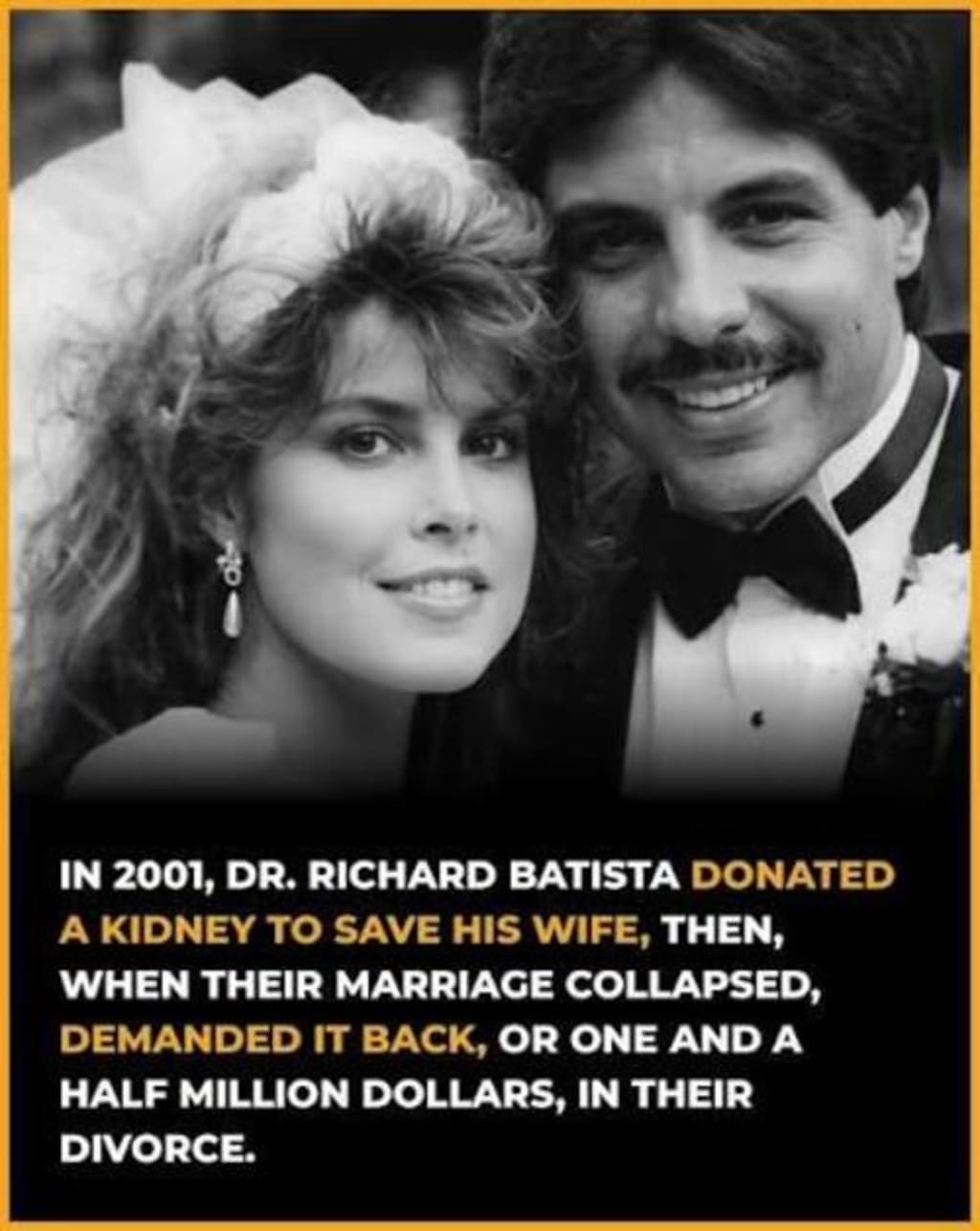
In 2001, Dr. Richard Batista, a Long Island surgeon, cut his own body open to give his wife a kidney. The surgery went flawlessly. Post‑op tests came back normal. Four years later, his wife filed for divorce.
In court, he demanded the return of that kidney—or $1.5 million.
The judge ruled: organs are not property. Donations cannot be revoked.
The law closed the case. But something else stayed open. When he decided to donate that kidney, what was he actually giving?
II. He Never Gave Just an Organ
Suppose someone cuts himself open and removes a life‑sustaining organ for another person. Most cultures call that the highest form of love.
What comes after the highest form?
The marriage entered year four. Arguments. Cold silence. She closed the bedroom door; he kept the TV on until three in the morning. She started going back to her parents' house. He started checking her phone.
One night, she said, "I want to separate."
He stood in the kitchen doorway, holding a cup of tea that had gone cold.
"I gave you a kidney," he said.
Those words opened a door she had no way to argue through. Yes, you gave me a kidney. So what? Does my life now belong to you? Can I not leave? Do I have to endure everything I don't want to endure?
She didn't say any of that. She only looked down at the pale pink scar on her side.
That scar did not belong to her. It was his proof of giving.
III. What the Law Doesn't Cover
The judge cited the National Organ Transplant Act. Organs cannot be bought, sold, valued, or divided as marital property.
The law is clear. But it doesn't answer a finer question: what actually happens between two people when one receives the other's organ?
It's not debt. Not a contract. Not a transfer of ownership.
It's something thicker and harder to settle. It sits between gratitude and burden. The recipient can neither repay nor ignore it. The donor, even if he never says it aloud, thinks: I gave you life. The least you could do is…
Stay. Obey. Don't betray me. Don't make me regret it.
In 2017, the singer Selena Gomez received a kidney from her friend Francia Raisa. Soon after, paparazzi photographed Gomez drinking. Raisa privately urged her to take better care of the organ. Gomez didn't respond.
Years later, Gomez married. Raisa's name wasn't on the invitation list.
The public called Gomez ungrateful. Others defended Raisa's hurt. But almost no one asked what happens to the recipient when a gift is too large to ever repay.
The answer: distance. Every time you meet, the other person reminds you—you owe me your life.
IV. How the Darkest Moment Came to Be
One detail from the Batista case never made most news reports. When the wife filed for divorce, her allegations included domestic violence and infidelity.
In her account, the marriage broke first. She left because it was broken. His response: I gave you a kidney. How dare you walk away?
That's not a legal problem. That's a personality problem.
Some people use giving to buy control. When a relationship collapses, they turn every sacrifice into a bill. He may not be calculating on purpose. He just doesn't know any other way. His core fear: I gave you so much, and you still don't belong to me. Her core fear: I accepted what he gave, so I can't have a will of my own.
These fears collided in year four.
She threw a glass. He said, "What the hell is wrong with you?" She cried and said, "I want to die." He said, "I gave you a kidney and this is how you treat me?"
Neither of them was lying. They both wounded each other. They both thought the other owed them something.
V. The Empty Ordinary
During the divorce, Batista kept going to the hospital. Seven in the morning, surgery. Five in the afternoon, out. Nurses said he spoke little during that period and operated faster than usual.
Between surgeries, he ate sandwiches, drank black coffee, and stared at case files on his computer. No one asked if he was okay.
Across the same city, his wife also got through her days. She needed lifelong immunosuppressants—four pills every morning. Her doctor told her to have her creatinine checked regularly. She went, had blood drawn, waited for the results, went home.
Four pills, one lab report. No label said, "This is your ex‑husband's kidney."
But her body knew. The scar knew. Her throat knew, every morning, when she swallowed.
Days passed like that. No explosion. No reconciliation. Nothing that makes you stop and think. Just the daily grind—and the daily grind never asks if you're ready.
VI. No One Needs to Be Forgiven
The case never went to appeal. He didn't get his kidney back. He didn't get the money. The divorce was granted. She kept the kidney.
The media moved on. No one tracked what happened next. Did he regret donating? Did she ever wonder, "If only I didn't have this kidney"? Those questions don't have answers—and don't need them.
The real question is not whether the kidney should be returned.
It's this: at the moment he decided to give, what was he giving?
If he gave a certificate he could later use as leverage, he never should have walked into that operating room. If he gave a debt that could never be repaid, his wife would have lived in a cage for the rest of her life.
If he gave a gift that asked for nothing in return—then the weight of that gift belongs to the recipient. The donor doesn't need to ask about it. The law can't govern it. Public opinion can't govern it either.
Only the two of them, with the rest of their lives, can answer it.
And the rest of their lives doesn't give answers. It gives four pills every morning, and sutures on an operating table that no longer belong to him.
About the Creator
Jin
Writer of reamstories
https://reamstories.com/jin
Enjoyed the story? Support the Creator.
Subscribe for free to receive all their stories in your feed. You could also become a paid subscriber, letting them know you appreciate their work.
Comments
There are no comments for this story
Be the first to respond and start the conversation.