
Everyone Called Him the Family Failure. He’s the Only One Who Never Left.
For seven years, my cousin has walked across the street every morning at 6:30 to care for our 91-year-old Fourth Grandma. The relatives with big careers send money. He sends himself.
The Child Who Didn't Amount to Much Is the One Who Stays by Your Side
When Fourth Grandma said those words, my cousin was squatting on the threshold wiping away tears.
That day he had been bullied again. A few half-grown boys in the village coaxed him. They said they would help him find work. They took him to the brick factory in town and had him unload bricks all afternoon. When it got dark, they ran off. He never got paid. When my cousin came back, his hands were covered in blood blisters. When they asked what happened, he could not speak. His mouth twisted, and the tears fell first. When his parents saw him, they scolded him again. His father slapped his chopsticks on the table. "Cry, cry, all you know how to do is cry. What else can you do besides cry?" His mother sighed beside him. "You. Your brain's no good. Your mouth's no good. What are we going to do with you in the future?"
Fourth Grandma happened to come by, carrying half a bag of oranges. She did not say anything at first. She walked over, pulled my cousin up from the threshold, and wiped his face with her sleeve. My cousin was a head taller than her. Being pulled by her, he looked like a big dog soaked through by rain. Fourth Grandma glanced back at his parents. Her voice was low. "What do you know? The child who doesn't amount to much is your child, the one who needs your love and care the most. The child who amounts to something, that child isn't yours anymore. When you're old, at best you'll hear other people praise them. That's all."
My cousin's parents did not answer. His mother carried the bowls and chopsticks into the kitchen. His father lit a cigarette. His expression was hidden in the smoke. Fourth Grandma did not stay long. She peeled an orange and handed it to my cousin. She threw the peel into the stove. The flames jumped. My cousin clutched the orange segments without eating them. Tears dripped onto the back of his hand.
That year, my cousin was fourteen.
In the years that followed, Fourth Grandma became my cousin's support.
When other children had game consoles, my cousin stood at their doorways and watched. Sometimes he watched for a whole afternoon. When Fourth Grandma found out, she went to town the next day and bought one. She pressed it into his hands. My cousin held the console and cried. His shoulders shook. The family thought Fourth Grandma spoiled him too much. They said, "Is a child with no future worth all this trouble?" Fourth Grandma did not argue. She came by every few days. She cooked the dishes he liked, took him to the supermarket, and let him pick out snacks. My cousin followed behind her, pushing the shopping cart. The wheels squeaked. He grinned, showing two tiger teeth.
Later, the capable brothers and sisters in the family left one by one. Some went to the provincial capital. Some went farther. They came back once a year for the New Year. At the dinner table they talked about projects, titles, mortgages. My cousin could not join in. He sat in the corner and poured tea for everyone. Someone asked what he did now. He said he helped out with property management in a residential compound, two thousand eight a month. The table went quiet for a moment. Then the conversation swung back to whose family had bought a new car.
The year Fourth Grandma turned eighty, her health began to fail. First blood pressure, then her heart, and later her legs and feet grew unsteady. When my cousin heard, he moved his things to the place across from Fourth Grandma's. It was a rented room, three hundred a month, with a north-facing window that was cold in winter. He said it was close and convenient.
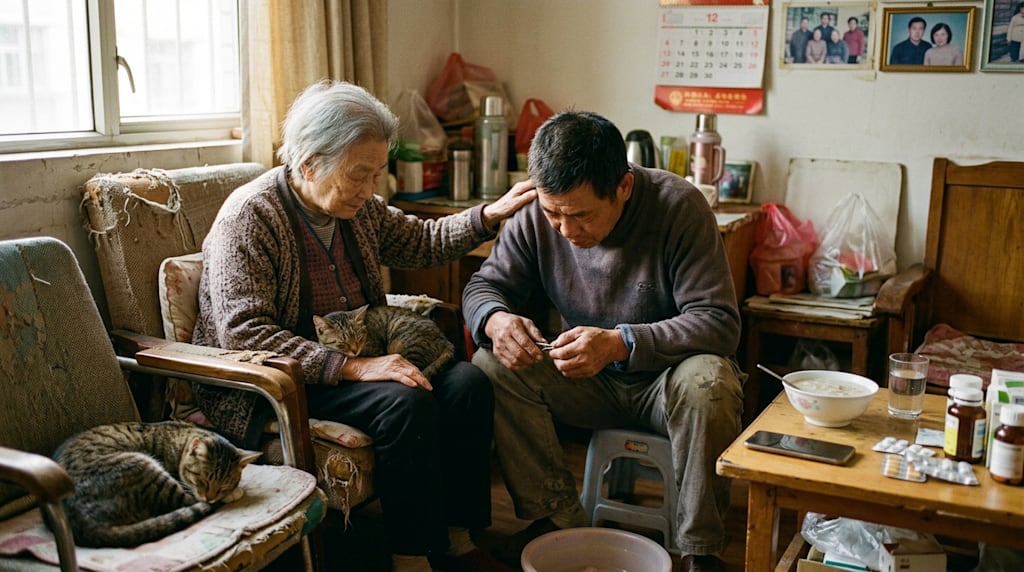
From then on, every morning at six thirty, my cousin pushed open Fourth Grandma's door. First he boiled a kettle of water. He sorted her morning, noon, and evening pills and set them on the corner of the table. Then he made breakfast. The porridge had to be soft, the vegetables chopped fine. Fourth Grandma's teeth were bad. After breakfast he cleared the bowls and chopsticks, mopped the floor, changed the cats' water, and refilled their food. He carried the litter box downstairs to dump it. Then he came back and carried the cats to the balcony to sun themselves. When Fourth Grandma wanted to go out, he supported her. They stopped every few steps. When she could not walk anymore, he squatted down, let her climb onto his back, and carried her downstairs step by step.
When Fourth Grandma went to the hospital for checkups, my cousin went with her. He could not remember what the doctor said, so he wrote it in a notebook. His handwriting was crooked. He wrote down every item. Back home, he copied the instructions from the medicine boxes in large characters and taped them to the head of the bed. Fourth Grandma could not see clearly. He read them aloud. Once. Then again.
One winter, Fourth Grandma suddenly fell ill. She was confused and did not recognize anyone. Her children rushed back and gathered around the bed, calling, "Mom." Fourth Grandma's eyes were empty. She looked at their faces and gave no sign of recognition. My cousin came back from buying medicine. As soon as he entered, Fourth Grandma's eyes moved. Her lips trembled. She called him by his childhood name. The medicine bag fell from my cousin's hand. He walked over, squatted by the bed, and held her hand tight. Fourth Grandma said, "In this family, this grandson is the best, the one who amounts to the most." My cousin kept his head down. Tears struck the bedsheet and spread into a small patch.
After that, Fourth Grandma's health went up and down. My cousin never left for a single day. Seven years. He never left the city. He never traveled. Friends asked him to work elsewhere. Wages doubled. He shook his head and said he could not leave. Some people laughed at him. They said he was foolish. They said what could he possibly gain by watching over an old woman. He did not answer. The next day, he still pushed open the door at six thirty.
In the hospital, I have seen many old people. Retired professors. Former officials. Parents whose children had settled abroad. The rooms were piled with supplements and flower baskets. The space beside the bed was often empty. Paid caregivers came on time and left on time. They were efficient. They said few words. The accomplished children said on the phone, "Dad, I can't get away. If you need money, tell me." The old person said, "Enough, enough. You go do your work." After hanging up, they stared out the window for a long time. I saw an old woman once. She was in the hospital for half a month. Her daughter came once and stayed forty minutes. When she was leaving, the old woman said, "You're busy. You don't need to keep coming." After the daughter left, the old woman took a photo from under her pillow and wiped it.
I have never seen another cousin like mine. Not one.
Fourth Grandma is ninety-one. My cousin is forty-five. He never married. He never bought a house. He does not have much in his bank account. When the neighbors mention him now, their tone has changed. They say Fourth Grandma is lucky to have such a grandson. They say, look at that child, he comes every day, rain or shine. They say, my son, I do not see him from one end of the year to the next.
My cousin does not know about these things. Every day at six thirty he pushes open the door. He boils water. He sorts pills. He cooks porridge. Fourth Grandma sits by the window. A cat is on her lap. Sunlight comes in and falls on my cousin's bent back. He is bending over, cutting Fourth Grandma's nails. Slowly. Gently.
Fourth Grandma suddenly says, "When you were little, they all said you wouldn't amount to anything."
My cousin does not look up. He grunts in acknowledgment.
Fourth Grandma says, "They amounted to something. They all left."
My cousin gathers the nail clippings into his palm and throws them in the trash. He says, "I don't leave."
Outside the window, birds call. The cat stretches. The porridge bubbles in the pot.
Fourth Grandma does not speak again. My cousin does not either. But that afternoon, when he washes Fourth Grandma's feet, her feet move gently in the basin. Like a fish stranded for a long time that has touched water again.
About the Creator
Jin
Writer of reamstories
https://reamstories.com/jin
Enjoyed the story? Support the Creator.
Subscribe for free to receive all their stories in your feed. You could also become a paid subscriber, letting them know you appreciate their work.
Comments
There are no comments for this story
Be the first to respond and start the conversation.