
Chapter 1 — I Ran Away From Home at Seven. My Parents Never Came Looking for Me.
During Chinese New Year, I spent nearly two weeks hiding across the street—waiting for someone to ask me to come home.
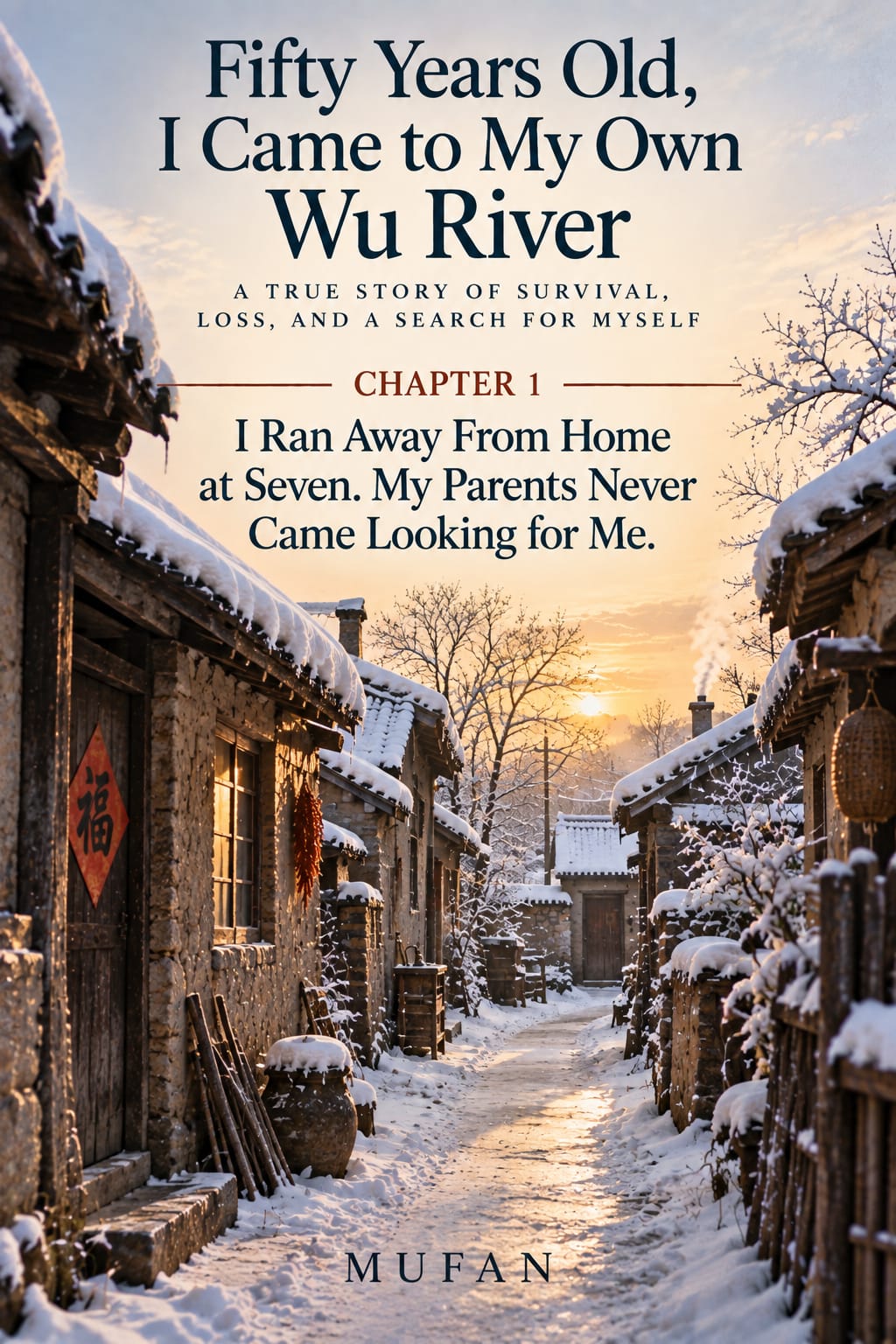
The first time I ran away from home, I was seven or eight years old. It was during the Spring Festival.
At the time, my family lived in a village in Henan Province, China. There were four of us: my father, my mother, me, and my younger brother, who was two years younger than I was. My father was an ordinary worker at a local township factory and earned very little. My mother did not work outside the home. We were poor.
I no longer remember exactly why I ran away.
Maybe I had been scolded. Maybe something else had happened at home. There were too many things like that. Standing could be wrong; sitting could be wrong. Speaking could be wrong, and staying silent might be wrong too. Decades later, I still remember running out of the house, but I can no longer pick out the one incident, among all those arguments and hurts, that finally sent me through the door.
What I do remember is what life felt like then.
We were so poor that we rarely had stir-fried vegetables. Most meals came with little more than pickled vegetables. When I was about six or seven, there were two meals with stir-fried vegetables that I have never forgotten. One was radish. I can no longer be certain what the other was—perhaps cabbage.
One time, when there was a stir-fried dish on the table, I kept reaching for it with my chopsticks. My father suddenly snapped at me, “Look how much you’re eating.” My mother said nothing.
The next time there was a stir-fried dish, I took only two bites and did not dare take any more.
I watched my brother sitting across from me. He kept reaching for the food and eating. Neither my father nor my mother said a word.
I finally asked, “Why don’t you say anything when he eats a lot? Why do you say something when I eat a lot?”
My father gave me only one answer.
“He can eat.”
Same table. Same dish. If I ate too much, I was scolded. If my brother ate too much, no one said anything.
At that age, I could not understand why.
My brother was not particularly strong, so my parents subscribed to a daily milk delivery for him. Every morning, half a jin of milk—about half a pound—was delivered to our door. My mother warmed it and gave it to him. Sometimes he also had an egg for breakfast.
I wanted one too. I told my parents, “I want an egg too.”
They said, “You don’t need one. He eats it because he isn’t healthy.”
At that age, I had never drunk milk. I did not even know what milk tasted like.
But I was thin and frail too.
I still could not understand: Why did he need it, but I didn’t?
Things like that accumulated day after day until I came to feel that, in that house, my brother could do anything and I could do nothing right.
Where could a seven- or eight-year-old child run to?
That night, I left home crying and went to my grandparents’ house. It was the only place I could go. Their house was diagonally across from ours. From their front door, you turned right and walked only a dozen or so meters—less than twenty—and you were at our house. Yet that short distance was as far as I was capable of going then.
I remember it being around seven in the evening, perhaps a little after. My grandparents always kept very early hours. In winter they often ate dinner around four in the afternoon, and by six or seven they were getting ready for bed. So by the time I reached their door, they were already settling in for the night.
I knocked.
My grandfather got up and opened the door. My grandmother had already lain down. When I came in, she got out of bed again.
My grandparents lived in a single room. A meter or two inside the door, on the right, my grandfather’s bed stood against the wall. Immediately to the left of the doorway was a large earthen stove. Beyond the stove, against the wall, was my grandmother’s bed.
They asked me what had happened. I told them about the things at home that had made me feel wronged over the years. I told them my parents were too partial to my brother, that they treated the two of us differently, and that I did not understand why.
My grandmother thought I was thinking too much. She told me not to dwell on it and urged me to go home and sleep. My grandfather reacted differently. He said some of the things my parents had done were wrong, and that he had not known things were like this in our home.
Still, they urged me to go back.
“I’m not going back,” I said.
They tried for a while longer, but I refused. After we had gone back and forth for some time, they finally stopped trying to persuade me and let me stay the night.
I got into my grandmother’s bed, and she lay down again. Eventually she fell asleep. My grandfather did too. The room slowly grew quiet.
I lay awake, listening to my grandfather snore, unable to fall asleep for a long time.
Over the next few days, I spent most of my time inside that room.
It was bitterly cold. The earthen stove was large enough for a person to sit on for warmth. Sometimes I sat directly on it. Sometimes I pulled up a stool and sat beside it, watching my grandmother cook.
I rarely went out into the courtyard. It was not because my grandparents stopped me. I simply did not want to go out. I was afraid I might run into my father, my mother, or my brother.
The walls were thick. From inside, I could barely hear ordinary voices from the street. But the firecrackers during the Spring Festival were so loud that their explosions still came through the heavy walls in bursts.
The longer I stayed, the closer my grandmother and I became. At first she had kept telling me to go home. Later she stopped bringing it up and took even more care of me.
Those days at my grandparents’ house were not all painful. Even eating felt different from the way it did at home.
My mother usually cooked as simply as she could. If there was an easier way to make a meal, that was how she made it; she rarely spent much time over food. My grandmother was different. She cooked with much more care. Even ordinary food tasted better to me when she made it.
Sometimes, before she cooked, she would ask, “What do you want to eat today?”
I would tell her, and she would make it for me.
One evening, my grandmother ate dinner early and went to bed around six or seven. By a little after nine, I was still awake and had begun to feel hungry.
“Grandma,” I called. “I’m a little hungry.”
She was already in bed, but she got up again. She did not simply find me a few leftovers. She started from scratch and made dumplings for me.
By the time the dumplings were ready and I had finished eating, it was after eleven.
I felt happy that night. Not only because the dumplings tasted good. I had said, “I’m hungry,” and my grandmother, already in bed for the night, had gotten up and spent all that time making something for me to eat.
I knew that if I had been at home and told my mother at nine o’clock at night that I was hungry, this would not have happened.
After I had been at my grandparents’ house for about four or five days, my mother came by.
There were only a day or two left before the Spring Festival.
The Spring Festival is China’s most important traditional holiday, and more than any other time of year, it is a time when families are expected to be together. People travel hundreds, even thousands, of miles to make it home for the holiday.
And I was only seven or eight years old, living diagonally across the street from my own home.
I was sitting beside the earthen stove. It was winter and bitterly cold, so the door was shut. There was a window in the wall behind the stove. It had no glass. Paper had been pasted over the wooden lattice.
First I saw the shadow of someone passing across the paper.
I could not tell who it was.
Then I heard my mother’s voice.
I recognized it immediately.
It was a voice I had heard all my life, yet at that moment it sounded both familiar and strangely unfamiliar. I had never gone four or five days without seeing my mother. I had never gone that long without hearing her voice.
She stood outside the door talking with my grandmother about preparations for the Spring Festival—what my grandmother planned to make, and when. If my grandmother was going to make steamed buns, stuffed buns, or something similar, my mother’s meaning was roughly: make some extra, and then she would not have to make as much herself, or perhaps would not have to make it at all.
When they finished talking about those things, they chatted for a while longer.
I sat inside and listened.
I was almost certain that, before she left, my mother would open the door, come inside, and tell me to go home.
I had already been away for four or five days, and the Spring Festival was almost here. I thought that no matter what had happened before, surely now she would tell me to come home.
So I waited.
I waited for them to mention me.
But they never did.
Eventually the voices outside stopped.
I did not see when my mother left. I had not noticed whether another shadow crossed the paper window. I even thought she might still be outside.
A little while later, my grandmother opened the door and came in alone.
She closed it behind her.
Only when the door shut did I understand:
My mother was gone.
I was stunned. I had been so sure she would come in and tell me to go home. After she left, I felt utterly desolate. My mother seemed even more like a stranger to me. I did not know what I was supposed to do. I felt as if that house was no longer my home.
My grandmother closed the door, walked a few steps into the room, and looked up at me. She looked at me only briefly, then lowered her head a little.
She said nothing.
After a while, she began talking to me about something else.
From that point on, my grandmother never again urged me to go home.
The truth was, it was not that I did not want to go home at all.
I was waiting for my father or mother to come and say just one thing to me:
“Come home.”
By the seventh or eighth day after I left, it was the first day of the Lunar New Year.
Early that morning, my grandfather went out into the courtyard to set off firecrackers, and I went with him.
In previous years, it had been my father who got up to set off the firecrackers, with my brother and me following him. This year, the person beside me was my grandfather.
After the firecrackers and breakfast, at around eight in the morning, we went out.
On the first morning of the Lunar New Year, people in the village traditionally went out to exchange New Year greetings. Our lane was narrow, only about three meters wide, with houses packed side by side along both sides.
I walked on my grandfather’s left, holding his hand with my right. At first, I was looking down.
When I raised my head, my father and my brother were coming toward us. They were only seven or eight meters away. Looking at them, I felt something strange: they were both familiar and unfamiliar. Unfamiliar because I had not seen them for seven or eight days, longer than I had ever gone without seeing them before. Familiar because I had spent the previous seven or eight years living with them.
My father was holding my brother’s hand. I was holding my grandfather’s. I felt nervous. I did not know what was going to happen. What I feared most was that my father would get angry and start scolding me.
I do not know when he first saw me. I only remember that from the moment I saw him, there was no visible change in his expression.
We kept walking toward one another.
My father did not turn toward me. Our eyes never met. When he reached my grandfather, he turned his head slightly and gave him a small nod. My grandfather nodded back.
Neither of them spoke. No one stopped.
My brother did not look at me either. He did not call out to me. He simply held my father’s hand and kept walking.
And just like that, we passed each other.
I did not turn around.
At that moment, I felt an emptiness open inside me.
It felt as if there were no family bond between us anymore. My father especially seemed like someone I knew, but someone who had nothing to do with me.
My brother was holding my father’s hand.
I was holding my grandfather’s.
For a moment, I felt as if my grandfather were my father.
I had been living with my grandparents for days. My grandfather had listened when I told him what had been happening at home and had said my parents were wrong about some things. And now, on the first day of the Lunar New Year, he was the one holding my hand and taking me out with him.
Without my quite realizing it, my grandfather had become the person I depended on.
Yet the man who had just walked past me was my father.
I had never felt the distance between us so strongly.
My grandfather kept walking with me. Near the north end of the lane, several neighbors were standing together. He stopped to talk with them, and I stood beside him.
It was the first day of the Lunar New Year.
My father had just walked past me holding my brother’s hand, while I stood there beside my grandfather.
I did not know what the neighbors thought.
I only remember how embarrassed I felt standing there.
On the second day of the Lunar New Year, my aunt came to visit my grandparents. According to the local New Year custom, married daughters usually returned to their parents’ home that day.
She knew I was still staying there and tried to persuade me to go home.
“I’m not going back,” I said.
My aunt sounded very confident. She said she would go talk to my parents and tell them to come and ask me to return. She spoke as though it would be simple.
I was not so sure.
My mother had already come once and had not asked me to go home. And my aunt did not really know what had been happening inside our family. So I did not believe that a few words from her would necessarily change anything.
Still, she went.
About an hour later, she came back.
I waited for her to tell me what had happened.
She explained nothing. She did not mention my parents coming to get me again.
Later, she left.
I do not know what she said to my parents or what they said to her. But from the way she acted when she returned, I knew it had not worked.
After the second day of the Lunar New Year, I stayed with my grandparents for a few more days.
By around the fourth or fifth day of the New Year, I had been there for about ten days. School would start again in another two or three days.
The longer I stayed, the more I understood that I could not go on living with my grandparents indefinitely.
If there had been somewhere else I could have lived long-term, somewhere I could have had a better life than at home, I think I might not have gone back. Even if my parents had eventually come for me, I might not have wanted to return.
But there was nowhere else.
I was only seven or eight years old, and school was about to begin again.
In the end, I had no choice but to go home.
That evening, I ate dinner at my grandparents’ house. By the time I went back, it was completely dark.
No one came to get me.
I walked those dozen or so meters home by myself.
I did not go into the room where my parents and brother lived. I went straight into the kitchen.
The kitchen was small, less than five meters deep. In the corner opposite the door was an earthen stove. Beside it were a work surface for preparing food and a large water jar. Just inside the door on the right was a window, with a table beneath it. Farther in was the small wooden bed where I slept. In the middle of the kitchen stood another small table where we usually ate.
My bed, the place where meals were cooked, and the place where we ate were all in the same room.
That night, no one came out to ask where I had been all those days. No one spoke to me about my running away.
I lay down on my bed and went to sleep.
At around six the next morning, my father and mother came into the kitchen as usual to cook breakfast.
I was awake, but I did not get up.
Sometimes I lay on my side facing the wall. Sometimes I lay flat on my back. When I was on my back, I could see my parents cooking out of the corner of my eye.
They were not far from me. I thought that when breakfast was ready, they would tell me to come eat.
But they did not speak to me.
I did not speak to them either.
They cooked as usual, then sat there and ate breakfast.
I lay in bed watching and listening, feeling as though they had not even noticed that I had come back.
As though none of the days I had been gone had happened.
As though I had never returned at all.
When they finished eating, they left the kitchen.
Only then did I get up. I went to the toilet and came back.
By a little after ten, I was hungry.
There was some food left from breakfast.
I looked at the leftovers and did not know whether I should eat them.
They had not called me to breakfast. But I was hungry. If I did not eat, I did not know what else I could do.
In the end, I ate.
But as I ate, I felt as if I were sneaking food.
I was in my own home, yet I felt as though I were stealing something to eat.
I even worried that if my father or mother suddenly walked in and saw me eating, I did not know what they would think of me.
It made me deeply uncomfortable.
I no longer remember what happened at lunchtime that day. I cannot say for certain whether my mother called me to eat.
What I do remember is that it was not until dinner that evening that I ate a normal meal again.
That was how my first attempt to run away from home ended.
I had thought that leaving would at least make them come looking for me.
They never did. In the end, I was the one who walked back.
My leaving changed nothing.
Running away did not change my situation.
It changed me.
I began to understand that even when something felt unfair, even when I could no longer stand it, I had no real ability to leave.
There was nowhere else I could live for any length of time, and I had no power to make my parents change.
What could a seven- or eight-year-old child do? If resisting changed nothing, all that remained was to endure.
I had to learn to endure more than before—to accept more of what felt unfair simply because there was nothing I could do to change it.
I ran away from home again in later years.
But after that first time, I never again expected my parents to come looking for me.
When home became unbearable, I would leave and hide somewhere for a few days, then come back on my own.
I knew they did not treat me the way other parents treated their children.
I just did not know why they treated me that way.
Comments
There are no comments for this story
Be the first to respond and start the conversation.