
A Mum Who Put Her Child First, And Considered Child Inclusive Mediation
The Day My Daughter Asked If She Could Tell Someone How She Felt

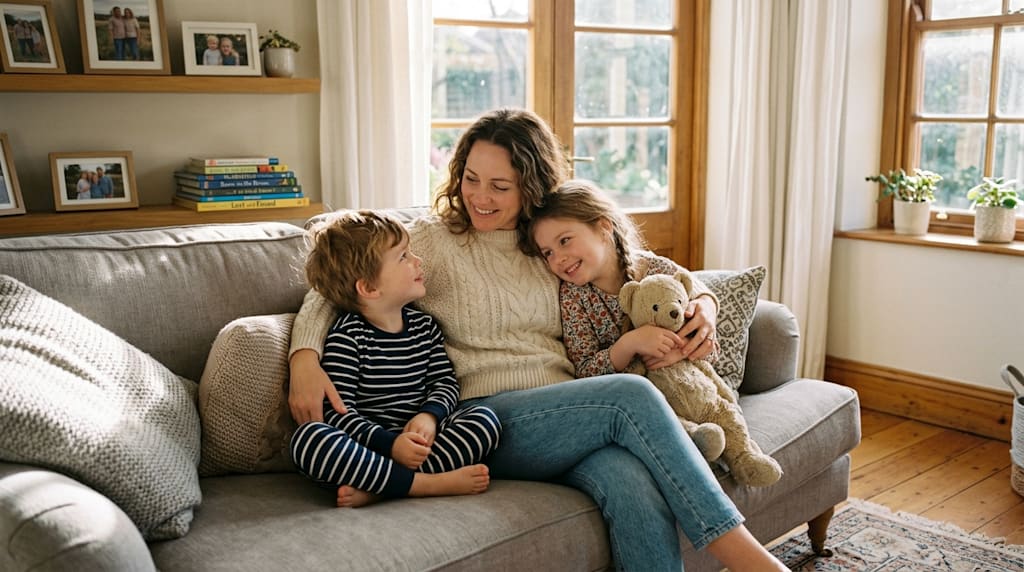
I have a photograph on my fridge of Eva on her ninth birthday, blowing out candles shaped like a lopsided number nine, her cheeks pink from running around the garden. It was taken nine months before her dad and I sat down at the kitchen table and admitted, quietly, that we couldn't carry on pretending.
I keep that picture there on purpose. It reminds me of the version of her I was trying to protect when everything started to come apart.
We were never one of those couples who shouted. If anything, that was part of the problem. We had drifted into a kind of polite cohabitation, two people who shared a child and a mortgage and a Netflix login, but who hadn't had a proper conversation in months. When Mark said, one evening after Eva was in bed, that he thought we should talk about separating, I wasn't shocked. I was relieved, and then immediately ashamed of being relieved.
The first few weeks felt unreal. We told ourselves we'd be the sensible ones. We even said the word "amicable" out loud, like it was a plan rather than a hope. But amicable is harder than it sounds when you're working out who keeps the house, who has Eva on which nights, and who pays for what. Within a fortnight, we were arguing about a dishwasher.
I remember the moment I realised Eva had noticed. She was in the bath, and I was sitting on the floor next to her, half listening to her chatter about a girl in her class who had a hamster. She stopped mid-sentence and said, very matter-of-factly, "Mum, are you and Dad going to live in different houses?"
I didn't have an answer ready. She just looked at me with those serious brown eyes and said, "Okay. But will you tell me before it happens?"
I sat on the bathroom floor for a long time after she went to bed.
A friend of mine, who'd been through her own separation, suggested mediation. She had a cousin who had skipped it, gone straight for solicitors and a c100 form, and ended up wishing he'd tried to talk it through first. I had a stubborn reaction at first. I thought mediation was for people who couldn't manage on their own. It took me another fortnight, and one particularly grim argument about who got the slow cooker, before I admitted she was right.
Booking the first session felt like a small surrender, but a useful one. We had a meeting on our own first, called a MIAM, just to make sure mediation was suitable. Then a few sessions together with someone who sat between us at a slightly too-small table and asked us, very calmly, what we actually wanted. Not what we were arguing about. What we wanted.
It turned out we wanted similar things. We both wanted Eva to feel safe. We both wanted to be in the same room at her school plays without it being weird. We both wanted to stop snapping at each other in front of her. The mediator kept gently steering us back to that whenever we got stuck on the smaller stuff.
Around the third session, when we were starting to talk seriously about child arrangements, she mentioned something I hadn't heard of before. She said that for some families, especially when there was a child who clearly had her own thoughts about what was happening, it could help for the child to have a voice in the process. Not to make decisions, she was very clear about that, but to be heard. She called it child inclusive mediation.
What changed my mind was something Eva said one Sunday afternoon. We were making cupcakes, just the two of us, when she asked me if she'd done something wrong. I asked her what she meant, and she said, very small, that she'd noticed Dad was looking at flats on his laptop, and she wondered if it was because of her.
I had to put the bowl down. I sat her on the kitchen counter and told her, as steadily as I could, that none of this was anything to do with her. She nodded and went back to the cupcakes. But I knew, in that moment, that the silence we'd been wrapping her in wasn't actually protecting her. It was just leaving her to fill in the blanks with the worst possible explanations.
We agreed to the child inclusive session.
A specially trained mediator met with Eva on her own, in a relaxed setting, with no pressure and no agenda. Eva knew she didn't have to say anything she didn't want to. She knew nothing would be repeated back to us unless she said it could be. She knew no one was going to ask her to choose between us, because that wasn't her job.
I don't know exactly what they talked about. I know they did some drawing. The mediator brought her back to the waiting area afterwards with a slightly proud look on her face, and Eva gave us a thumbs up and asked if we could go and get a bubble tea.
What came back to us, with Eva's permission, was a small handful of things she wanted us to know. She wanted to keep her bedroom as it was, even if she had two bedrooms in two houses. She wanted to take her favourite things between both. She didn't want to be the one explaining things to her grandparents. And she wanted us to please, please, not say bad things about each other in front of her, even by accident.
That last one stayed with me for weeks.
Hearing those things, in her words, changed the shape of every conversation Mark and I had after that. Not because we suddenly agreed on everything, but because we had a clearer sense of who we were doing this for. The dishwasher seemed less important. The slow cooker stopped being a battleground. We worked out a parenting plan that made room for what she'd said, and we wrote it down properly so neither of us had to rely on memory or goodwill on a bad day.
Eva is eleven now. She has two bedrooms, two sets of bedside lamps, and a teddy who travels in a small backpack she has long since outgrown. She tells me, sometimes, that her friends at school think it's weird that her parents get on. I tell her that we worked at it, because she was worth working for.
I still have the photograph on the fridge. But I've added a new one next to it, taken last summer, of the three of us at her school sports day. Mark is cheering. I'm laughing. Eva is mid-leap over a bean bag, her face full of pure, uncomplicated joy.
That's the picture I look at now, when I want to remember why we did it the way we did.
This story is based on real mediation experiences, with details changed to protect confidentiality.
About the Creator
Jess Knauf
Jess Knauf is the Director of Client Strategy at Mediate UK and Co-founder of Family Law Service. She shares real stories from clients to help separating couples across the UK.
Jess is author of The Divorce Guide in England & Wales 2016.
Enjoyed the story? Support the Creator.
Subscribe for free to receive all their stories in your feed.
Comments
There are no comments for this story
Be the first to respond and start the conversation.