
You Don’t Hate Liang Canbin’s Differential Geometry. You Hate the Entry Point.
A physics-first reading path through Frankel, Isham, Wang Zuoqin, Lee, Tu, and Nakahara.
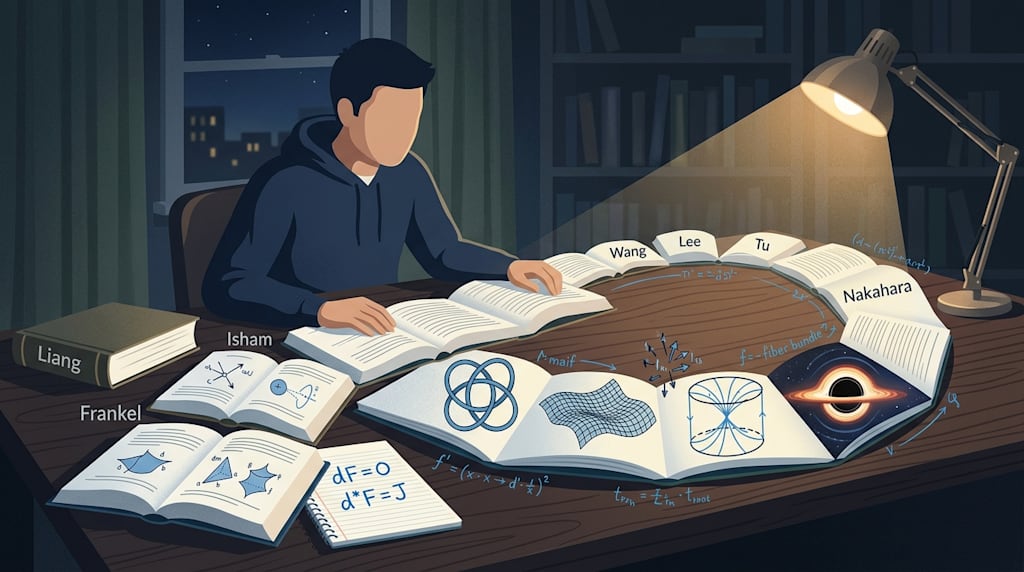
You open Liang Canbin. The first page defines a topological space. A few pages later, you meet manifolds, homeomorphisms, tangent spaces. You know every symbol. You cannot connect them. You ask why manifolds need topology. You ask why the metric needs tensors. The first five chapters do not answer. The answers sit later in the book, or they assume you will fill them in yourself.
The problem is the entry point.
Liang’s book reads like mathematics lecture notes. Definitions, theorems, proofs. It works as a reference. It works on a second or third pass. It works when you already know why the structure exists and want details. It does not work as a first book for a physics student who needs motivation first.
Physics students learn math best in a different order. See a physics problem or a geometric picture. Notice that the old language cannot express it. Introduce a new structure. Then return to the rigorous definition. Liang’s book reverses this. It gives the rigorous definition first and asks you to accept it. Getting stuck is normal.
Answer the two questions first.
Why must manifolds rely on topology?
Topology is the minimum language of continuity. A manifold is a topological space that is locally Euclidean. It is a topological space first. Without topology, you cannot talk about open sets, neighborhoods, continuity, homeomorphism, connectedness, compactness, or Hausdorffness. When a manifold is “locally like Euclidean space,” both “locally” and “like” need homeomorphism. Homeomorphism is a topological idea. Without topology, you cannot even say two spaces are the same in the sense of continuity.
In physics, spacetime as a manifold needs topology to define continuous curves, open neighborhoods, causal structure, limits, and convergence. Topology is the skeleton of the manifold idea. You have read the first three chapters of Armstrong’s Basic Topology and understood invariance under continuous deformation. That is enough. Next, know that a manifold is a topological space plus a locally Euclidean structure and a smooth structure.
Why must the metric rely on tensors?
The metric can be written without tensors, but tensor language is the best fit for coordinate-independent geometry. The metric g takes two tangent vectors at a point and gives their inner product. It determines length, angle, volume, geodesics, curvature, and finally gravity. In coordinates, it is g_{\mu\nu}(x). Change coordinates and its components change. Physical laws cannot depend on a coordinate system. You need an object that transforms by a fixed rule under coordinate changes. That object is a tensor. The goal is coordinate independence. Tensor language is how you get it. The metric is a symmetric, nondegenerate (0,2) tensor field. It turns tangent vectors into cotangent vectors. It turns length and angle into fields on the manifold. Once this clicks, the tensor definitions, transformation rules, and covariant derivatives in Liang’s book become technical steps.
Now, substitutes. No single book replaces Liang’s book. Use several books for several jobs.
Motivation: Frankel, Isham.
Theodore Frankel, The Geometry of Physics: An Introduction. It starts from surfaces, vectors, and differential forms. Physics examples run through it: electromagnetism, mechanics, relativity, gauge fields. It does not open with abstract definitions. It shows geometric intuition first. By Chapter 2, you can write Maxwell’s equations as dF=0 and d*F=J. That action teaches more than ten pages of tensor definitions.
Chris J. Isham, Modern Differential Geometry for Physicists. This is a concise set of lectures for theoretical physics doctoral students. It uses coordinate-free methods from the start. Chapter 1 covers basic topology, which connects to the Armstrong you have already read.
Structure: Wang Zuoqin’s notes, Lee, Tu.
Wang Zuoqin, Differential Manifolds lecture notes. The link you gave is correct. These notes condense Lee’s GTM 218 and add Wang’s understanding. They start from topological manifolds and introduce category language where it helps. They explain many “why define it this way” questions from a high viewpoint. The limitation is fiber bundles, which the course hours did not cover. As a first framework, they are excellent.
John M. Lee, Introduction to Smooth Manifolds (GTM 218). This is the standard graduate text. It is encyclopedic and detailed. Use it as a reference. When a concept is unclear, look it up. Do not read it straight through. It is too thick, and you will get lost.
Loring Tu, An Introduction to Manifolds. Lighter than Lee, more complete than Wang’s notes, and especially clear on differential forms. Use it to supplement Wang’s notes or as a first English text.
Physics: Nakahara, Hou Boyuan and Hou Boyu.
Mikio Nakahara, Geometry, Topology and Physics. The standard text for theoretical physics graduate students. It goes from topology and homology to fiber bundles, characteristic classes, index theorems, and their uses in quantum field theory and string theory. If you want theoretical physics, you will open this book eventually.
Hou Boyuan and Hou Boyu, Differential Geometry for Physicists. A Chinese physics-oriented classic. It is very large and covers manifolds, fiber bundles, and quantum physics applications. Treat it as a handbook. Do not read it straight through. Look up chapters when needed.
Mathematical rigor: Spivak, Ma Tian.
Michael Spivak, A Comprehensive Introduction to Differential Geometry. A classic, but it leans toward mathematics departments and cares little about physics motivation. It can cover the math in the first five chapters of Liang’s book. It is not a first book. His smaller Calculus on Manifolds is more concise. Many physics students use it as a hard first pass into manifolds.
Ma Tian, Manifold Topology. In Chinese, with physics background. It covers homology, cohomology, characteristic classes. Not a first book. Useful as a topology supplement.
A workable path:
Stage 0: Topological intuition. Finish Armstrong on connectedness, compactness, quotient spaces, and homotopy. Keep it shallow. Enough to use.
Stage 1: Manifolds and tangent spaces. Read Wang Zuoqin’s notes and Tu. Understand topological manifolds, smooth structures, tangent spaces, vector fields, and smooth maps. Check Lee for unclear definitions.
Stage 2: Tensors, differential forms, connections, curvature. Read Frankel and Isham. Understand why tensors are coordinate-free linear algebra, why differential forms unify electromagnetism, why connections are needed, and how curvature describes bending. Now open Liang’s book. You will find you can read it.
Stage 3: Fiber bundles and gauge fields. Read Nakahara and the relevant chapters of Hou and Hou. Understand principal bundles, associated bundles, connections, curvature, characteristic classes, and their use in gauge theory.
Stage 4: General relativistic geometry. Read the second half of Liang, plus Wald’s General Relativity and Carroll’s Spacetime and Geometry. Apply the geometry to Einstein’s equations, geodesics, tidal forces, black holes, and cosmology.
Stage 5: Mathematical advancement. Read Spivak’s Calculus on Manifolds, advanced chapters of Lee, and Ma Tian. Fill in rigorous proofs, homology and cohomology, and index theorems.
How to read. Do not read page one to the last page. For each chapter, ask what problem the structure solves. Ask what happens without it. On the first pass, read motivation and examples. Skip proofs. On the second pass, read definitions and theorems. Work a few simple examples by hand. On the third pass, return to physics. See how the structure appears in electromagnetism, general relativity, and gauge fields. Take notes in four columns: definition, motivation, example, physics correspondence.
When you learn differential forms, do not only remember d^2=0. See how it writes Maxwell’s equations as dF=0 and d*F=J. When you learn connections, do not only remember Christoffel symbols. See how they define the covariant derivative, produce curvature, and describe tidal forces.
Minimal book list: Frankel, The Geometry of Physics; Isham, Modern Differential Geometry for Physicists; Wang Zuoqin, Differential Manifolds notes; Lee, Introduction to Smooth Manifolds; Tu, An Introduction to Manifolds; Nakahara, Geometry, Topology and Physics; Hou Boyuan and Hou Boyu, Differential Geometry for Physicists; Spivak, Calculus on Manifolds; Armstrong, Basic Topology.
Keep Liang’s book. Put it in Stage 2 and Stage 3. Use Wang and Frankel to build motivation and framework. Use Lee and Tu for details. Use Nakahara for fiber bundles. Then return to Liang. The definitions will have a history.
Now open Chapter 2 of Frankel. Take a sheet of paper. Write Maxwell’s equations as dF=0 and d*F=J. If you cannot, come back.
About the Creator
Jin
Writer of reamstories
https://reamstories.com/jin
Enjoyed the story? Support the Creator.
Subscribe for free to receive all their stories in your feed. You could also become a paid subscriber, letting them know you appreciate their work.
Comments
There are no comments for this story
Be the first to respond and start the conversation.