
The Price of Being Seen
What a 16th-Century Bath Attendant Teaches Us About Status

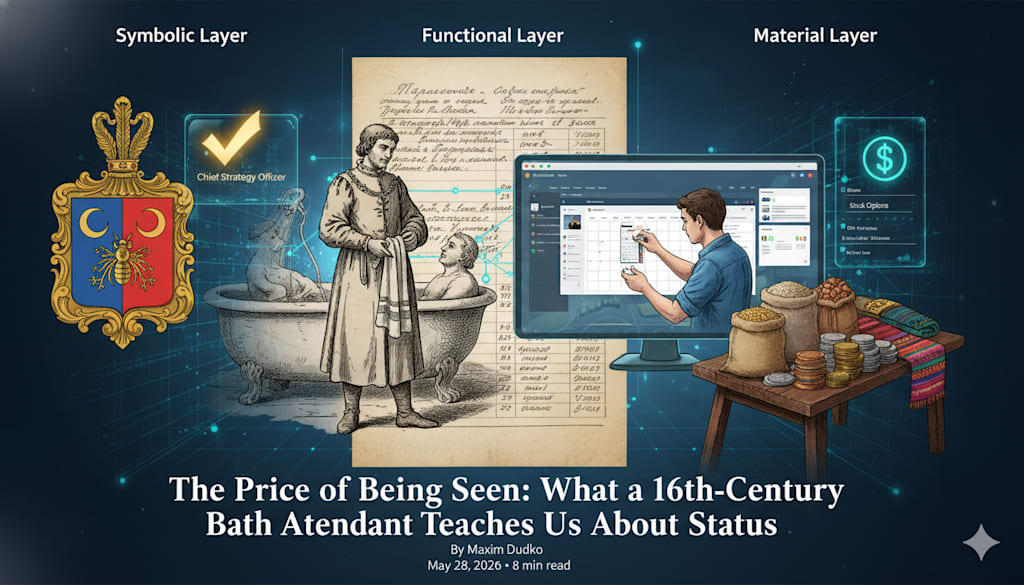
What do a noble coat of arms and a royal bath attendant have in common?
At first glance, absolutely nothing. One is an elegant, visual code—a shield split into colors, decorated with cresent moons, bees, and ostrich feathers. The other is a bizarre line item from a 16th-century Russian payroll, listing the salary of a guard (oprichnik) who was compensated in rubles, grain, fabric, and given the peculiar title of "ceremonial bath attendant."
But if you look at them together for a moment, a deeper pattern starts to show. Neither of these artifacts is just about art or bookkeeping. They are both parts of an ancient, invisible machine built to solve a single human problem: how do we make people readable to power?
The Quest for "Legibility"
Modern people usually think of power as something physical: laws, databases, tax forms, and police. But real control is often quieter. It works by classifying us, naming us, and putting us into boxes.
A shield with a coat of arms isn't just a decoration; it’s a 5-second resume. It tells everyone in the room who you are, who your family is, and where you stand before you even open your mouth. Similarly, a historical ledger recording how many bags of grain a worker receives isn't just about feeding them. It translates a complex, unpredictable human being into a clean, administrable profile.
Societies need these shortcuts to function. Without them, large systems would fall apart under the weight of their own confusion.
Think about your last trip to an airport. The TSA system doesn’t care about your childhood dreams or your favorite books. To the airport, you are a barcode, a passport number, and a security status. The system compresses "you" down to a few data points so it can move thousands of people through a metal tube every hour. The same thing happens in hospitals, where a plastic wristband and a diagnosis code translate a human body into a sequence of decisions.
But this trade-off has a cost. To make a system easy to manage, you have to flatten the humans inside it. The danger is that, over time, we start mistaking the simplified profile for the actual person.
The Three Layers of Status
We often assume that status is just a matter of wealth. But if you look at how institutions actually treat people, status is a three-story house:
The Material Layer: Your tangible rewards—the modern salary, stock options, or, in the 16th century, bags of grain and bolts of cloth.
The Functional Layer: What you actually do day-to-day—your real duties, decisions, and tasks.
The Symbolic Layer: Your signs of belonging and honor—your titles, office size, or the specific emblem on your shield.
When these three layers line up, we feel valued and secure. But when they split apart, things go wrong.
We’ve all seen this in modern corporate life. You might have a high symbolic status (a fancy title) but terrible material compensation (you're underpaid). Or you might be functionally essential to the entire company running smoothly, yet completely invisible on the symbolic layer—getting no recognition while others take the credit. Most workplace resentment lives in the gaps between these three layers.
The Intimacy of the Bath Attendant
This brings us back to our 16th-century bath attendant. Why would a ruler pay a premium, in both grain and prestigious fabric, to someone whose job was to help him bathe?
Because physical proximity is dangerous. In premodern times, the closer you were to the ruler’s physical body, the more opportunities you had to assassinate them—or to whisper in their ear and influence policy.
Ceremony was the tool used to manage this risk. By turning a highly personal, intimate act of bathing into a formal, "ceremonial" duty, the system neutralized the danger. It turned a regular person into a structured role.
We do the exact same thing today, just without the medieval bathhouses. Think of an executive assistant who manages an influential CEO's calendar, or a chief of staff who filters who gets to speak with a political leader. On paper, their jobs might look purely administrative. But in reality, their power is immense because they control access and intimacy. We use formal titles and security clearances to keep this closeness professional and predictable.
Ceremony isn't just decorative fluff; it’s the operating system that makes intense human hierarchies tolerable.
The Danger of the Compressed Life
Every symbol is an exercise in compression. A shield might use a bee to represent industriousness, or a crescent to signify tradition, because you cannot carry your entire life story into every interaction. You need visual shorthand.
Today, our shorthand looks like LinkedIn headlines, credit scores, follower counts, and annual performance reviews. These metrics help companies and platforms scale up, but they also turn us into caricatures. A high score or a shiny title can hide a toxic personality, while a lack of metrics can make an incredibly kind, brilliant worker invisible to the system.
If we look back at historical records, we see that identity has always been a negotiation between who we really are and what the system is capable of measuring.
Reading Beyond the Code
As our world becomes more digital, automated, and metrics-driven, the lesson of the old coat of arms feels more urgent than ever.
Legibility is highly efficient. It allows us to coordinate across continents, build massive companies, and organize complex societies. But legibility is not truth.
An organizational chart might show you who holds the official authority, but it won't tell you who actually keeps the office from melting down on a Friday afternoon. A resume might list someone's functional history, but it won't show their capacity for empathy or resilience.
Every stable order depends on converting human messiness into a shared code. We need the codes to work together. But we also have to remember how to look past them. The moment we stop looking for the real human behind the emblem, the ledger, or the spreadsheet, the systems we built to organize our lives start to flatten us instead.
About the Creator
Maxim Dudko
My perspective is Maximism: ensuring complexity's long-term survival vs. cosmic threats like Heat Death. It's about persistence against entropy, leveraging knowledge, energy, consciousness to unlock potential & overcome challenges. Join me.
Enjoyed the story? Support the Creator.
Subscribe for free to receive all their stories in your feed.
Comments
There are no comments for this story
Be the first to respond and start the conversation.