
The Homework Looks Fine. That’s the Problem.
AI made coping easier, teachers more procedural, and parents more controlling. The students who learn to think for themselves will split from those who only learn to comply.
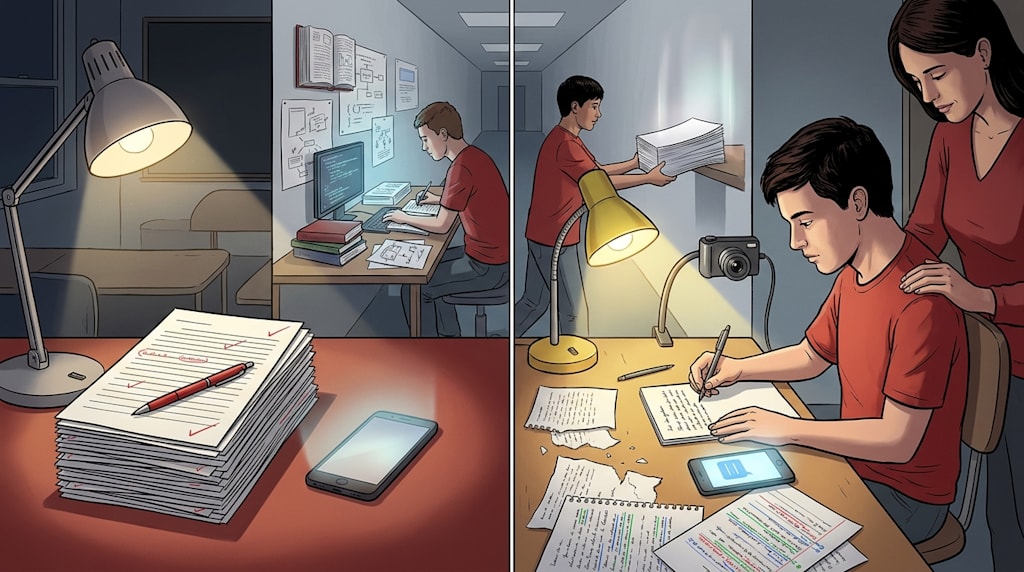
At ten at night, a message landed in the parent chat: “If your child used AI for today’s essay, message me privately.” Ms. Li put the phone face down. Forty-two essays covered her desk. The top one was neat. It opened with a poem, ran three parallel paragraphs through the middle, and closed on “New Era Youth.” She underlined those last three words in red. The pen stopped. She had asked the boy why he put that phrase there. He said, “The template has it.”
Coping with homework was old work. Students bought workbooks with the answers still attached. They copied friends, copied model essays, invented answers that sounded right, memorized problem types, smuggled notes into exams, paid someone to sit the test, searched answers on a phone, hunted down old exam papers, asked the teacher for points. Now there is a chat box. One prompt produces the essay, the steps, the report. The old errors were easy to spot. A letter of introduction for taking the subway. “主=6.” Now the flaws are quieter. The format is right. The word count is right. The answer looks plausible. Nothing in the procedure is wrong. It takes longer to ask, “Why this formula here?” The student goes quiet for three seconds. “The answer key says so.”
That is where AI causes trouble. It makes procedural compliance cheap. Homework comes in. The process closes. Nobody knows whether the student can do the work. Learning shows up in the places nobody can see: can the student explain the idea without tools, can they reason through a changed condition, can they catch the error inside an AI answer. If the evaluation stops at the final text, AI becomes the easiest stand-in.
Across the office, the homeroom teacher filled out forms. Home-school communication records. Student concern logs. Notes on differentiated homework. She filled each line, put down her pen, and said, “First make sure nothing violates the rules.” The sentence was quiet. It described a lot of teachers. When the system asks for no incidents and a completed process, correcting one student’s mistake costs hours and may never be seen. The safe choice is to protect the bottom line. More roles work this way now: procedure first, result later; immunity first, substance later. Teachers care less about whether a student learns. Parents care less about what kind of person their child becomes, as long as they supervise the child without breaking the law or getting caught. Everyone guards a small piece of process. Nobody answers for whether a person grew.
At home, another scene. A camera sits above the desk. Wrong answers must be corrected in color. Essays must open with “I remember it was a sunny morning.” When the child misses a problem, the page is torn out and copied three times. The mother stands beside him. “I don’t care how you do it. Hand it in by ten.” The child nods. The next day the homework is neat and correct. The teacher asks, “How did you think about this problem?” The child says, “My mom said to write it this way.” Ask again. The child says nothing.
Pressure and distortion breed resistance. Resistance rarely looks like a slammed table. More often it looks like going through the motions, muddling through, putting on a show, meeting the procedure and ignoring the result. Tell him to study, and he studies for you to see. Tell him to write, and he writes for you to see. You check, and he hands in work with no visible flaw. What stays in his head is not his concern. In this game, satisfying the adult is safer than learning.
The two scenes meet. Tools get stronger, so coping gets easier. Teachers retreat from responsibility. Parents either withdraw or over-control. Basic survival gets easier, so muddling through can still carry a person through school and keep them alive on a safety net. Thinking ability will split. Active learners use AI to press questions, build projects, and cross-check answers. They treat the tool as an amplifier. They grow fast. They can handle tools, invent better ones, reach goals, and set new ones. People who follow the easy path, or who have been twisted by parental pressure into not wanting to learn, use AI to cope with homework, exams, teachers, and parents. Their knowledge stays at the childhood stage. In the future, parents or society will support them and leave them to fate. Where no safety net exists, they fall out of the system.
It is too easy to blame this on students who “don’t know better.” First responsibility matters. First responsibility is not isolated responsibility. A person who has never felt autonomy or competence will not turn around because someone says, “Learn for yourself.” Motivation needs choices inside a safe range, visible progress, and feedback from the world outside. Education should let students run the loop early: choose, get feedback, bear the result, improve. Waiting for society to beat the lesson into them is a waste. Coercion buys obedience. It does not upgrade thinking. Bind learning to pain, and few people will love understanding the world.
The useful question is what to muddle through and what to protect. Life contains boring, repetitive, administrative work. Do that work at low cost. Simplify the process. Some of it does not need muddling at all. Skip it. Put the saved time into hard, reliable knowledge and skill: reading, writing, math, logic, programming, experiments, communication, project management, physical and emotional regulation, and the ability to define a problem, find resources, verify an answer, and carry the consequence. The test is not “Will the teacher check?” The test is whether the skill transfers, whether it can be verified, whether it forms a feedback loop, and whether it improves your power to predict and change the world. It looks like coping with homework, exams, teachers, and parents. It is coping with your own thinking and your future.
With AI in the room, evaluation has to look at evidence of learning. Live explanation: why this way, where is the error, what changes if the condition changes. Process records: drafts, iterations, failed versions, reasons for revision. Projects: can the student define an open problem, find resources, make trade-offs. Cross-checking: can the student judge an AI answer and catch its mistake. Long tracking: not one assignment, but a curve of growing ability. AI is not only a cheating tool. It is an accelerator for active learners. That gap will widen. The key is not just diligence. It is autonomy, competence, and connection: Why am I learning? Can I learn this? Does it connect to the world?
The next morning, Ms. Li received another essay. The title was “My Mother.” It opened with “I remember it was a sunny morning.” She turned to the last page. A pencil line sat at the bottom: “Teacher, I wrote this one myself. It may not be good.” She put down her red pen and looked up. The student was bending over his backpack, pushing a phone inside. The screen was still lit. In the AI chat box, an unsent message waited: “Help me revise it, but don’t change too much.”
About the Creator
Jin
Writer of reamstories
https://reamstories.com/jin
Enjoyed the story? Support the Creator.
Subscribe for free to receive all their stories in your feed. You could also become a paid subscriber, letting them know you appreciate their work.
Comments
There are no comments for this story
Be the first to respond and start the conversation.