
The Digital Revolution of Handwritten Notes: Beyond Basic OCR
How AI-Powered Document Solutions Are Transforming the Way We Capture, Convert, and Manage Handwritten Information

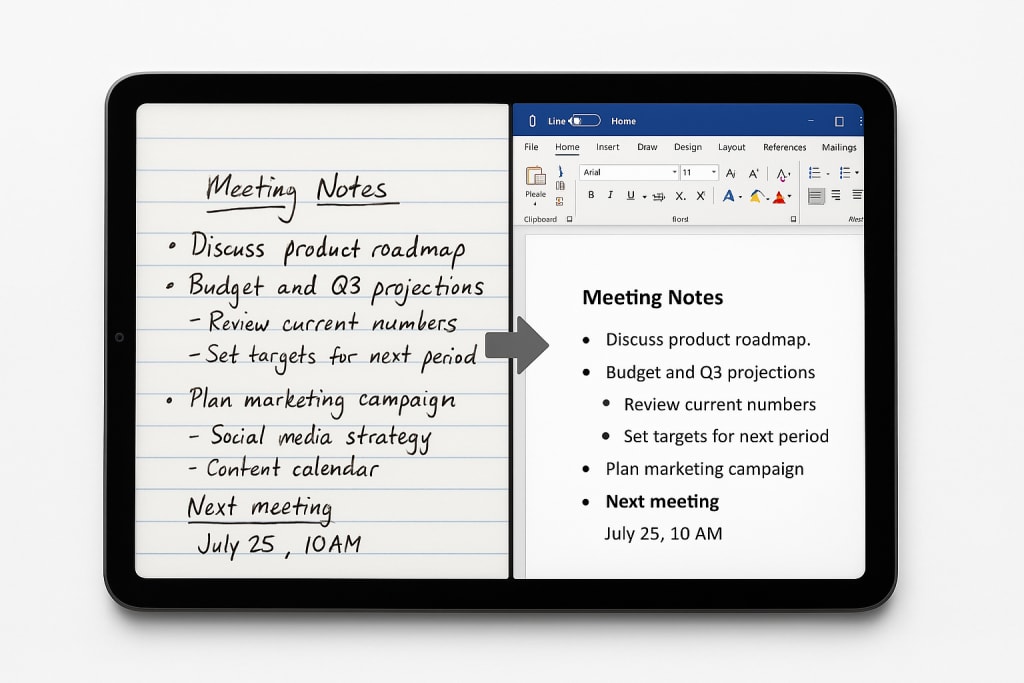
Most Persons could relate to this. That moment when you're staring at a pile of handwritten notes from a meeting, class, or brainstorming session, knowing you need to somehow transform this analog chaos into digital order. The traditional approach? Manually type everything out—a tedious process that can take hours.
Or maybe you've tried basic OCR (Optical Character Recognition) apps only to end up with plain or inaccurate text that loses all your formatting, tables, and visual organization. Then comes the frustrating dance of copying, pasting, and reformatting everything from scratch.
The Handwritten-to-Digital Dilemma
According to productivity research, professionals spend an average of 5-10 hours weekly dealing with document conversion and formatting. For those working with handwritten materials, that number often doubles. It's not just about converting text—it's about preserving meaning, structure, and visual hierarchy.
"The biggest challenge isn't just digitizing text," says Dr. Emma Richards, a productivity researcher at Stanford. "It's maintaining the structural integrity of the information. When we lose formatting, we lose significant cognitive context."
The Evolution of Document Management Solutions
Document management has come a long way from the simple file cabinets of yesteryear. The first generation of digital solutions focused on basic storage—creating virtual folders for PDF files. The second generation added OCR capabilities, but usually as separate tools requiring multi-step processes.
Today, we're seeing a third generation emerge: integrated platforms that seamlessly handle the entire document life cycle from capture to editing to storage and beyond.
Why Formatting Matters in Digital Transformation
When we write by hand, we naturally use spatial organization, color coding, and structural elements like tables to make information easier to process. These aren't just aesthetic choices—they're vital cognitive tools that help us understand and recall information.
Research from the University of California found that preserving the original formatting of notes increases information retention by up to 37%. Yet most conversion tools strip away these crucial elements.
Beyond Basic OCR: Integrated Document Management
This is where advances in AI-powered document processing are changing the game. New tools like Copywrite are taking the concept of document digitization beyond basic OCR.
I recently discovered this platform while researching solutions for my own document management challenges. Unlike traditional OCR tools, Copywrite preserves the formatting, colors, and even converts handwritten tables into digital tables—all while providing a familiar editing environment similar to the word processors we already know.
The workflow is refreshingly simple: snap a photo of handwritten notes, let the AI process it, and then edit the fully-formatted document in an interface that feels like working in a word processor. No more copying and pasting between apps or spending hours rebuilding tables.
Creating Your Own Efficient Document Workflow
Whether you're using advanced tools or working with simpler options, here are some best practices for creating an efficient document workflow:
- Capture at the source - Digitize documents as early in the process as possible
- Standardize your organization system - Create consistent folder structures and naming conventions
- Consider cloud accessibility - Ensure you can access documents from anywhere
- Prioritize searchability - Make sure your digital documents are easily searchable
- Build version control habits - Establish clear practices for managing document versions
The Future of Document Management
The future of document management looks increasingly integrated. We're moving away from siloed tools toward comprehensive ecosystems that handle everything from capture to collaboration. By 2027, analysts predict that 85% of document workflows will be fully digital, with AI handling most of the conversion and organization work.
What's particularly exciting is the democratization of these technologies. Tools that were once available only to large enterprises with substantial IT budgets are becoming accessible to small businesses and individuals.
The handwritten note isn't going away anytime soon—there's something cognitively valuable about the act of writing by hand. But the barrier between analog and digital is becoming increasingly permeable, allowing us to enjoy the benefits of both worlds.
For those still juggling between scanning apps, OCR tools, and document editors, it might be worth exploring more integrated solutions like Copywrite. The hours saved on document conversion and formatting alone could transform your productivity.
What document management challenges are you facing? Have you found effective solutions for bridging the gap between handwritten and digital workflows? The conversation about document management continues to evolve, and I'd love to hear your experiences.
About the Creator
Daniel Atu
productivity specialist and document management consultant who helps professionals and organizations streamline their information workflows.
Enjoyed the story? Support the Creator.
Subscribe for free to receive all their stories in your feed.
Comments
There are no comments for this story
Be the first to respond and start the conversation.