
The Answer Sheet Jiangsu Took Ten Years to Write
Inside the 2018 meeting where officials admitted the gaokao had become “chaotic churning,” and laid out the numbers that would change thousands of students’ lives.
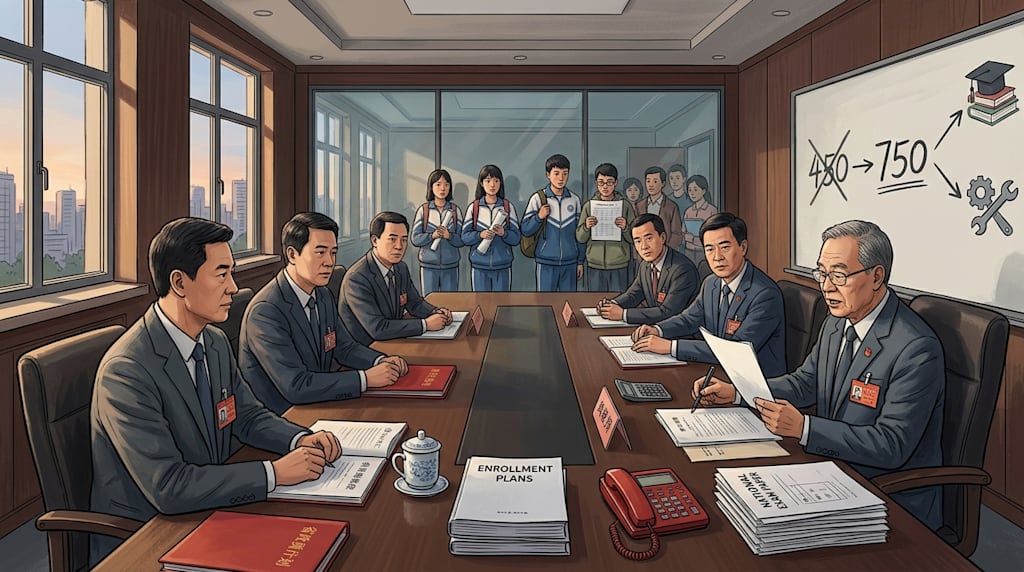
On June 15, 2018, the Jiangsu Provincial Party Committee held an expanded meeting of its Standing Committee. The agenda had three items: high school enrollment, gaokao reform, and gaokao question-setting. The Provincial Education Department reported first. The party secretaries of the prefecture-level cities then spoke in turn. Provincial departments, the vice governor in charge, and some Standing Committee members followed. The governor spoke. The party secretary spoke last.
The meeting did not announce a new slogan. It listed unpaid bills and dates.
1. The Education Department: Three Measures for Three Pressure Points
The director of the Provincial Education Department spoke on three areas.
First, vocational-academic streaming at the high school entrance level. The department proposed four measures: give students more choices in the zhongkao, let each city set its own vocational-academic ratio with no provincial quota; explore a two-way exchange mechanism between general and vocational tracks, so that comprehensive high school students can choose to sit the ordinary gaokao; strengthen general high school resources and expand supply; and implement a vocational education pilot program to deepen secondary vocational reform.
Second, get more Jiangsu students into high-level universities. The department had recently made representations to secure more places for Jiangsu students at 985 and 211 universities. The targets were: no less than 25 percent of the Jiangsu enrollment plan at ministerial universities located in Nanjing; provincial universities to increase in-province places to more than 50 percent; out-of-province universities to expand enrollment of Jiangsu students; and accelerate new campus construction at some universities. On the night of June 14, department leaders contacted the universities they respectively liaise with and went through the measures one by one. They had confirmed an increase of 1,309 places in Jiangsu’s 2018 enrollment plan.
Third, push forward gaokao reform. The 2008 gaokao scheme had three problems: a low total score, subject selection driven by utilitarian calculation, and low science literacy among students. The new gaokao scheme would be implemented in 2021. The department proposed: set elective subjects reasonably; change the score composition to a total of 750, with Chinese, mathematics, and foreign language at 150 each; and use the national unified paper, starting with the foreign language paper in 2019 and the Chinese and mathematics papers in 2020. In 2019, Jiangsu would merge the first- and second-tier undergraduate batches into a single first-tier batch, and cancel the bonus for “A” grades.
The three measures mapped onto three pressure points: zhongkao pressure, the low share of places at top universities, and the gaokao scheme itself. The department did not stop at principles. It gave ratios and dates. The 1,309 additional places were already confirmed.
2. The Cities: A Catalog of Complaints
The party secretaries of the prefecture-level cities spoke in turn. Their remarks concentrated on the 2008 gaokao scheme. A survey showed that 46 percent of teachers and 70 percent of parents regarded it as churning. It had not produced the intended results. Physics and chemistry had become high-risk subject combinations. Tsinghua and Peking University reported that Jiangsu students’ science quality was poor and their competitiveness was falling. Top universities had repeatedly cut Jiangsu enrollment plans, which did not match Jiangsu’s status as a major education province.
The complaints were specific. The total score was only 450, so every point mattered and differentiation was low. One point could separate 1,000 students. English was harder than CET-4 and CET-6, did not match the curriculum standards, and over-weighted language subjects. Science students could not stand out. The provincial paper’s difficulty was uneven and unstable. Teachers could not judge how to teach. Students were seriously skewed by subject. Mathematics contained hard and strange questions: the first half “gave away points,” the second half “killed.” This did not improve talent quality or student physical and mental health. Boys’ advantage had fallen in particular. Yangzhou University had a male-female ratio of 45:55; at Huaiyin Normal University, female students exceeded 70 percent. The small gaokao arrangement left teaching resources idle and increased student burden. The vocational-academic ratio was unreasonable. Compared with surrounding provinces, Jiangsu’s ratio was the lowest, which pushed enormous pressure onto the zhongkao and then down into primary school and kindergarten. It also fed after-school tutoring and school-choice fever. The common demand was: make a scientific new gaokao plan, learn from Zhejiang’s experience, cancel the small gaokao, raise the total score, use the national unified paper, adjust the vocational-academic ratio reasonably, and fight for a higher share of Jiangsu students at top universities.
The remarks pointed in one direction. The design itself had gone wrong: a low total score weakened differentiation; the grade system and the “see A” bonus made subject choice utilitarian; unstable provincial question-setting left teaching without a reliable standard; a tight vocational-academic ratio moved pressure earlier. Education problems spilled out of education and became family anxiety, public opinion, and a talent competitiveness problem.
3. The Vice Governor and Standing Committee Members: Problems Do Not Erase Results
The vice governor in charge and some Standing Committee members spoke. They noted that the provincial party secretary had adjusted his weekly schedule. He had not slept well on Monday night. On Wednesday he spent a full day researching in Nanjing, Zhenjiang, and Yangzhou. On Thursday afternoon he researched for half a day. Every day he was gathering information and communicating with the Ministry of Education, the Central Office, and the State Council Office. They called this an example of emancipating the mind. Jiangsu education did have problems. Problems did not mean denying achievements. The number of Jiangsu gaokao candidates had fallen year by year, from 540,000 to 330,000. In some cases, enrollment places exceeded the number of candidates. This did not help Jiangsu’s high-quality development. The large petition in 2016 sounded the alarm. Only today was the problem being addressed. The Education Department’s three measures were essential.
4. The Governor: Start with What People Are Most Unhappy About
The governor spoke. The public opinion report of June 11 had concentrated on deep-seated problems in Jiangsu education. He called for emancipating the mind, seeking truth from facts, and taking both goal and problem orientation. Reform should start with what ordinary people were most dissatisfied with. The current dissatisfaction was that children could not get into high school, that the top-university admission rate was low, and that competition was too fierce. These problems were in front of them and had to be solved. The thinking should start from deepening quality education and raising the scientific literacy of the whole nation.
He laid out the arithmetic. Half of the children could not attend ordinary high school. They had no choice. Competition was pushed down into kindergarten. Jiangsu’s high gaokao admission rate was built on a small number of candidates. As a result, high-level universities admitted fewer Jiangsu students, and double-first-class universities admitted even fewer. Jiangsu had 5.8 percent of the national population, but Tsinghua admitted less than 1 percent of its students from Jiangsu. Ten years of gaokao reform required a look back and a hard reflection. The scheme used grades without points, the total score was too low, and levels could not be separated. Questions were made especially hard and strange. Tutoring and training proliferated. Burdens became extremely heavy. Even a top scorer could fail to get into a top university. Reform was imperative.
The governor proposed five points. First, raise admission rates: ministerial universities to 25 percent, later to 30 percent; provincial universities to 50 percent; out-of-province universities to 6 percent. Second, build overpasses and open channels: strengthen applied universities, give secondary vocational students a way forward, and use higher vocational education as a fallback. Third, deepen gaokao reform: push it forward this year, change the score to 750, align Chinese, mathematics, and foreign language with the national papers, and guide students in subject selection. Fourth, strengthen vocational education. None of the reforms meant less attention to vocational education. Open all channels, promote high-level development, and let that drive vocational education. Fifth, unify thinking. Start acting immediately. Implement the meeting’s arrangements fully by 2021. Do not worry too much about new large class sizes. Do more and say less. Guide public opinion well. Make a good thing work without causing ambiguity.
5. The Party Secretary: First, a Self-Criticism
The party secretary spoke last. He said that after research and discussion, views had converged. This helped unify thinking, make scientific decisions, and strengthen confidence in reform. At the beginning there had been difficulty because people understood the national policy of “roughly equal” vocational and academic enrollment differently. He had analyzed the policy. In 2002 the phrase “roughly equal” was proposed; in 2005 it was emphasized again. Both had specific backgrounds. In 2002 the hope was to raise the proportion of high school education: whether general or vocational, as long as children went on to high school. In 2005 the hope was that eastern regions would admit some vocational students from central and western regions so that resources would not sit idle. The national policy should reflect and respect individual wishes, not violate them, and should not impose hard quotas. Jiangsu had implemented “roughly equal” most strictly and had the best streaming results, but it had sacrificed public satisfaction. “We cannot sacrifice children’s interests for a good-looking statistic or for praise.”
He had looked at the vocational-academic ratios of each province from 2015 to 2018. Guangdong, Shaanxi, and other regions had total populations not much different from Jiangsu, but their gaokao candidate numbers were much higher. The whole country was implementing “roughly equal.” Why were the results so different? Because elsewhere vocational education was not discriminated against. In Jiangsu it was. Elsewhere it was the active choice of the child’s family; vocational education did not carry a sense of inferiority. In Jiangsu, children were cut off by scores.
He had read the analyses and evaluations of Jiangsu’s gaokao by academics and ordinary people. He had reported to the Central Office and the State Council Office and had contacted the Ministry of Education. He first made a self-criticism. Jiangsu had one-sidedly pursued the admission rate by reducing the denominator and highlighting the numerator. This was a problem in the governing idea. It distorted central policy, caused public dissatisfaction, and created serious negative social impact. Jiangsu had sought novelty and churned too much. It was called reform, but in substance it was churning and chaotic churning. The problem now had reached a point where it had to be solved. A full and serious reflection was needed.
Jiangsu had been the earliest and loudest in calling for quality education, but it was the most exam-oriented and the toughest. Jiangsu’s gaokao difficulty was the highest in the country. After-school training was hot. Children’s burdens were heavy. Family financial burdens were heavy. He knew several education bureau directors who had sent their own children abroad. They said they had to, because the pressure was too great and they feared their children could not get into university in China. The zhongkao policy was pressed so tight that the final gaokao admission rate was naturally high. “This practice deceived us for so many years.” Many high-quality quotas had gone to other regions. In 2017, Jiangsu’s total first-tier admission number was actually less than Inner Mongolia’s, not to mention Shaanxi’s. “We need to learn mathematics properly.”
The Ministry of Education did not impose strict limits on provincial enrollment plans; it internally understood them at around 30 percent. In Jiangsu, only Nanjing University exceeded 30 percent; most universities did not even reach 20 percent. The gaokao had been changed five times in ten years. Teachers did not know what to follow. Parents complained everywhere. Reflection should not be limited to the education departments; all relevant departments should reflect. They had to adhere to a people-centered approach. Why were people dissatisfied with Jiangsu education? Public opinion had persisted for years, and the year before last there had been a large petition that pressed for a solution. Their practice had in substance distorted central policy, and there was also an element of interest. What they should pursue was “roughly equal” on the basis of fully satisfying wishes.
He mentioned that comrades from outside the province had warned him that Jiangsu’s repeated gaokao reforms and provincial question-setting involved interest relationships, and that he should be careful. He said he did not think it had reached an insoluble point. To advance major reform, the key was whether one stood on the people’s side and genuinely put the people at the center.
6. The Problem List: From Scores to People
The party secretary’s speech produced a problem list.
First, Jiangsu’s status as a major education province was declining. Because they had distorted higher-level policy and had not truly upheld education as the foundation, Jiangsu’s status was falling and its gaokao level was falling overall. They should not be intoxicated by current scores and admission rates, thinking that 90 percent was good enough. If the early streaming at the zhongkao was included, 90 percent discounted to 45 percent. This deprived a considerable number of children of opportunity. In the past, universities rushed to Jiangsu to recruit. Now Jiangsu candidates lacked competitiveness and attractiveness; universities did not want them. How could Jiangsu claim to be ahead?
Second, the “friendship” of top-university admissions exposed a mismatch in selection direction. He had asked Tsinghua’s president Qiu Yong to increase the quota. Qiu Yong said, “This year I’ll add one place for you.” Given their friendship, the result should not have been just that. In substance, Jiangsu’s gaokao selection direction did not match Tsinghua’s. A leader had said the day before: Jiangsu students are good, but they do not take physics and chemistry; I do not want a single one.
Third, the neglect of physics and chemistry hurt innovation and talent supply. Why was Jiangsu’s creative capacity not strong? Because high schools generally did not value physics and chemistry. Hard streaming at the zhongkao moved pressure earlier and killed many children. During research he saw psychological counseling rooms in middle schools, with teachers providing counseling. Fourteen- and fifteen-year-olds were made to look lifeless. In the past, children from ordinary rural families still had a channel to schooling. Now it was tightly blocked. Without physics and chemistry, how could innovation be promoted? He had thought Jiangsu children were still capable. Research showed they had become very weak. They entered undergraduate study, could not win scholarships, could not keep up academically, and only barely caught up by the third year.
Fourth, the ABC grade system had serious defects. The two language subjects were disadvantageous to rural children, whose English foundation was weak, making them a vulnerable group. Under the ABC system, one C kept a student out of a top university. In 2008 there was a report: a student at the High School Affiliated to Nanjing Normal University ranked first in the city in the liberal arts, was the liberal arts top scorer, and exceeded the first-tier line by 92 points. But because he had a B in politics, he could not enter Peking University. Later Nanjing University admitted him through a selective indicator. Then the selective indicator was canceled, and such students had even fewer paths.
Fifth, students were cut down artificially, wasting talent. He had chatted with the party secretary of Nanjing University of Aeronautics and Astronautics, who had come from Northwestern Polytechnical University. At Northwestern Polytechnical, teachers told their children: if you do not work hard, you can only stay at Northwestern Polytechnical. After he moved to Nanjing University of Aeronautics and Astronautics, its teachers reported that their own children found it very hard to get into the university. Not for any other reason: they were cut down artificially. Jiangsu’s average years of schooling were only 9.57, too low. In a few years, Jiangsu’s talent supply would become a major problem. They could not consider problems apart from Jiangsu’s reality, and could not treat churning as reform.
7. The Direction: Give the Choice Back to the Children
For things already identified, and for debts owed to the people, a solution had to be found. They could not wait. The general direction was to create conditions and give choice back to children, so that they had more opportunities to receive higher education. They had to end the stigma attached to vocational education. It should not be a hard cut by scores; students should choose the education that suits them. The “roughly equal” principle should be understood accurately. Each city would no longer set quotas, would not impose rigid policy requirements, and would not one-sidedly pursue admission rates. Cities should combine local realities and fully satisfy students’ autonomous choices. In education supervision, a vocational-academic ratio of 6:4 would count as qualified. Localities could be encouraged to run more comprehensive high schools so that children could sit the gaokao. He especially reminded the party secretaries to understand and handle “roughly equal” flexibly.
On the gaokao scheme, he favored keeping it as consistent as possible with the national scheme, not churning, and making it simple and clear. “I cannot understand the current scheme. It is even harder for children. And before they understand it, it changes again.” He wanted one national paper, no more provincial paper. Someone had said that Jiangsu candidates’ scores might then be very high. He said that was not necessarily so. That might have been true in the past, but not now. They should not overestimate themselves. Even catching up with the eastern regional average might still be difficult. If Jiangsu did well, no one needed to be forced; universities would come to compete for students. Jiangsu could also go to the top and fight for places. With such a small base and provincial exams with such a low total score, how could they fight?
On subject setting, he proposed unifying Chinese, mathematics, and foreign language, strengthening physics, chemistry, history, and politics, and striving for fixed combinations. Total score 750. The foreign language score could be reduced a little: Chinese and mathematics 150 each, foreign language 120, politics and history 120 each, elective 90. This would align with the national scheme and make it easier to measure Jiangsu’s level. Zhejiang’s new scheme used 6 out of 3, with more than 20 combinations. That was too many. Students ran between classes in large numbers. Teachers could not keep up. Classrooms were insufficient. They should not overestimate students’ capacity and make them run everywhere. Jiangsu should be relatively fixed: 3+2+1.
He also made one point clear: cancel the academic proficiency test next year. In its original meaning, an academic proficiency test should not be run this way. Like a computer proficiency test, it should be for non-computer majors, not computer majors. The current academic proficiency test in substance denied high school education. In addition, no ABC grades, and no increase in student burden.
On university admissions, Jiangsu had 330,000 gaokao candidates. They were the best, selected through layer after layer of exams. They had to be guaranteed a good education. Many provinces admitted 70 percent of their first-tier students from within the province; Jiangsu only 20 percent. That could not stand. In-province first-tier admissions should exceed 50 percent. Ministerial universities should be no less than 25 percent, gradually reaching 30 percent within three years. He had contacted several university presidents, and they supported Jiangsu. Jiangsu should actively fight for places. If a university did not reach 25 percent, provincial matching support should be canceled. “If they want to complain, let them complain to me.” For out-of-province key universities, the admission ratio could be set according to the public resource ratio. Jiangsu had 5.8 percent of the national population. If admissions exceeded 5.8 percent, that was not discrimination against Jiangsu. If they did not reach 5.8 percent, that was discrimination against Jiangsu. Jiangsu had made a large contribution to the national economy and should fight for its due share with confidence.
The gaokao was the command baton, and the baton had to change. The Education Department’s special meeting the day before and its overnight work were good. The Education Examination Authority should keep its eyes on the commitments. Whatever universities promised should be published. Use the places well and do not waste them. For those who could not get into undergraduate programs, a fallback plan should be studied. Jiangsu had many private universities and privately run public universities. They should think of ways and coordinate. This could help a little with heavy student burdens, tutoring fever, and school-choice fever. “We cannot use children as test subjects. We must align with the central government, adhere to educational laws and the people’s standpoint, and be responsible to history and the people.”
8. Closing: No Settling Old Scores, but Someone Must Answer
Facing problems accumulated over history, everyone was answering an exam paper, and everyone had to answer it well. Thinking had to be truly emancipated. This was not only a matter of understanding but also of feeling. They had to grasp the key crux and study teacher issues systematically. The measures studied above should be implemented in a low-key way, with attention to working methods. Do not argue. Distinguish between internal and external. Do not reopen old accounts. If the responsibility falls on us, we take it. Do not find excuses. Do not set conditions.
The meeting ended there. The measures had dates. The ratios had numbers. The debts had names. The next step was to implement them by 2021, and to publish what was promised.
About the Creator
Jin
Writer of reamstories
https://reamstories.com/jin
Enjoyed the story? Support the Creator.
Subscribe for free to receive all their stories in your feed. You could also become a paid subscriber, letting them know you appreciate their work.
Comments
There are no comments for this story
Be the first to respond and start the conversation.