student
From balancing your course load to forging relationships with classmates to extracurricular involvement, these are the tried and true methods to nail your career as a student.
Who can benefit from dissertation writing services?
Dissertation writing is often described as one of the most intellectually demanding tasks a student faces. It requires rigorous research, critical thinking, time management, and the ability to present arguments in a structured and academically acceptable manner. As expectations grow in universities across the UK, students from all academic backgrounds are increasingly turning to dissertation help to meet their academic goals.
By Andersan Smithabout a year ago in Education
Top 10 Most Famous Stories in the World
1. Romeo and Juliet – William Shakespeare This tragic love story follows Romeo and Juliet, two young lovers from feuding families in Verona. Despite their families’ hatred, they fall deeply in love and secretly marry. When misunderstandings and fate intervene, their efforts to be together end in tragedy. Romeo believes Juliet is dead and takes his own life. When Juliet awakens and finds Romeo dead, she also dies by suicide. Their deaths eventually reconcile their families. A tale of youthful passion, fate, and the destructive power of hatred, Romeo and Juliet is one of the most enduring and heartbreaking stories in literature, symbolizing the theme of love against all odds.
By Anwar Jamilabout a year ago in Education
Never Too Late
On a sunny May afternoon, the campus of Hillside University buzzed with anticipation. Proud families gathered, students donned caps and gowns, and the sound of bagpipes signaled the start of the commencement procession. But one graduate stood out among the sea of twenty-somethings: Edna Taylor, an 82-year-old great-grandmother with a brilliant smile and a stride that defied her age, slowly made her way to her seat, her silver curls peeking out from under her mortarboard. Edna’s journey to that moment had been anything but conventional. Born in 1943 in rural Kentucky, Edna was the eldest of six children. Her parents were tobacco farmers, and life was a daily rhythm of chores, school, and helping to raise her younger siblings. Education, while valued, took a backseat to survival. At 16, she left school to care for her mother who had fallen ill. By 18, she was married. By 25, she had three children and a small sewing business she ran from her kitchen. “I always loved learning,” Edna would later say. “I used to sneak my brother’s algebra books after I put the kids to bed. It was like a puzzle to me, something to untangle.” Over the decades, Edna’s life followed the familiar patterns of many women of her generation. She raised her children, supported her husband’s career, became a grandmother—and eventually, a great-grandmother. She never resented her life; she found joy in family, faith, and community. But a quiet longing lingered—an unfinished dream. When her husband passed away in 2007, Edna was 64 and suddenly found herself alone in a house too big and too quiet. She started volunteering at the local library, where she was surrounded by books and young minds. That’s when the idea struck her: Why not go back to school? At first, her children thought she was joking. “College? At your age, Mom?” her daughter Carla asked with wide eyes. But Edna wasn’t joking. She applied to Hillside University’s continuing education program and began with a single class—Intro to Literature. She was terrified. “I hadn’t written a paper in over 50 years,” she chuckled. “I didn’t even know how to use a computer mouse.” With the help of her youngest grandson, Malik, she learned to navigate email, Word documents, and online discussion boards. Every Sunday evening, she sat at her kitchen table, textbooks stacked beside her laptop, typing with one finger and sipping chamomile tea. The more she learned, the hungrier she became. Two years became four. Four became ten. And Edna, bit by bit, earned enough credits for a Bachelor of Arts in History. “She was in my American Civil War seminar,” said Professor Lillian Brooks. “At first, the students didn’t know what to make of her. But soon, they were staying after class to hear her stories. Her insights were incredible. She brought history to life because, in many ways, she had lived through the repercussions of so much of it.” Indeed, Edna often enriched classroom debates with personal anecdotes—her memories of the Civil Rights Movement, the Kennedy assassination, the Vietnam War. When a younger classmate expressed frustration over systemic racism, Edna listened carefully, then recounted the first time she saw segregated water fountains as a little girl. “I think students began to see her as a living bridge between past and present,” Professor Brooks reflected. But it wasn’t always easy. Edna battled arthritis that made long walks across campus painful. She failed a math course twice before finally passing with the help of tutoring. And during the COVID-19 pandemic, she had to learn Zoom, often squinting at her screen and asking, “Can y’all hear me?” before joining a virtual lecture. There were moments she almost gave up. “I remember crying over a ten-page paper on Reconstruction,” she said. “I told my grandson I was too old for this. He looked me straight in the eye and said, ‘You’ve come too far, Grandma. Finish strong.’” And she did. On graduation day, as her name was called, the entire stadium erupted in applause. Her children, grandchildren, and great-grandchildren waved homemade signs: “Go, Grandma!” and “82 and Educated!” Some wept, others cheered. Edna rose slowly, her joints aching but her spirit soaring. She accepted her diploma with trembling hands and tears in her eyes. “I did this for me,” she said later in her commencement speech, “but I also did it to show that it’s never too late. Whether you’re 18 or 80, your dreams matter.” Her speech went viral. Within days, news outlets across the country picked up the story. She was invited on talk shows and received hundreds of letters from strangers who said she inspired them to return to school or pursue long-lost passions. One message, in particular, stood out to her: a single mother from Detroit who wrote, “I saw your story and enrolled in night school. If you could do it, I figured I had no excuse.” Edna now speaks at local high schools and community centers, encouraging others to pursue lifelong learning. She’s even considering a master’s degree in education, saying, “Well, I’ve come this far. Why not?” Her grandchildren have started calling her “Dean Grandma,” and the nickname stuck. As she looks back on her journey, Edna remains humble. “People say I’m brave, but really, I just kept showing up. I showed up every day, every class, every challenge. I believe if you show up for your life, even when it's hard, even when you’re scared, beautiful things happen.” And that’s the legacy she hopes to leave: not just a college degree, but a reminder that it’s never too late to begin again. --- Moral of the story: Age is just a number, but dreams are timeless.
By Faizan Khanabout a year ago in Education
🩺📉 From Medical Student to Forex Trader: My True Survival Story. AI-Generated.
📌 “I didn’t trade to get rich. I traded to survive.” Hello everyone, my name is [Insert Your Name or Handle], and this is not a fairy tale story about Forex.
By Future Doctor Diaries🩺 and Skillsabout a year ago in Education
Advice from Richard Alan Wolf: Lessons from a Life in Space Physics
Richard Alan Wolf is a name etched into the very foundation of space physics. A Professor Emeritus and Research Professor at Rice University, Wolf has spent more than five decades exploring one of the most complex and awe-inspiring systems in our cosmic neighborhood: Earth’s magnetosphere. His research has helped shape the way we understand the movement of charged particles in near-Earth space, the physics of geomagnetic storms, and the behavior of space plasmas under dynamic conditions.
By Richard Alan Wolfabout a year ago in Education
: “The World of Chemistry: Its Importance and Role in Our Everyday Life
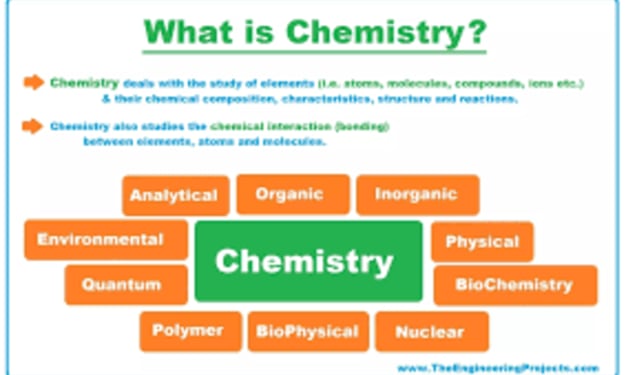
Chemistry – The Central Science of Everyday Life --- 1. Introduction Chemistry is the branch of science that explores the composition, structure, properties, and changes of matter. It seeks to answer essential questions like: What is this made of? How does it react? Why does it change? From the oxygen we inhale to the fuel that powers our vehicles, chemistry plays a role. It helps explain why leaves turn yellow in autumn, how cooking oil fries food, or how medications cure illnesses. Everything around us — from the soft drinks we sip to the smartphones we use — involves chemistry in some form. Chemistry is called the “central science” because it links physical sciences (like physics) with biological sciences (like biology and medicine). Understanding chemistry means understanding how the world works at a fundamental level — from molecules to mountains. --- 2. Main Branches of Chemistry Chemistry is a vast field divided into several specialized branches. Each focuses on a particular type of substance or process: a. Organic Chemistry This branch deals with compounds made primarily of carbon and hydrogen, often including oxygen, nitrogen, sulfur, and more. These compounds form the basis of all life. Examples: fuels (gasoline, diesel), plastics (polyethylene), medicines (aspirin), perfumes, synthetic fibers, food flavors, pesticides. Why important? Organic chemistry helps in drug development, materials science, and understanding living organisms. --- b. Inorganic Chemistry Inorganic chemistry studies compounds that are not based on carbon-hydrogen bonds, such as metals, salts, and minerals. Examples: table salt (NaCl), ammonia (NH₃), sulfuric acid, ceramic materials, paint pigments, catalysts. Applications: Used in manufacturing, construction materials, fertilizers, and water treatment. --- c. Physical Chemistry This field combines chemistry and physics. It explains how and why chemical reactions happen and studies the physical properties of matter. Topics covered: thermodynamics, reaction kinetics, equilibrium, phase changes, quantum mechanics. Applications: energy storage systems (batteries), industrial chemical reactions, explosives, and fuel efficiency. --- d. Analytical Chemistry Analytical chemistry focuses on identifying and measuring substances. It answers questions like "What is this made of?" and "How much of a substance is present?" Used in: food quality control, forensic labs, environmental testing, pharmaceutical research. Examples: blood sugar testing, water contamination analysis, testing drug purity. --- e. Biochemistry Biochemistry studies the chemistry of living organisms. It looks at biological molecules like proteins, DNA, RNA, carbohydrates, and lipids. Applications: medicine, genetic engineering, nutrition science, disease research, metabolic studies. Examples: how enzymes work, how food is digested, how cells produce energy. --- f. Industrial Chemistry (New Addition) This branch focuses on large-scale production of chemicals and materials used in industries. Examples: manufacturing of fertilizers, cement, glass, petrochemicals, soaps. Importance: Helps optimize production processes, minimize cost, and improve sustainability. --- 3. Chemistry in Daily Life Though often unnoticed, chemistry touches every aspect of our everyday routine: --- a. In Food and Cooking Cooking involves chemical changes like Maillard reactions (browning of food), boiling, frying, and baking. Preservatives (like sodium benzoate) prevent microbial growth. Additives improve flavor, color, and texture (e.g., MSG, citric acid). Nutritional labels use data from chemical analysis to calculate calories, proteins, fats, etc. --- b. In Cleaning and Hygiene
By Mudasir Shafiq about a year ago in Education