student
From balancing your course load to forging relationships with classmates to extracurricular involvement, these are the tried and true methods to nail your career as a student.
The Gift Of the Heart
Title: The Gift of the Heart In a quaint little village nestled between towering mountains and lush green meadows, there lived a poor boy named Aryan. His tattered clothes and worn-out shoes were a testament to the hardships he faced daily. Despite the adversities, Aryan's heart was as pure as the morning dew, and he never let poverty extinguish the light of hope in his eyes.
By be original3 years ago in Education
The Quantum Quest
In the bustling town of Newtonville, where scientific curiosity was as common as laughter, four high school friends found themselves on an unexpected adventure that would challenge their understanding of reality and friendship. Meet Alex, the brainy and inquisitive student with a passion for physics; Mia, the talented artist with a flair for creativity; Jack, the witty and tech-savvy jokester; and Lily, the compassionate and nature-loving environmentalist.
By be original3 years ago in Education
15 Prophecies That May Shape Humanity's Future
In the realm of mystics and fortune-tellers, seers have made predictions that have sometimes come eerily close to reality. From Mars missions to telepathy and designer babies, here are 15 prophecies that might unfold in the near future.
By Shiran Pallewatta3 years ago in Education
The Enchanted Atlas
Once upon a time in the quaint village of Everdawn, nestled between misty mountains and ancient forests, lived a young girl named Elara. Elara was a dreamer with a heart full of curiosity, always seeking adventure beyond the boundaries of her home. Her favorite spot was an old library that stood at the outskirts of the village.
By be original3 years ago in Education
Theodolite
The theodolite is a fundamental and precise surveying instrument used in geodesy, engineering, and various other fields for measuring horizontal and vertical angles. It plays a crucial role in triangulation, traversing, and other surveying tasks that require accurate angle measurements.
By Stanislav Cekov3 years ago in Education
Geodesy
The history of geodesy can be traced back thousands of years, with its roots in ancient civilizations. Geodesy has evolved over time, driven by the need for accurate measurements of the Earth's shape and size. Here is an overview of the key developments in the history of geodesy:
By Stanislav Cekov3 years ago in Education
Which are the best and highest paying Travelling Affiliate?
what is an Affiliate marketing? Affiliate marketing is where you promote someone else’s product or service. When someone purchase those product or service through your affiliate link you earn a commission according to affiliate program. You just need to be a little creative to earn thousand dollars. Let’s talk about Affiliate programs.
By LGS Educate3 years ago in Education
Mastering the Future: 13 Must-Have AI Skills to Launch Your AI Career
Artificial Intelligence (AI) is quickly becoming one of the most in-demand fields of study today, with AI-driven technology transforming the way we live, work, and play. With this increasing demand, individuals interested in an AI career need to have the necessary skills and knowledge to thrive in the field. Fortunately, there are numerous Artificial Intelligence Courses and certifications available to help individuals acquire these skills.
By Gour Sinha3 years ago in Education
5 Essential Tips for Academic Writing
Demystifying Your Literature Review: 5 Essential Tips for Academic Research The literature review is a critical component of academic research, where you assess and analyze existing literature related to your topic. However, navigating this process can be daunting. To help you tackle your literature review effectively, we have compiled five essential tips that will simplify the process and make it more manageable.
By Shiran Pallewatta3 years ago in Education
Why was India split into two countries?
In August 1947, India gained independence after 200 years of British rule. What followed was one of the largest and bloodiest forced migrations in history. An estimated one million people lost their lives. Before British colonization, the Indian subcontinent was a patchwork of regional kingdoms known as princely states populated by Hindus, Muslims, Sikhs, Jains, Buddhists, Christians, Parsis, and Jews. Each princely state had its own traditions, caste backgrounds, and leadership. Starting in the 1500s, a series of European powers colonized India with coastal trading settlements. By the mid-18th century, the English East India Company emerged as the primary colonial power in India. The British ruled some provinces directly, and ruled the princely states indirectly. Under indirect rule, the princely states remained sovereign but made political and financial concessions to the British. In the 19th century, the British began to categorize Indians by religious identity a gross simplification of the communities in India. They counted Hindus as “majorities” and all other religious communities as distinct “minorities,” with Muslims being the largest minority. Sikhs were considered part of the Hindu community by everyone but themselves. In elections, people could only vote for candidates of their own religious identification. These practices exaggerated differences, sowing distrust between communities that had previously co-existed. The 20th century began with decades of anti-colonial movements, where Indians fought for independence from Britain. In the aftermath of World War II, under enormous financial strain from the war, Britain finally caved. Indian political leaders had differing views on what an independent India should look like. Mohandas Gandhi and Jawaharlal Nehru represented the Hindu majority and wanted one united India. Muhammad Ali Jinnah, who led the Muslim minority, thought the rifts created by colonization were too deep to repair. Jinnah argued for a two nation division where Muslims would have a homeland called Pakistan. Following riots in 1946 and 1947, the British expedited their retreat, planning Indian independence behind closed doors. In June 1947, the British viceroy announced that India would gain independence by August, and be partitioned into Hindu India and Muslim Pakistan— but gave little explanation of how exactly this would happen. Using outdated maps, inaccurate census numbers and minimal knowledge of the land, in a mere five weeks, the Boundary Committee drew a border dividing three provinces under direct British rule: Bengal, Punjab, and Assam. The border took into account where Hindus and Muslims were majorities, but also factors like location and population percentages. So if a Hindu majority area bordered another Hindu majority area, it would be included in India but if a Hindu majority area bordered Muslim majority areas, it might become part of Pakistan. Princely states on the border had to choose which of the new nations to join, losing their sovereignty in the process. While the Boundary Committee worked on the new map, Hindus and Muslims began moving to areas where they thought they’d be a part of the religious majority but they couldn’t be sure. Families divided themselves. Fearing sexual violence, parents sent young daughters and wives to regions they perceived to be safe. The new map wasn’t revealed until August 17th, 1947 two days after independence. The provinces of Punjab and Bengal became the geographically separated East and West Pakistan. The rest became Hindu-majority India. In a period of two years, millions of Hindus and Sikhs living in Pakistan left for India, while Muslims living in India fled villages where their families had lived for centuries. The cities of Lahore, Delhi, Calcutta, Dhaka, and Karachi emptied of old residents and filled with refugees. In the power vacuum British forces left behind, radicalized militias and local groups massacred migrants. Much of the violence occurred in Punjab, and women bore the brunt of it, suffering rape and mutilation. Around 100,000 women were kidnapped and forced to marry their captors. The problems created by Partition went far beyond this immediate deadly aftermath. Many families who made temporary moves became permanently displaced, and borders continue to be disputed. In 1971, East Pakistan seceded and became the new country of Bangladesh. Meanwhile, the Hindu ruler of Kashmir decided to join India a decision that was to be finalized by a public referendum of the majority Muslim population. That referendum still hasn't happened as of 2020, and India and Pakistan have been warring over Kashmir since 1947. More than 70 years later, the legacies of the Partition remain clear in the subcontinent: in its new political formations and in the memories of divided families.
By Terema Remx3 years ago in Education
The most beautiful building in the world
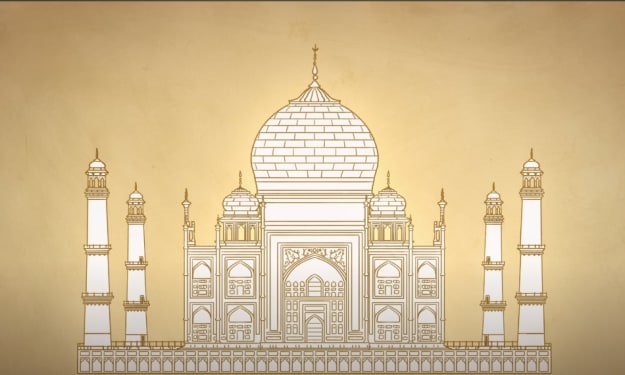
It’s 1631 in Burhanpur, and Mumtaz Mahal, beloved wife of Mughal Emperor Shah Jahan, is giving birth to their 14th child. A healthy girl is born, but not without difficulty. Shah Jahan rushes to Mumtaz’s side, but he cannot save her. Sobbing uncontrollably, the emperor decides to build a tomb worthy of his queen: an earthly replica of Paradise to embody their perfect love and project the power of the Mughal Empire for all time. Construction of the Taj Mahal began roughly seven months later. Royal architects worked to bring Shah Jahan’s vision to life at a site chosen by the emperor in the bustling imperial city of Agra. The Yamuna riverfront was already dotted with exquisite residences, gardens, and mausoleums. But when complete, the Taj Mahal would be the most magnificent structure of all. In addition to housing Mumtaz’s mausoleum, the plans included a garden, mosque, bazaar, and several caravanserais to house visiting merchants and diplomats. Together, this complex would seamlessly blend Persian, Islamic, Indian, and European styles, establishing the Taj Mahal as the culmination of Mughal architectural achievement. The entire compound was laid out on a geometric grid, incorporating meticulously planned bilateral symmetry. To further establish an atmosphere of balance and harmony, the architects divided the complex into two spheres, representing the spiritual and earthly domains. Most of the structures were made of brick and red sandstone, with white marble accents. This was a common motif in Mughal architecture, inspired by ancient Indian traditions associating white with spiritual purity and red with warriors and royalty. But the central mausoleum took more inspiration from the Islamic tradition. Framed by four minarets, the structure was covered entirely in white marble from quarries over 400 kilometers away. Its main dome towered above the skyline, and those within the cavernous chamber experienced an otherworldly echo lasting almost 30 seconds. Perfecting the Italian stone-working technique, pietra dura, craftsmen used all manner of semi-precious stones to create intricate floral designs representing the eternal gardens of Paradise. Calligraphers covered the walls with Quranic inscriptions. And because the Islamic depiction of Paradise has eight gates, the mausoleum’s rooms were designed to be octagonal. The garden in front of the mausoleum was split into four parts in the Persian style, but its flora reflected the Mughals’ nomadic Central Asian heritage. Flowers and trees were carefully selected to add color, sweet scents, and fresh fruit to be sold in the bazaar. Masons built intersecting walkways, pools, and channels of water to weave through the lush greenery. Even before its completion, Shah Jahan used the Taj to host the annual commemoration of Mumtaz’s death, celebrating her reunification with the Divine. Directly across the river, Shah Jahan built another sprawling garden with a central pool that perfectly reflected the mausoleum. Building this intricate complex took 12 years and employed thousands of skilled craftsmen and artisans, from masons and bricklayers to masters of pietra dura and calligraphy. After the Taj was completed in 1643, Shah Jahan retained some of these craftsmen for routine repairs, and hired Quran reciters, caretakers, and other staff to maintain the complex. He paid these workers by establishing a vast endowment for the Taj— a system which remained in place until the early 19th century. Since its completion, Shah Jahan’s grand memorial has drawn travelers from around the world. And every time a visitor is awed by the mausoleum, the emperor’s goal is achieved anew. Unfortunately, after 15 years of presiding over Mumtaz’s memorial, Shah Jahan fell ill and a war of succession broke out between his sons. While Shah Jahan eventually recovered, his son, Aurangzeb, had already emerged as the new emperor. For the last eight years of his life, Shah Jahan lived under house arrest in Agra’s Fort, where he could see the Taj glimmering in the distance. When he died in 1666, he was buried next to Mumtaz, his grave breaking the complex’s symmetry, so that his wife could remain at the Taj’s center for all eternity. This video was made possible with support from Marriott Hotels. With over 590 hotels and resorts across the globe, Marriott Hotels celebrates the curiosity that propels us to travel. Check out some of the exciting ways TED-Ed and Marriott are working together and book your next journey at Marriott Hotels.
By Terema Remx3 years ago in Education
The rise and fall of the Mughal Empire
It’s 1526 in what is now Northern India, and Sultan Ibrahim Lodhi is about to face off against a prince from Central Asia, Zahiruddin Muhammad Babur. To quash the threat, the Sultan brings his war elephants to battle. But it’s said that the explosions of Babur’s cannons and muskets startled the elephants and they trampled the Sultan’s own army. Babur had long harbored ambitions of building his own empire. Though he was descended from some of the world’s most successful conquerors, he struggled to gain a foothold among the many ambitious princes in Central Asia. So he turned his attention to India, where his descendants stayed and built the Mughal Empire, one of the wealthiest and most powerful states in the early modern world and home to nearly a quarter of the global population. Babur died just four years after that fateful battle, but his own memoirs and the work of his descendants immortalized him in colorful fashion. His daughter, Gulbadan, recalled in her own memoir how Babur having recently given up drinking filled a newly-constructed pool with lemonade rather than wine. His grandson, Akbar, commissioned exquisite miniature paintings of Babur’s stories one depicted the empire’s founder riding through his camp, drunkenly slumped over his horse. It was Akbar who consolidated Mughal power. He established protections for peasants which in turn increased their productivity and generated more tax revenue and embarked on military campaigns to expand Mughal territory. Princes who swore allegiance to him were rewarded, while he made brutal examples of those who resisted, killing them and many of their subjects. His conquests opened access to port cities on the Indian Ocean, which connected the Mughals to Arab, Chinese, Ottoman, and European traders, bringing in incalculable wealth, including silver and new crops from the Americas. As the Muslim ruler of a diverse, multiethnic empire, Akbar worked to create internal cohesion by appointing members of the Hindu majority to high positions in his government, marrying a Hindu bride, and distributing translated copies of the “Mahabharata,” an ancient Indian epic poem, to his Muslim nobles. Akbar also hosted lively religious debates where Sunni and Shia Muslims, Hindus, Jains, Zoroastrians, and the newly arrived Portuguese Jesuit missionaries defended the merits of their respective faiths. While most participants viewed this as an intellectual exercise, Portuguese missionaries were disappointed by their failure to convert Akbar. The Mughals built architectural masterpieces such as the Taj Mahal and the Red Fort, a palace three kilometers around, that housed 50,000 people and contained the magnificent gold and jewel-encrusted Peacock Throne. Just the throne took seven years to construct. During its first 180 years, the Mughals had only six rulers, which contributed to the empire’s stability. When the fourth emperor, Jahangir, struggled with alcohol and opioid addiction, his wife, Nur Jahan, took the reins as co-ruler. When a traitorous general captured her husband in an attempted coup, she negotiated his release and rallied the army to stop the rebellion. She once led a hunting party to track down a tiger that was terrorizing a village, leading one poet to write: “Though Nur Jahan be in form of a woman In the ranks of men she’s a tiger-slayer.” Following the death of the sixth emperor, Aurangzeb, in 1707, seven emperors took the throne over the next 21 years. These frequent transitions of power reflected the larger political, economic, social, and environmental crises that plagued the empire throughout the 18th century. In response to this turmoil, regional leaders started refusing to pay taxes and broke away from Mughal control. The British East India Company offered military support to these regional rulers, which in turn increased the company's political influence, enabling it to eventually take direct control of Bengal, one of the wealthiest regions in India. By the 19th century, the East India Company had massive political influence and a large standing army, which included Indian troops. When these troops revolted in 1857, aiming to force out the British and restore Mughal influence, the British government intervened, replacing company rule with direct colonial rule, deposing the last Mughal emperor and sending him into exile. And so, over three centuries after its founding, the Mughal Empire came to an end.
By Terema Remx3 years ago in Education