student
From balancing your course load to forging relationships with classmates to extracurricular involvement, these are the tried and true methods to nail your career as a student.
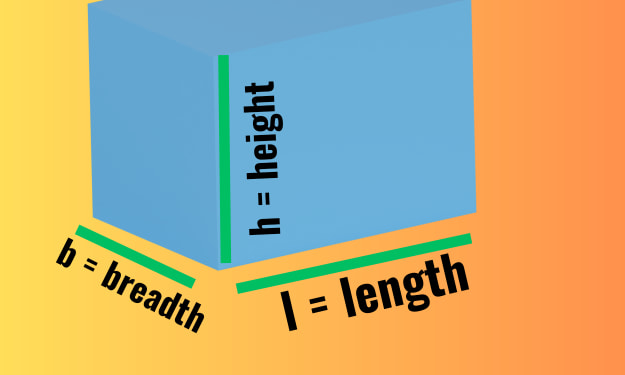
Surface Area Of Cuboid
Introduction: The world of geometry is filled with fascinating shapes and structures, each with its unique properties and characteristics. Among these, the cuboid reflects out as a fundamental and versatile three-dimensional figure. In this article, I will explain into the intricacies of Surface Area Of Cuboid, exploring its definition, formula, and practical applications.
By champak jyoti3 years ago in Education
Find the Volume of a Cylinder
Introduction Realising the volume of geometric shapes is a fundamental concept in mathematics and their practical applications in various fields. One such shape is the cylinder, a three-dimensional figure which has two parallel circular bases connected by a curved surface. How to calculate the volume of a cylinder is a crucial skill, especially in fields like engineering, physics, and architecture. In this article, I will try to delve into the intricacies to Find the Volume of a Cylinder, exploring its mathematical derivation, practical applications, and providing step-by-step examples for a better understanding.
By champak jyoti3 years ago in Education
PHP Online Compiler for Learning Web Development
With the help of our comprehensive reference to PHP online compilers, explore the world of web programming. Gain knowledge quickly, solve problems with ease, and maintain your edge in the dynamic world of web development.
By micahgreen3 years ago in Education
Why are plant leaves green?
Leaves are green because they contain chlorophyll, which is used for photosynthesis. Green is the predominant colour in nature and is found in most plants. The lush greenness of forests and hillsides is a characteristic of nature.
By Samantha Baker-Bent3 years ago in Education
Shocking Truth About Your Lifespan on Other Plantes
Upon reaching Mercury, you'd quickly observe its close proximity to the sun, being the smallest and nearest planet. Despite its size, Venus holds the title for the hottest planet. Mercury completes its orbit in 88 days, contrasting Earth's 365-day orbit. Daytime temperatures on Mercury soar above 800°F, while the dark side drops to -300°F due to the lack of atmosphere. Surviving involves navigating between extreme heat and cold, with oxygen posing a challenge. Mercury's atmosphere, unable to retain heat, limits your stay to how long you can hold your breath. Additionally, the planet features a magnetic field generating solar winds, forming plasma tornadoes. Venus, with gravity akin to Earth, can heat up to nearly 1,000°F. Walking or jogging is impractical due to instant melting, and extreme pressure would crush you, reminiscent of being underwater. Mars, despite its "red planet" nickname, is cold and has a rotation period of around 687 days. Its thin, unbreathable atmosphere hosts dust storms and polar caps with carbon dioxide. Survival is possible by holding your breath, requiring thick clothing for warmth. Jupiter, the largest planet, rotates in just 10 hours, featuring the Great Red Spot, a massive storm lasting over 300 years. Jupiter's gravity, strong winds, and lack of oxygen make survival impossible. Pluto, considered a dwarf planet, experiences frigid temperatures of -400°F. Its thin atmosphere contains methane ice on mountains. Despite a lengthy orbit of 248 years, a day on Pluto is only six Earth days. Weak gravity demands holding your breath, but the cold atmosphere allows only brief survival. Neptune, the windiest planet, has a core resembling Earth's and orbits the sun in over 150 years. It's known as "The Blue Planet" due to its hydrogen-helium atmosphere. Neptune's pressure, lack of oxygen, and wind conditions restrict survival to a few seconds. Saturn, the second-largest planet, boasts rings made of ice particles and rocks. A day on Saturn lasts 11 hours, with extreme pressure deep within the planet. Survival is limited to a few seconds, similar to Jupiter. Titan, Saturn's moon, resembles Earth with liquid rivers, oceans, and lakes, covered with methane and ethane. Our moon lacks oxygen, allowing survival only as long as you can hold your breath. Tardigrades, microscopic creatures, are the most resilient on Earth, surviving extreme conditions, including space. Humans require proper gear for survival beyond Earth. Discussing the sun, its temperatures can reach 27 million°F, making it instantly lethal. Earth remains the only habitable place, offering a balanced environment for an average human lifespan. Scientists explore the potential for human colonization on Mars, utilizing robots like Tesla Bots. Tardigrades stand out as Earth's resilient creatures, with potential survival even if a large asteroid hits. However, humans, without proper gear, are not designed for life beyond Earth. Pythias Oasis, a unique underwater spring discovered along the Cascadia subduction zone, serves as a lubricant between tectonic plates. If water seepage increases, it could lead to stress buildup, triggering earthquakes. Venus, with an exceptionally long day of 243 Earth days, experiences extreme atmospheric pressure. Its dense atmosphere, rich in carbon dioxide, results in high temperatures, making it challenging for human exploration. Mercury, despite its swift orbit of 88 Earth days, has a slow spin on its axis, causing a day lasting 176 Earth days. Extreme temperature swings, reaching 800°F during the day and -290°F at night, are attributed to its thin atmosphere. Mars, known as the red planet, showcases diverse colors in its landscape. Dust storms, dust-covered polar caps, and Olympus Mons, the largest volcano, contribute to its unique features. Mars also experiences Marsquakes, providing insights into its interior. Saturn's iconic rings, composed of ice particles and debris, might have originated from a catastrophic event, possibly linked to the extinction of dinosaurs on Earth. Saturn's hexagon at its North Pole remains a mysterious structure, with varying theories on its formation.
By Cleiton Clemente3 years ago in Education
20 wonders of the world
Exploring the Wonders of the World The world is adorned with marvels that captivate our imagination and showcase the ingenuity of human achievement. Here, we delve into 20 wonders that span the globe, each with its own unique story and cultural significance.
By M RAFLI EKA PRAMUDITHA3 years ago in Education
White Blood Cells | Types and functions:
White Blood Cells are otherwise called as Leukocytes. The name leukocyte derived from Greek word leuk means ‘white’, cyte means ‘cell’. WBC main role is to protect the body against microbes. WBC surround microbes, engulf and destroy the foreign particles by phagocytosis mechanism.
By Sathishkumar3 years ago in Education
Anatomy and Physiology of the Human Body
In this lesson on anatomy and physiology, we will discuss the relationship between these two subjects. While they can be studied separately, I believe they are best understood when studied together. Anatomy focuses on the form, structure, and location of bodily parts. For example, let's consider the pericardium, which is the sac that surrounds the heart. The term "pericardium" is derived from "cardia" or "cartium," which means heart, and "per" which usually means around or surrounding. The pericardium is made of connective tissue and is slightly larger than the heart itself. It is located right here, providing some anatomical facts about the pericardial sac. On the other hand, physiology is more concerned with the function of bodily parts and the processes involved. It explores how different organs are connected and what each organ is doing in relation to others. Taking the pericardium as an example again, it serves as a protective and lubricating layer for the heart. The fluid inside the sac acts as lubrication for the beating heart, similar to how oil is necessary for the proper functioning of moving engine parts. The pericardial sac plays a vital role in maintaining the health and function of the heart.
By Millicent mary3 years ago in Education
Exploring the Pomodoro Technique: Understanding, Guidelines, Application, and Instrumentation
The Pomodoro technique is a strategy for enhancing individual productivity and concentration during task completion. This method segments work periods into brief intervals, typically spanning 25 minutes, termed "Pomodoro", interspersed with several brief pauses and a more extended break.
By ITWEBMIND.COM3 years ago in Education