interview
Interviews with educators, innovative graduate students and individuals who've devoted their lives to the development of the world's youth.
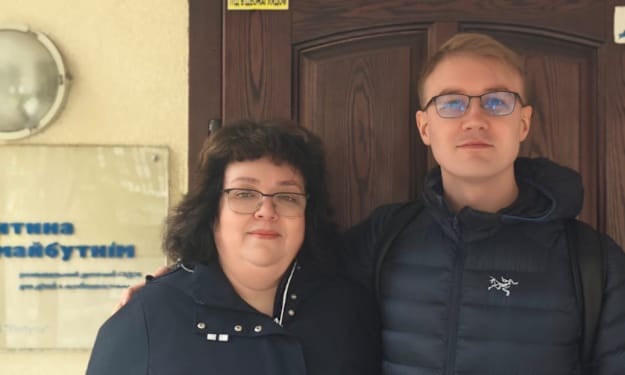
Inna Sergiyenko: How She Built "Child with Future" and Advanced Autism Support in Ukraine
By Scott Douglas Jacobsen and Iryna Sergiyenko (Translation, Ukrainian-English) Inna Sergiyenko is a Ukrainian autism advocate, educator, and founder connected with Child with Future, a Kyiv-based initiative supporting children with developmental disabilities and their families. Motivated by her son’s autism diagnosis in Israel, she helped establish a preschool model integrating education, developmental services, and specialist support in one setting. Her work expanded over many years into broader advocacy for autism awareness, disability rights, parent support, and improved professional training and service coordination across Ukraine.
By Scott Douglas Jacobsen7 months ago in Education
Mariia Klymyk on Torture, Deaths, and Abuse in Russian Captivity
Mariia Klymyk is a Ukrainian journalist, war-crimes documenter, and human rights researcher at the Media Initiative for Human Rights (MIHR). She serves as co-head of MIHR’s Department for the Protection of the Rights of Military Personnel and Their Families, where she leads work on Ukrainian prisoners of war and missing persons. Her work includes collecting testimonies about war crimes committed by the Russian Federation, researching places of detention in occupied Ukrainian territory and Russia, and producing investigations and analytical materials on captivity and disappearances. Klymyk joined MIHR in April 2022 and holds a master’s degree in journalism from Lviv Polytechnic National University.
By Scott Douglas Jacobsen7 months ago in Education
Ed Buckner on Secular Leadership, Humanist Values, and the Future of Freethought
Ed Buckner is a prominent advocate for secularism, former president of American Atheists, and past executive director of the Council for Secular Humanism. With decades of experience, Buckner emphasizes the importance of nurturing future leaders and recognizes the need for unity in the secular movement while acknowledging differences. He believes in focusing on improving humanity without religious dominance. Buckner continues to share his insights through his Substack blog, Letters to a Free Country, which reaches readers worldwide. Now nearing 80, Buckner remains engaged in writing and reflection.
By Scott Douglas Jacobsen7 months ago in Education
Trump’s AI “Jesus Image” Sparks Backlash — Even Among Allies
When AI, Power, and Religion Collide: The Controversy Around Trump’s “Jesus Image” In the current political landscape, images move faster than explanations. And when those images are powered by artificial intelligence, the gap between intention and interpretation becomes even more dangerous. That tension was on full display when Donald Trump shared an AI-generated image that many believed portrayed him as Jesus Christ. The reaction was immediate, widespread, and notably, not limited to his critics. At first glance, the image carried strong symbolic weight. Trump appeared in attire resembling religious robes, placing his hand on a figure in a healing gesture. Surrounding elements included followers, celestial imagery, and national symbols like the American flag and the Statue of Liberty. For many viewers, the message felt clear, regardless of intent. Trump later clarified that the image was meant to depict him as a doctor, someone healing people, possibly in a humanitarian or Red Cross context. He dismissed the backlash as another example of media distortion. But by the time that explanation surfaced, the interpretation had already solidified in the public mind. This is where the situation becomes more complex. The backlash did not just come from political opponents or media outlets. It also came from within ideological and cultural spaces that are often aligned with Trump. Pastor Doug Wilson, who has connections to Defense Secretary Pete Hegseth, openly criticized the image. His response was measured but direct. He acknowledged that Trump removed the image and rejected any explicit comparison to Christ, but he emphasized that the visual message itself could not be ignored. Wilson pointed out that people across the political spectrum interpreted the image in a similar way. According to him, the robe-like appearance, the positioning of the hands, and the surrounding symbolic elements aligned too closely with traditional representations of Jesus. In his view, even if the act was unintentional, it crossed a line. He described it as “accidental blasphemy,” making an important distinction. It was not a deliberate attempt to elevate oneself to a divine status, but it still reflected a lapse in judgment. And for someone in a position of influence, that lapse matters. Wilson’s perspective carries weight because of his influence within certain conservative and religious communities. His church, Christ Church, has gained attention for its connections to figures within the Trump administration. Earlier in the year, he was invited to speak at the Pentagon, signaling a level of proximity to power that makes his criticism more significant. This is what makes the situation different from typical political controversies. It is not just about disagreement between opposing sides. It is about discomfort emerging from within aligned circles. That kind of reaction usually signals a deeper issue, one that goes beyond surface-level outrage. At the center of this controversy is a larger question about the role of AI in shaping political identity. AI-generated content allows public figures to create powerful, symbolic imagery without the traditional constraints of reality. It enables them to project narratives, roles, and personas that might not be easily expressed through words alone. But that same power comes with a risk. AI does not just create images. It amplifies meaning. It compresses complex ideas into a single frame that people interpret instantly, often emotionally, and rarely with context. In this case, the intended narrative of healing was overshadowed by a much stronger visual association. Religion carries deep emotional and cultural significance, especially in the United States. When political figures appear to step into that space, even indirectly, it triggers a different level of scrutiny. The speed of digital communication makes this even more intense. By the time Trump clarified his intent, the image had already circulated, been analyzed, criticized, and internalized by millions. The explanation became secondary to the impression. This highlights a fundamental shift in how communication works today. Intent no longer controls meaning. Perception does. And perception is shaped in seconds, often before any clarification can catch up. The removal of the image from Trump’s Truth Social account suggests an acknowledgment of that reality. Whether it was a strategic decision or a response to internal pressure, it reflects an understanding that some lines, even unintended ones, carry consequences. What this incident ultimately reveals is not just a misstep, but a structural challenge. Public figures are now operating in an environment where every piece of content can take on a life of its own. AI accelerates that process, making it easier to create but harder to control. And when that content intersects with deeply sensitive domains like religion, the margin for error becomes extremely small. This was never just about one image. It was about how power chooses to present itself, how technology reshapes that presentation, and how quickly meaning escapes the control of the person who created it. In that sense, the controversy is less about what Trump intended and more about what the image exposed.
By Unfiltered Guy7 months ago in Education
How Bitcoin is Changing the Way We Buy Homes
For decades, buying a home has followed a familiar script: save cash, secure a mortgage, and hand over a sizable down payment. But in today’s evolving financial landscape, a new player is reshaping that process—decentralized finance (DeFi) combined with Bitcoin. What once sounded futuristic is quickly becoming reality, as lenders and fintech platforms begin accepting cryptocurrency as part of the homebuying journey.
By AnthonyBTV7 months ago in Education
The Best Ways to Budget in Today’s New Economy
The economy has shifted in ways that many of us can feel every day—rising prices, fluctuating job markets, and evolving financial tools have made traditional budgeting methods feel outdated. What worked five or ten years ago may no longer hold up in today’s environment. The good news? With a few smart adjustments, you can build a budgeting strategy that not only keeps up with the times but helps you stay ahead.
By AnthonyBTV7 months ago in Education
Dr. Kela Henry on the Front Lines of Health Equity
Dr. Kela Henry brings a deeply personal and wide-ranging perspective to the conversation about health equity. As a primary care physician who has cared for patients across generations, cultures, and economic backgrounds, her practice reflects the realities of modern medicine in diverse communities. From treating uninsured patients to working with families navigating language and cultural barriers, Dr. Henry has witnessed firsthand how systemic gaps in housing, income, and access to care shape health outcomes.
By Chris Adams7 months ago in Education
I Tried Replacing Processed Snacks With Simple Foods — Here’s What I Noticed
I didn’t plan to make a big change. It started with something simple. One day, I realized that most of the snacks I was eating during the day were processed. Nothing unusual—just the kind of things you grab quickly when you’re busy. Chips, packaged sweets, and anything that didn’t require much thinking.
By Mohammed Ismail7 months ago in Education
Nataliya Plaksiyenko-Butyrska, Ukraine and East Asia: How China, Japan, and North Korea Are Reshaping Global Security Ties
Nataliya Plaksiyenko-Butyrska is an Associated Senior Fellow at the New Europe Center and an expert on East Asia. Nataliya Plaksiyenko-Butyrska is a Ukrainian foreign-policy analyst and East Asia specialist serving as an Associate Senior Fellow at the New Europe Center. Her work focuses on the Asia-Pacific, China’s regional influence, and Ukraine’s relations with Asian partners. She has written more than 100 analytical pieces and contributed to major Ukrainian media outlets. Her background includes studies in journalism, diplomacy, and Korean institutions, informing her policy analysis and public commentary today across Europe and Asia alike.
By Scott Douglas Jacobsen7 months ago in Education
I Live By the Bottle. Top Story - April 2026.
For about a week I had the Norovirus. The Norovirus is a gastrointestinal virus that causes vomiting and diarrhea. Most people get over it within three days. It is troublesome for the elderly and young children, as well as people with medical conditions. I, myself, have a rare medical condition called Nephrogenic Diabetes Insipidus.
By Sid Aaron Hirji7 months ago in Education
Khrystyna Kurhanska on DoLadu Support Veteran Rehabilitation
Khrystyna Kurhanska is a Ukrainian entrepreneur, aromatherapist, and mental-health advocate based in Kyiv. She is chair of the board and public head of the NGO DoLadu, registered in November 2022 to support the mental health, rehabilitation, and reintegration of Ukrainian defenders, veterans, and the wider public. Public speaker bios state that DoLadu has operated mental-health centres in Kyiv hospitals and served more than 1,650 people, while later public interviews cite assistance to more than 1,800 service members. Kurhanska also founded the aroma-branding agency Ol.factory and Kamana perfume store, combining business, sensory design, psychology, and veteran-focused social recovery work.
By Scott Douglas Jacobsen7 months ago in Education