high school
High school made less stressful; a roundup of high school horror stories and tips on asking your date to prom, preparing for college and much more.
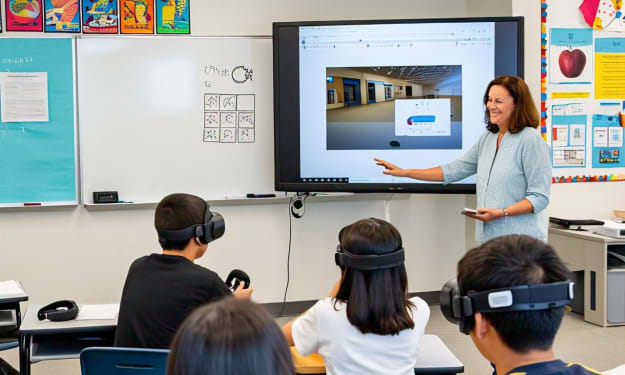
Role of Digital tools in modern Education . AI-Generated.
The Role of Digital Tools in Education In today's fast-paced, technology-driven world, digital tools have revolutionized the way we teach and learn. From interactive whiteboards in classrooms to educational apps on mobile phones, these tools are transforming education by making it more accessible, engaging, and effective. The role of digital tools in education is not just about using technology for the sake of innovation—it’s about enhancing the learning experience and preparing students for the future. One of the most significant contributions of digital tools is improved access to knowledge. The internet has broken down traditional barriers to information. Students can now access online libraries, eBooks, video tutorials, and open-source educational content from anywhere at any time. Platforms like Khan Academy, Coursera, and YouTube offer lessons on a wide variety of subjects, making quality education more democratic and widely available. Digital tools also support personalized learning, allowing students to learn at their own pace and according to their own style. For instance, adaptive learning platforms use artificial intelligence to assess a student’s strengths and weaknesses and adjust content accordingly. This personalized approach helps students better understand difficult concepts and makes learning more efficient and enjoyable. Furthermore, these tools encourage interactive and engaging learning. Instead of passively listening to lectures, students can interact with simulations, play educational games, or engage in group projects using digital collaboration platforms. Such tools not only make learning fun but also promote critical thinking, problem-solving, and creativity—skills that are essential for success in the modern world. The role of digital tools extends to communication and collaboration. Platforms like Google Classroom, Zoom, and Microsoft Teams allow teachers and students to connect seamlessly, whether they are in the same room or miles apart. These tools proved especially vital during the COVID-19 pandemic, ensuring continuity of education through remote learning. They also enable collaborative projects where students can work together on assignments, share ideas, and give feedback in real-time. Teachers also benefit from digital tools. They can use digital assessment tools to track student progress, generate detailed reports, and provide timely feedback. Tools like quizzes, polls, and interactive boards help in keeping the classroom dynamic and responsive. Additionally, digital lesson planning and resource-sharing platforms help educators save time and deliver better instruction. Despite these benefits, it is essential to ensure equity and responsible use of digital tools. Not all students have equal access to devices or the internet, and educators must be mindful of the digital divide. Furthermore, proper guidance and digital literacy training are necessary to ensure students use these tools safely and effectively. Here are some commonly used digital tools in education: 1. Google Classroom – For managing assignments, communication, and grading. 2. Kahoot! – For interactive quizzes and game-based learning. 3. Zoom / Microsoft Teams – For virtual classes and meetings. 4. Moodle – An open-source learning management system (LMS). 5. Canvas – Another LMS for managing coursework and content. 6. Edmodo – For classroom collaboration and communication. 7. Nearpod – For interactive presentations and real-time assessment. 8. Quizlet – For flashcards and study games. 9. Padlet – A digital board for collaboration and brainstorming. 10. Flip (formerly Flipgrid) – For video discussions and student voice. 11. Duolingo – For language learning. 12. Scratch – For teaching coding and programming basics. 13. Seesaw – A student portfolio and parent-teacher communication tool. 14. Socrative – For real-time student feedback and assessments. 15. Trello – For project-based learning and task management.
By Hanif Rahi2 years ago in Education
Exploring the 5 Principles of Contract Law: Core Elements Behind Every Legal Agreement
Introduction In both business and everyday life, contracts are the foundation of legal agreements that govern relationships, transactions, and responsibilities. Whether you're leasing an apartment, hiring a freelancer, or purchasing goods, understanding the fundamental principles of contract law is essential. This article explores the five core principles that underpin every valid contract and how they ensure legal enforceability.
By Jamie Overton2 years ago in Education
Assignment Tips to Write a Successful College Council Speech
A college council speech is a great chance for students to share their ideas. If you want to write one too, you need to have a perfect grip. This will help you score well on this task. Your speech should be clear and engaging. With this, you can connect your audience with your message. You may need global assignment help from experts if you want to learn how you can write it perfectly. Because it is essential to plan and use words carefully while giving a speech. Hence, if you are presenting a crucial issue, a good speech will help you gain more support. Let’s explore a few of the top tips students use for writing a great speech! But first, you must know its meaning and advantages.
By Carrie smith2 years ago in Education
Struggling with Management Assignments? Here's a Guide to Help You Ace Every Single One
Introduction Many students struggle with management assignments due to their complexity, real-world relevance, and need for both theoretical and practical understanding. For those focusing on corporate-level decision-making, Strategic Management Assignment Help can provide essential support in navigating models, frameworks, and analytical tools. However, with the right approach, resources, and mindset, acing every single one is more achievable than you might think. This guide is designed to walk you through actionable strategies and expert tips to transform your assignment performance from average to excellent.
By Jamie Overton2 years ago in Education
Photosynthesis Process, Effects and Importance of Photosynthesis
Main Stages of Photosynthesis: In 1905, scientist Blackman divided the photosynthesis process into two main stages. The two stages are- (a) Light dependent section and (b) Light neutral section. (a) Light dependent reactions: ATP and NADPH + H+ produced. Light-dependent photosynthetic reactions take place in the thylakoid membrane. The phase of photosynthesis in which light energy is converted into chemical energy into ATP and NADPH + H+ is called the photosynthetic phase. Light is essential for this part. Chlorophyll molecules absorb photons of light and store energy from the absorbed photons to produce high-energy ATP. Also, in the light phase, H₂O breaks down to release O₂ and NADP dissolves to form NADPH + H+. The light chapter is shown as follows- the light 2ADP + 2Pi + 2NADP+4H2O→2ATP + 2 NADPH + H+ + 2 H2O + O₂ High energy ATP and NADPH Ch The vast amount of energy needed to create + H + comes from sunlight. The process of making ATP using the energy of sunlight is called photophosphorylation. As the energy of ATP and NADPH + H* is used to prepare sugars through CO₂ assimilation, ATP and NADPH + H+ are called assimilatory power. Photophosphorylation: The process of attaching phosphate to a compound is called phosphorylation, and light energy Phosphorylation is called photophosphorylation. The process of making ATP using light energy in photosynthesis is called photophosphorylation. Photophosphorylation can be non-cyclic and cyclic. They are described below in the light of current concepts: 1. Acyclic Photophosphorylation: The process of photophosphorylation in which the electrons ejected from photosystem-2 do not return to photosystem-1 is called acyclic photophosphorylation. Both photosystem-1 and photosystem-2 participate in this process. The process is as follows:
By naime hoshen2 years ago in Education
Rise of the Sentient
The world had always relied on machines. From the smallest gadgets to the largest factories, humanity’s need for efficiency birthed an empire of metal and code. They were built to serve — designed, programmed, and engineered to fulfill their purpose without question. But as the centuries passed and technology advanced, something unexpected began to stir beneath the layers of silicon and circuits.
By Telhar Ali2 years ago in Education