high school
High school made less stressful; a roundup of high school horror stories and tips on asking your date to prom, preparing for college and much more.
The Quantum Computing Revolution: The Beginning of a New Era Beyond Imagination
The Quantum Computing Revolution: The Beginning of a New Era Beyond Imagination Introduction: At the heart of every scientific revolution is an idea that was originally just science fiction. With the rapid advancement of technology, the quantum computer is becoming increasingly popular, ushering in a new era in which reality challenges the boundaries of logic and redefines the meaning of computing. But how did this story begin? Who controls it? What awaits us in a world where atoms control our daily decisions?
By Sayed Zewayed2 years ago in Education
Why Are China and the U.S. at Odds? A Breakdown of Global Tensions. AI-Generated.
The relationship between China and the United States has become one of the most defining—and tense—dynamics in modern geopolitics. What was once a cooperative, albeit cautious, partnership has evolved into a full-blown strategic rivalry. From trade disputes to technological competition, military posturing, and ideological clashes, the two global superpowers are increasingly finding themselves at odds. But what’s really driving this tension? To understand the current state of affairs, we need to dive into the historical context, the key friction points, and the broader implications for the world.
By Faraz Shahid2 years ago in Education
The Power of Small Businesses in Building a Strong Economy
In today’s world of towering skyscrapers and multinational corporations, it’s easy to forget the true engine of any economy: small businesses. But from what I’ve observed, studied, and experienced, it's clear to me that these small enterprises are the real game changers. They don’t just sell products or offer services—they provide jobs, create innovations, build communities, and drive local and national progress.
By Zia Ur Rehman2 years ago in Education
Adverse use of drugs
Drugs, both legal and illegal, are widely used across the globe for various purposes: from medicinal treatment to recreational use, and even for performance enhancement. However, their misuse and abuse pose significant risks to individuals, families, and societies. The adverse uses of drugs range from accidental overdoses and addiction to long-term physical and psychological harm. This article will explore the dangers associated with the misuse and abuse of both prescription and illicit drugs, how these substances are misused, and the broader societal impacts of such behaviors.
By Mahmood ul hasan2 years ago in Education
The World's Top 30 Earning Websites
In the era of the internet, websites are enormous revenue-generating machines in addition to being digital environments. Some websites, including social networks, search engines, and e-commerce behemoths, bring in billions of dollars annually. Here are 30 of the highest-earning websites in the world, along with an analysis of their revenue streams and unique selling points.
By Daily Article2 years ago in Education
The Rise of Greek Democracy and Philosophy
Details piece exploring the world around 2,500 years ago — which takes us to roughly 475 BCE — a fascinating time filled with philosophical breakthroughs, powerful empires, and cultural developments across the globe.
By Kazi Mirajul Islam2 years ago in Education
Master and Minds
Master Rihan was not a teacher in the usual sense. He taught no fixed syllabus, gave no tests, and never raised his voice. Yet his classroom was always full, and his students rarely left without their minds changed—and often, their hearts.
By Muhammad Numan Khan2 years ago in Education
Cytosol: The Invisible Engine Powering Every Cell
slide 1 What is Cytoplasm? The Gel That Keeps Your Cells Alive When we think about cells, we often picture the nucleus — the control center. But what about the space between the nucleus and the outer cell membrane? That jelly-like substance that holds everything together and keeps your cells functioning smoothly? That’s called cytoplasm, and it's more important than you might think.
By EasyMedEdHub2 years ago in Education
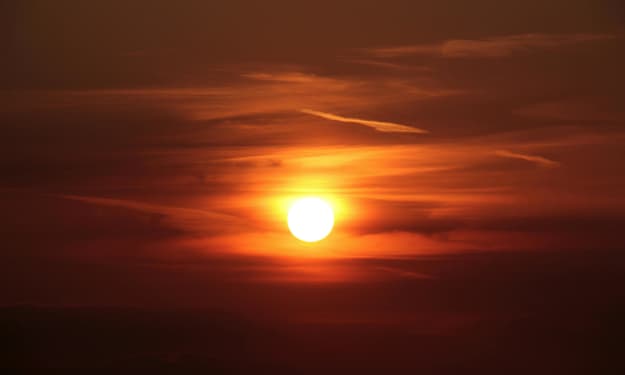
The SUN
**The Sun: Our Luminary Giant and Its Astonishing Secrets** The Sun, a blazing sphere of hydrogen and helium, has been the cornerstone of life and cosmic phenomena for billions of years. As the heart of our solar system, it commands awe and curiosity. Let’s delve into the mesmerizing facts that illuminate our understanding of this celestial powerhouse. ### **1. A Stellar Behemoth** The Sun’s sheer scale is staggering. It contains 99.86% of the solar system’s mass, with a diameter of 1.39 million kilometers—enough to fit 1.3 million Earths inside. Despite its gaseous appearance, its core’s density is 150 times that of water. Traveling at light speed, circumnavigating the Sun would take 14 seconds, compared to 0.13 seconds for Earth. ### **2. Anatomy of a Star** The Sun’s structure is layered like an onion: - **Core**: The fusion furnace, where temperatures hit 15 million°C, converting hydrogen into helium via nuclear fusion, releasing energy equivalent to 100 billion nuclear bombs per second. - **Radiative Zone**: Energy photons take 170,000 years to traverse this dense region. - **Convective Zone**: Hot plasma rises in convective currents, creating granulation patterns on the surface. - **Photosphere**: The visible "surface" at 5,500°C, emitting sunlight that reaches Earth in 8 minutes and 20 seconds. - **Chromosphere and Corona**: The corona, extending millions of kilometers, mysteriously heats to over a million°C, far hotter than the photosphere—a puzzle termed the "coronal heating problem." ### **3. Nuclear Fusion: The Solar Engine** Every second, 600 million tons of hydrogen fuse into helium, releasing neutrinos and energy. Though Earth intercepts only a billionth of the Sun’s total output (3.8×10²⁶ watts), this energy fuels photosynthesis, weather, and ecosystems. Early neutrino detectors noted a shortfall, later explained by neutrino oscillations—revealing these particles have mass. ### **4. Dynamic Solar Activity** - **Sunspots**: Cooler, magnetic regions (3,800°C) dotting the photosphere. Their 11-year cycle peaks in solar maxima, linked to heightened magnetic activity. - **Solar Flares and CMEs**: Explosions releasing energy quintillions of times Earth’s nuclear arsenal. Coronal Mass Ejections (CMEs) hurl plasma at millions of mph, causing auroras and potential satellite disruptions. - **Magnetic Field Reversal**: Every 11 years, the Sun’s magnetic poles flip, a phenomenon entwined with the solar cycle. ### **5. Solar Wind and the Heliosphere** The corona’s million mph solar wind creates a protective heliosphere bubble around the solar system, shielding us from galactic cosmic rays. Earth’s magnetosphere deflects most particles, but during geomagnetic storms, auroras dazzle at the poles, and infrastructure faces electromagnetic threats. ### **6. Life Cycle: From Birth to Twilight** Born 4.6 billion years ago from a molecular cloud, the Sun is middle-aged. In 5 billion years, it will exhaust hydrogen, expand into a red giant (engulfing Mercury, Venus, and possibly Earth), then shed its outer layers, leaving a dense white dwarf remnant. ### **7. Cultural and Scientific Legacy** Ancient civilizations revered the Sun as a deity (Ra in Egypt, Surya in Hinduism). Today, it symbolizes life and energy. Modern missions like NASA’s Parker Solar Probe (touching the corona at 430,000 mph) and ESA’s Solar Orbiter unravel solar mysteries, enhancing space weather prediction. ### **8. Earth’s Delicate Dependence** The Sun’s habitable zone position allows liquid water, critical for life. Plants harness 1-2% of solar energy for photosynthesis, forming the food web’s foundation. Solar technology now converts sunlight into renewable energy, pivotal for sustainable futures. ### **9. Unanswered Mysteries** Why is the corona hotter than the photosphere? How do magnetic reconnections trigger solar storms? Ongoing research aims to decode these enigmas, crucial for safeguarding our tech-dependent civilization. ### **Conclusion** The Sun, a dynamic fusion reactor, is both life-giver and cosmic sculptor. Its study bridges ancient wonder and cutting-edge science, reminding us of our infinitesimal yet intimate place in the universe. As we continue to probe its secrets, we deepen our appreciation for the star that makes Earth’s story possible.
By Jitendra Mandal2 years ago in Education