book reviews
Book reviews for scholastic growth; read material from the world's top educators with our collection of novels, memoirs, biographies, philosophical texts and textbooks.
Wheels of Freedom: The Timeless Journey of the Bicycle
There are few inventions in history as simple, elegant, and enduring as the bicycle. With just two wheels, a frame, pedals, and a handlebar, this humble machine has rolled its way into almost every corner of the world — and every corner of the human experience. The bicycle is not just a vehicle. It is a tool of freedom, a symbol of independence, a gateway to childhood, and, for many, a lifeline to school, work, or adventure. The Birth of the Bicycle The idea of the bicycle can be traced back to 1817, when a German baron, Karl von Drais, invented the “Laufmaschine” or “running machine.” It had no pedals and was pushed along with the feet — a sort of walking aid on wheels. Then came innovations: Pedals in the 1860s. Chain drives in the 1880s. Rubber tires, gears, and brakes that gradually transformed it into the modern bicycle we recognize today. By the late 19th century, bicycles had exploded in popularity, especially in Europe and America. They were affordable, easy to maintain, and gave individuals — especially women — a new sense of freedom and mobility. A Ride Through History The bicycle has played surprising roles in history: During wars, bicycles were used by messengers and soldiers for quiet, fast travel. In the early 20th century, they became a means of protest and equality, especially in women’s rights movements. In developing countries, bicycles became the bridge to opportunity — taking children to school, farmers to markets, and healthcare workers to villages. A Machine of Simplicity and Power What makes the bicycle so powerful is its simplicity. Unlike cars or trains, it doesn’t need fuel, doesn’t create noise, and doesn't pollute. It is powered by the rider alone, converting human energy into motion with almost magical efficiency. Bicycles come in many types: Road bikes for speed and racing. Mountain bikes for off-road adventure. Hybrid bikes for city commuting. Electric bikes (e-bikes) for longer, assisted journeys. Cargo bikes for carrying goods or children. No matter the type, every bicycle is a declaration: "I move myself." More Than Just Transport Ask anyone who’s ridden a bike, and they’ll tell you — it’s not just about going from one place to another. It’s about the feeling of the wind on your face, the freedom of an open road, the childhood memory of your first solo ride, wobbly and proud. Cycling builds fitness, strengthens mental health, and reduces carbon footprints. It’s a personal act that benefits the whole planet. Bicycles in Modern Life In crowded cities, where traffic chokes and pollution soars, bicycles are becoming the smartest solution. Cities like Amsterdam, Copenhagen, and Tokyo have built entire infrastructures around bicycles — with dedicated lanes, parking zones, and even traffic lights for cyclists. Post-pandemic, people across the world turned to bicycles again — for safe transport, exercise, and peace of mind. The Bicycle as Culture and Art Over time, bicycles have become more than machines — they are icons of culture. In movies like E.T. and The Bicycle Thieves, they carry meaning beyond motion. In sports, cycling is a global spectacle — from the Tour de France to Olympic races. In art, music, and even fashion, bicycles continue to inspire. They're painted on walls, sung about in folk songs, and remembered as the first taste of independence for millions. Faces Behind the Handlebars Every cyclist has a story. A student racing the clock to make it to school. A delivery worker weaving through city traffic. A traveler exploring mountain trails. A mother taking her child on a scenic ride. A boy learning balance and bravery all at once. The bicycle is democratic — it belongs to no class, no race, no age group. It is one of the few machines that levels the road for everyone. The Future Rolls Forward With climate change concerns and urban congestion, the future of transport must be clean, compact, and efficient — exactly what bicycles offer. Innovations in cycling technology include: E-bikes with smart sensors and GPS. Foldable bikes for small apartments. Solar-powered bike lanes and charging stations. Bike-sharing programs in major cities. The bicycle may be old, but it’s more relevant today than ever. --- Conclusion The bicycle, in all its quiet glory, reminds us that sometimes, the best way forward is not faster or fancier — it’s simpler. It connects us with our environment, with our health, and with our younger selves. In a world spinning ever faster, the bicycle lets us pause, pedal, and truly experience the ride.
By Noman Afridiabout a year ago in Education
Steel on Tracks: The Everlasting Journey of Trains
When the world was slower, quieter, and smaller, a deep whistle broke the silence — and everything changed. That whistle belonged to a train, and it signaled the beginning of a journey not just for passengers, but for humanity itself. Trains, often called the steel giants of the land, are more than just a mode of transport. They are history in motion — a symbol of progress, industry, and the undying human desire to connect. The Dawn of a Revolution The story of trains begins in the early 19th century, during the Industrial Revolution. In 1804, Richard Trevithick built the first full-scale working railway steam locomotive. However, it was George Stephenson's "Rocket" in 1829 that truly launched the age of steam locomotion. Early trains were powered by steam engines, belching smoke and sparks as they rolled across new tracks laid across Europe, the United States, and eventually the world. These iron machines opened new frontiers, carrying coal, goods, letters, and lives to places never reached before. A Moving Machine of Wonders The design of a train is deceptively simple — wheels on tracks — but the engineering behind it is brilliant. Trains move with minimal friction, which allows them to carry tons of weight over long distances. A single train can replace hundreds of trucks, making it one of the most efficient and eco-friendly transport options even today. There are various types of trains: Steam Trains: The pioneers, driven by coal-fired boilers and pistons. Diesel Trains: Introduced in the 20th century, using internal combustion engines. Electric Trains: Cleaner, quieter, and faster — now dominate most modern rail networks. Bullet Trains (High-Speed Rail): Japan’s Shinkansen and France’s TGV reach speeds over 300 km/h, shrinking continents with speed and comfort. The Romance of the Rails Beyond speed and mechanics, trains have always carried a romantic charm. Unlike planes or cars, a train ride offers time — to look outside, to think, to feel. The gentle rocking, the rhythmic click-clack, the scenery sliding by like a moving painting — it’s travel with soul. Writers, poets, and filmmakers have long been fascinated by trains. From Agatha Christie’s “Murder on the Orient Express” to the Hogwarts Express in Harry Potter, trains often become characters themselves — mysterious, magical, and memorable. Changing Landscapes and Lives Trains did not just move people — they shaped nations. In America, the transcontinental railroad united east and west. In India, railways became the backbone of administration and economy during British rule and continue to serve millions daily. In Europe, rail travel connects countries faster than air in many cases. Trains brought villages into cities, and cities into economies. They became lifelines for workers, merchants, students, and dreamers. Technology Meets Tradition Today’s trains are marvels of modern design. Maglev Trains: These use magnetic levitation to float above the tracks and glide silently at 600+ km/h. Smart Trains: Equipped with AI, sensors, and predictive maintenance systems. Green Trains: Hydrogen-powered and solar-assisted models are being tested to make future rail travel carbon-free. Yet, while technology advances, the essence remains — a train is still a long, steel creature that comes alive with a horn and carries lives within its belly. The Human Side of the Tracks At every station, there are stories. A child waves at a passing engine. A mother cries as her son departs. Lovers meet at platforms. Travelers sleep, read, and dream as landscapes roll by. For some, a train is just transport. For others, it’s freedom, escape, or even home. Railway stations themselves are cultural icons — from the grand chandeliers of New York’s Grand Central to the buzzing life of Lahore Junction or the speed and silence of Tokyo’s Shinkansen terminals. Challenges and the Road Ahead Trains face challenges too: aging infrastructure, urban congestion, and rising costs. Yet governments across the world are investing in railways as part of climate goals and sustainable future plans. Smart cities of the future will have high-speed metros, automated trains, and integrated ticketing. Railways are not just surviving — they’re evolving. --- Conclusion The story of the train is the story of human progress — of rails laid across deserts and mountains, of stations that never sleep, of people moving together toward a shared tomorrow. Whether it’s the thunder of a steam engine, the hum of an electric motor, or the whisper of a maglev, trains remind us that life is a journey — and every journey deserves a track.
By Noman Afridiabout a year ago in Education
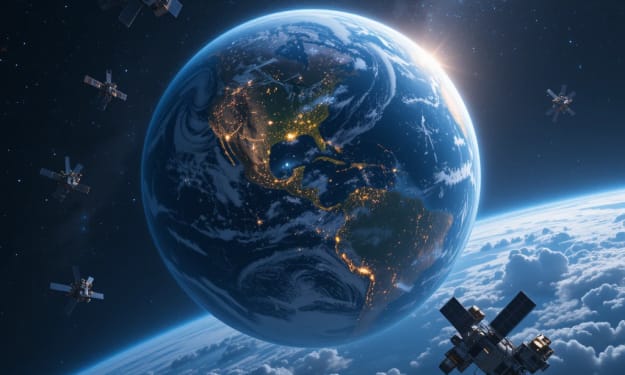
Satellites: The Silent Watchers of the Sky
Far above the blue skies, beyond the reach of birds and airplanes, silent machines float endlessly in orbit. These are satellites — one of humanity’s most powerful tools, quietly transforming life on Earth without making a sound. We rely on them more than we realize. When you check the weather, use GPS, watch international news, or make a video call — a satellite is working for you. These man-made marvels orbit the Earth 24/7, capturing data, relaying signals, and helping us understand, communicate, and survive in a fast-moving world. But what exactly is a satellite? How do they work? And why are they so vital to our lives? What Is a Satellite? In simple terms, a satellite is any object that orbits another. The Moon is Earth’s natural satellite. But in modern language, "satellite" usually refers to artificial satellites — machines launched into space by humans to serve specific purposes. The first artificial satellite was Sputnik 1, launched by the Soviet Union in 1957. It was a small, beeping metal sphere that marked the beginning of the space age. Today, there are more than 7,000 active satellites orbiting our planet, each with a unique mission — from communication and navigation to climate monitoring and military surveillance. How Satellites Work Satellites orbit Earth due to the perfect balance between gravity and speed. Once launched into space, a satellite moves fast enough to avoid falling back to Earth, but not fast enough to escape its gravity. This creates a continuous falling motion around the planet — what we call orbit. There are different types of orbits: Low Earth Orbit (LEO) for closer, faster satellites like those used for imaging; Medium Earth Orbit (MEO) for GPS satellites; and Geostationary Orbit (GEO) for communication satellites that appear stationary from the ground. Each satellite is equipped with solar panels for power, antennae for communication, and sensors or cameras to perform its tasks. Uses of Satellites: Changing Earth from Space 1. Communication: Satellites are the backbone of modern communication. Whether it's mobile networks, internet connectivity in remote areas, live television broadcasts, or long-distance phone calls — satellites transmit signals across the globe. 2. Navigation: Every time you use Google Maps or a car’s GPS, you’re connecting to a network of satellites in MEO. These satellites send timing signals, which help calculate your exact location on Earth. 3. Weather and Climate Monitoring: Satellites equipped with special sensors monitor clouds, storms, ocean temperatures, and more. They help predict weather patterns, warn about natural disasters like hurricanes and floods, and track long-term climate change. 4. Earth Observation: High-resolution cameras on satellites take images of Earth’s surface. These are used in agriculture, forestry, mining, urban planning, and environmental protection. They help us monitor deforestation, pollution, water levels, and even wildlife migration. 5. Defense and Security: Satellites play a crucial role in military operations. They are used for spying, surveillance, missile tracking, and secure communication. In modern warfare, space is the high ground. The Silent Heroes: Unseen but Essential Despite their importance, satellites are rarely noticed. They work quietly, without needing human presence, tirelessly orbiting day and night. Their benefits are vast, but their visibility is limited — and that’s part of their magic. From the farmer using satellite data to predict rainfall, to the airline pilot guided by satellite navigation — these floating machines are silently making our lives easier and safer. Challenges and Concerns With thousands of satellites in orbit, space is becoming crowded. Old, unused satellites and broken parts — known as space debris — pose a threat to active satellites and future missions. Moreover, increasing military satellites raise concerns about the weaponization of space. Global cooperation is needed to ensure that space remains peaceful and sustainable. The Future: Smarter, Smaller, Swarming The satellite industry is evolving fast. New trends include: Miniaturized satellites (CubeSats) that are cheaper and quicker to launch. Satellite constellations, like SpaceX’s Starlink, which aim to provide global internet coverage. AI-powered satellites that can analyze data in real time without sending it back to Earth. In the future, satellites will become even more embedded in our lives — helping us manage cities, protect nature, respond to disasters faster, and explore distant planets. --- Conclusion Satellites are not just machines in the sky. They are extensions of human curiosity, intelligence, and ambition. Orbiting quietly above us, they observe, connect, and protect. They are the silent guardians of Earth — watching over us, guiding us, and preparing us for the future. Every time we look up at the stars, remember: among them, man-made stars are working for you — lighting the path forward.
By Noman Afridiabout a year ago in Education
Laptop: Today’s Necessity, Tomorrow’s Weapon
In the 21st century, technology is not just a convenience — it is the backbone of our lives. Among the many digital tools we use every day, the laptop stands as a symbol of personal power and progress. From students learning online to professionals working remotely, the laptop is no longer just a machine; it is a lifeline, a companion, and a weapon of productivity. Gone are the days when desktops ruled the tech world. The world demanded mobility, and laptops answered. Lightweight, powerful, and increasingly affordable, laptops have become essential in nearly every field — education, business, healthcare, design, engineering, and even agriculture. They are shaping how we learn, work, create, and communicate. The Rise of the Laptop: From Luxury to Necessity Not too long ago, owning a laptop was considered a luxury. Only big corporations, universities, or the wealthy could afford them. But over the past two decades, the price of laptops has dropped while their power has increased dramatically. Today, even a student in a small village can access global knowledge through a basic laptop and internet connection. This change has flattened the world, giving people from every background a chance to compete, learn, and grow. Laptops are now used in every corner of life. In education, they allow online learning, research, and digital collaboration. In business, they power virtual meetings, presentations, and project management. In the creative world, writers, artists, and musicians use laptops to create content that reaches millions. Laptops in Education: The Digital Classroom Perhaps one of the greatest impacts of laptops has been in education. During the COVID-19 pandemic, millions of schools shut down globally. But learning didn’t stop. It shifted online — and laptops were the classroom. Students attended classes, gave presentations, submitted assignments, and took exams — all from their rooms. This not only kept education alive but also opened the door to new digital skills. Even now, post-pandemic, the role of laptops in education is bigger than ever. Teachers design interactive lessons, students access online libraries, and learning has become self-paced and flexible. Without laptops, such progress would have remained a dream. Remote Work and the Freedom to Create In the world of work, the laptop has become the ultimate office. Whether you’re an accountant or an artist, a coder or a content creator, a laptop enables you to work from anywhere. Coffee shops, parks, even while traveling — your office is where your laptop is. This flexibility has improved work-life balance and allowed people to explore freelance and entrepreneurial opportunities. Moreover, laptops are platforms of creativity. Video editors, graphic designers, writers, animators — all use laptops to bring their imagination to life. A song created on a laptop in a bedroom can go viral worldwide. A business idea developed on a spreadsheet can attract investors. A story written late at night can inspire thousands. Challenges and the Digital Divide However, not everything is perfect. Millions still cannot afford a laptop. In many parts of the world, students share devices, families live without reliable internet, and people are left behind in the digital race. This is the digital divide, and it is real. If laptops are the future, then the future must be made accessible for all. Governments, NGOs, and private companies must work together to make laptops affordable and available, especially in underprivileged areas. Only then can we truly empower the next generation. The Future of Laptops: Smarter, Smaller, Stronger As technology evolves, so will laptops. We are already seeing AI-powered machines, foldable screens, touchscreen hybrids, and cloud-connected devices. In the near future, laptops may become more personalized, energy-efficient, and integrated with virtual reality and AI. But no matter how advanced they become, their purpose will remain the same: to connect us, empower us, and help us build a better future. --- Conclusion A laptop is not just an electronic device. It is a modern-day tool of survival, learning, and success. It is a window to the world and a weapon of creation. Whether you’re a student dreaming big, a professional solving problems, or a creator inspiring others — the laptop is your faithful partner on the journey.
By Noman Afridiabout a year ago in Education
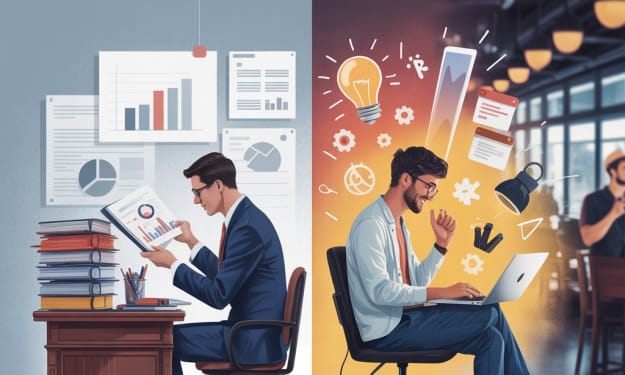
Business vs. Entrepreneurship: Key Differences and What Sets Them Apart
In today’s rapidly evolving economy, the terms business and entrepreneurship are often used interchangeably. On the surface, both involve starting and managing a venture that sells products or services for profit. However, the reality is that business and entrepreneurship are two distinct paths shaped by mindset, innovation, and long-term goals. Understanding the difference between business and entrepreneurship can help aspiring founders choose the path that aligns with their vision and personality.
By Shafi Ullahabout a year ago in Education
The Boy Who Shared His Lunch
On the first day of school, Sam wasn’t nervous—he was protective. Not of his books or his backpack. But of his lunch. It was packed with his favorites: a crustless peanut butter and jelly sandwich, apple slices, a cookie wrapped in foil, and a juice box cold enough to fog up the lid. To Sam, this wasn’t just lunch. It was comfort. It was his.
By Ahmad Malikabout a year ago in Education