book reviews
Book reviews for scholastic growth; read material from the world's top educators with our collection of novels, memoirs, biographies, philosophical texts and textbooks.
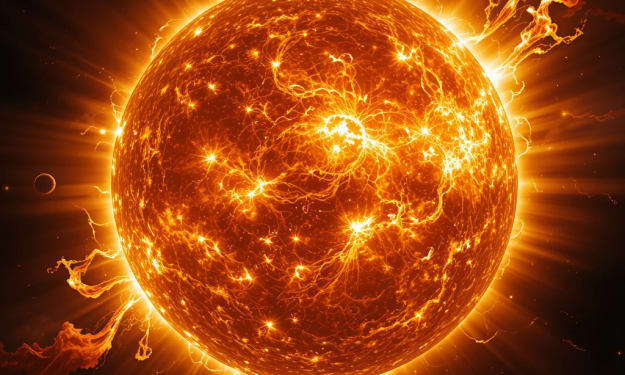
The Fiery Heart of Our Solar System: Mysteries of the Sun
Every morning, the Sun rises with timeless grace, bathing the world in golden light. Yet behind its calm appearance lies a raging inferno, a cosmic engine that has burned for over 4.6 billion years. The Sun is not just a glowing ball in the sky—it is the center of our solar system, the giver of life, and a symbol of divine power across countless civilizations. But how much do we truly understand about this blinding, burning giant? A Star is Born The Sun formed from a giant cloud of gas and dust that collapsed under its own gravity. As the material compressed, it began to heat up, igniting nuclear fusion at its core. This process continues to this day, converting hydrogen into helium and releasing immense energy in the form of heat and light. This light takes eight minutes to reach Earth, but its journey begins in the Sun's core, where temperatures exceed 15 million degrees Celsius. Layers of Light and Fire The Sun is composed of several layers, each with unique properties. At the center lies the core, where fusion happens. Surrounding that is the radiative zone, followed by the convective zone, where hot gases churn like boiling water. The photosphere is the visible surface, giving us sunlight. Above it, the chromosphere and the corona extend outward, visible only during solar eclipses. The corona, surprisingly, is hotter than the surface and remains one of astronomy’s greatest puzzles. Solar Storms and Flares The Sun is far from calm. It constantly ejects particles and energy in the form of solar flares and coronal mass ejections (CMEs). These powerful storms can affect satellites, communication systems, and even electrical grids on Earth. In 1859, a massive solar storm—known as the Carrington Event—disrupted telegraph lines worldwide. Scientists warn that a similar event today could paralyze modern technology. The Sun’s Role in Life and Death Without the Sun, life as we know it would not exist. It drives our climate, powers photosynthesis in plants, and provides energy that fuels all ecosystems. But the Sun is not eternal. In about 5 billion years, it will exhaust its hydrogen fuel and expand into a red giant, possibly engulfing Mercury, Venus, and even Earth. Eventually, it will shed its outer layers and become a white dwarf—a quiet end to a blazing life. A Cultural and Spiritual Icon Since the dawn of time, humanity has worshipped the Sun. Ancient Egyptians revered Ra, the sun god. The Aztecs offered sacrifices to please their solar deity, Huitzilopochtli. In Hinduism, Surya is honored with daily prayers. Even modern culture embraces the Sun through art, poetry, and symbolism—as a force of truth, hope, and rebirth. Scientific Exploration: Watching the Sun Closely Modern science has allowed us to study the Sun in unprecedented detail. NASA's Parker Solar Probe is the closest any spacecraft has ever come to the Sun, diving through the corona to collect data about solar wind and magnetic fields. These missions are helping us understand how the Sun affects space weather and how to protect Earth from future solar threats. A Reminder of Our Fragility and Wonder The Sun reminds us of both our power and our vulnerability. It nurtures life, yet it can also destroy. It is constant, yet ever-changing. The more we study it, the more we realize how little we know. And as we look up at the golden horizon, we are reminded that even the most familiar things hold untold mysteries. The Sun is not just a star. It is our beginning, our sustenance, and one day, it may mark our end.
By Noman Afridi2 years ago in Education
The Silent Guardian: Secrets of the Moon Unveiled
When we gaze at the night sky, the Moon greets us with a tranquil presence—a silver sentinel hanging above us, offering light, rhythm, and wonder. Yet behind its gentle glow lies a world brimming with cosmic secrets. The Moon, often romanticized in poetry and painted in stories, is far more than a beautiful celestial body. It is a silent guardian of Earth and a witness to the violent birth of our solar system. The Moon’s Origin: A Collision of Worlds Scientists believe the Moon was born approximately 4.5 billion years ago, shortly after Earth itself formed. The prevailing theory suggests a Mars-sized object named Theia collided with Earth, causing massive debris to orbit our planet. Over time, this debris coalesced, forming what we now see as the Moon. This cosmic crash not only shaped our Moon but also contributed to Earth’s tilted axis, giving rise to seasons. Locked in Dance: Earth and Moon’s Gravitational Bond The Moon is tidally locked with Earth, meaning the same side always faces us. This synchronous rotation has created a balance—a cosmic dance—that has stabilized Earth’s wobble and, by extension, its climate. Without the Moon’s gravitational pull, tides would be minimal, and the delicate balance of marine life would be disrupted. A Record of Time: The Lunar Surface Unlike Earth, which constantly reshapes itself through weather and tectonic activity, the Moon’s surface is ancient and largely unchanged. Craters from meteoroid impacts, vast lava plains called maria, and towering mountains reveal a timeline of cosmic events etched in stone. Every mark on the Moon is a story—untouched, preserved, and waiting to be understood. Human Footprints and Future Dreams In 1969, Neil Armstrong left the first human footprint on the Moon, declaring, “That's one small step for man, one giant leap for mankind.” That moment symbolized the peak of human achievement and sparked a renewed curiosity about our nearest neighbor. Since then, we’ve sent multiple missions to study the Moon’s surface, composition, and hidden treasures. Water ice, discovered in shadowed craters, offers hope for future lunar bases that may one day support human life. The Moon’s Influence on Culture and Myth Beyond science, the Moon has always had a profound effect on human imagination. From ancient civilizations who worshipped it as a deity to modern lovers who admire its glow, the Moon has been a muse, a mystery, and a mirror. In Chinese folklore, it’s home to the Moon Goddess Chang’e. In Native American traditions, it marks time and seasons. In modern science fiction, it’s a setting for futuristic colonies and alien life. Why the Moon Still Matters With growing interest in space exploration, the Moon is once again in the spotlight. Nations and private companies alike are racing to establish a permanent presence on its surface. Why? Because the Moon may be the gateway to deeper space. Its low gravity and close proximity make it an ideal launchpad for Mars missions and beyond. Moreover, studying the Moon helps us understand planetary formation, cosmic evolution, and even Earth’s own geological past. A Guardian in Silence The Moon does not speak, but it tells a story louder than words. It controls our tides, brightens our nights, and stands as Earth’s closest ally in the cosmos. It is a silent guardian—watchful, unwavering, and mysterious. As we continue to uncover its secrets, one truth remains: the Moon is not just a rock in space. It is a part of who we are.
By Noman Afridi2 years ago in Education
Quantum Algorithms Outperform Classical Solvers in Optimization Tasks, Study Reveals
A groundbreaking study has demonstrated that quantum algorithms can surpass classical solvers in solving certain optimization problems, marking a significant step toward practical quantum advantage. This research highlights the potential of quantum computing to revolutionize industries reliant on complex optimization, such as logistics, finance, and artificial intelligence. Below, we explore the study’s findings, the implications for quantum and classical computing, and the challenges that remain before quantum optimization becomes mainstream.
By Niranjon Chandra Roy2 years ago in Education
The Little Girl and the Lost Puppy – A Heartwarming Tale of Kindness
A Whimper in the Rain The storm growled like an angry beast, its thunder shaking the windows of Emma’s tiny house. Rain lashed against the glass, turning the world outside into a blur of gray and gloom. But beneath the howling wind, Emma heard something else—a sound so small and sad it made her heart squeeze tight.
By Ahmad Malik2 years ago in Education
Museums is the Social, Cultural, and Educational
The Core of Our Cultural, Social, and Educational Identity: Museums Museums are much more than just structures with exhibits and relics. They are essential organizations that uphold education, protect our common heritage, and provide a sense of social cohesion. In a world where globalization, technology, and cultural variety are interacting at previously unheard-of levels, museums are essential for helping people learn throughout their lives, connect with their heritage, and expand their knowledge of other cultures.
By Md Foiz Ullah2 years ago in Education
"The Evolution of E-Learning: Online Education in the Digital Age"
The Evolution of E-Learning: Online Education in the Digital Age In recent years, e-learning has emerged as a transformative force in the field of education. As technology continues to advance, the way we learn and teach has undergone a massive shift. The evolution of e-learning, from its humble beginnings to its current role as a cornerstone of modern education, has brought with it numerous innovations that have reshaped the educational landscape. Today, online education offers a dynamic, accessible, and globally connected learning environment that empowers both students and educators. This article will explore the journey of e-learning, analyze the technologies that have driven its evolution, and examine its advantages, challenges, and the future of digital education.
By Shamshair Khan Hasan Zai2 years ago in Education
"Cybersecurity Tips: How to Stay Safe on the Internet"
Cybersecurity Tips: How to Stay Safe on the Internet In today's digital age, ensuring online safety has become more important than ever. As we rely increasingly on the internet for work, education, shopping, and social interaction, the risks associated with cybersecurity are ever-growing. With cybercrime evolving and becoming more sophisticated, cybersecurity awareness is crucial for everyone, regardless of their digital experience. Protecting yourself online not only safeguards your personal data but also prevents potential identity theft, financial loss, and other digital threats.
By Shamshair Khan Hasan Zai2 years ago in Education
The Lion and the Poor Man. Content Warning. AI-Generated.
Subtitle: A Tale of Mercy in the Wild In the vast expanse of the African savannah, where golden grasses waved like an endless sea and the sun ruled the skies, there lived a lion whose roar echoed through the wind like thunder. He was feared by all—called Zuberi, the mighty. With a mane as dark as midnight and eyes that burned like fire, he had no challengers, no equals, and no need for mercy.
By shahid kash2 years ago in Education