book reviews
Book reviews for scholastic growth; read material from the world's top educators with our collection of novels, memoirs, biographies, philosophical texts and textbooks.
The Night School
M Mehran By day, the city’s old community center was quiet. Dusty chairs stacked against the walls, faded posters curling at the edges, a basketball court echoing with silence. But when the sun dipped below the skyline, the lights flickered on and the doors opened to a different kind of classroom: the night school. Here, students weren’t children. They were parents, taxi drivers, factory workers, janitors—people who had once walked away from education but were now walking back. --- The Woman with the Red Notebook Among them was Maria, a mother of two who carried a small red notebook everywhere she went. She worked at a diner all day, then rushed to class in the evenings, her hands smelling faintly of coffee and soap. Maria had dropped out of high school at sixteen to help her family. For years, she told herself it was too late. But the night school gave her another chance. On the first day, the teacher asked, “Why are you here?” Maria’s voice cracked as she whispered, “I want to show my kids that it’s never too late.” She opened her red notebook, wrote the alphabet across the page, and smiled like she had discovered treasure. --- The Retired Teacher The night school was run by Mr. Singh, a retired teacher who could have enjoyed quiet evenings at home but instead chose to spend them in classrooms filled with people chasing unfinished dreams. He often said, “Education is not a clock you can run out of. It is a flame you can relight.” His students weren’t easy to teach. They came exhausted from long shifts, some embarrassed to admit how much they had forgotten. But Mr. Singh’s patience was infinite. He broke lessons into steps, celebrated small victories, and reminded them, “Every page you turn is proof that you’re moving forward.” --- The Struggles The night school wasn’t glamorous. There were no smartboards or shiny textbooks. Sometimes the heating broke. Sometimes students fell asleep at their desks, not because they didn’t care, but because their bodies had already given everything during the day. Yet they returned. The single father who balanced homework and child care. The immigrant who wanted to improve her English so she could open a small business. The teenager who had once been expelled but realized he wanted more than dead-end jobs. Each student carried a story of loss and a hope for renewal. --- Maria’s Turning Point For Maria, math was the hardest subject. Numbers slipped through her fingers like water. One night, after a long shift, she sat staring at fractions until tears blurred the page. “I can’t do this,” she muttered. Mr. Singh pulled up a chair beside her. “Maria, do you know why fractions matter?” She shook her head. “They matter because they remind us that even something broken can be whole again.” Maria looked at him, startled, then back at her notebook. Slowly, she began solving the problem. That night, she got her first answer right. --- Graduation Months turned into years. Students dropped out, new ones joined, but Maria never missed a class. Her children would wait at the diner after school, cheering her on as she finished assignments. Finally, the night came: graduation. The community center was packed, folding chairs lined in crooked rows, balloons tied to the old basketball hoops. When Maria’s name was called, her children leapt to their feet, clapping and shouting, “That’s our mom!” She walked across the stage, holding her red notebook in one hand and her diploma in the other. For her, it wasn’t just a certificate. It was proof that she had turned broken pieces into something whole. --- Beyond the Classroom Education is often seen as something that belongs to youth. We picture backpacks, playgrounds, exams, and lockers. But education belongs to everyone. It belongs to the mother who returns to school after decades, the grandfather learning to read for the first time, the refugee writing English words with trembling hands. The night school in the old community center was proof. It showed that learning doesn’t end with age, circumstance, or failure. It ends only when we stop believing in possibility. --- A Lesson for All of Us Maria now helps her children with their homework at the kitchen table, guiding them through math problems with the patience she once needed for herself. She tells them, “Dreams don’t have expiration dates. They only expire when you give up.” Her story is a reminder that education is not linear. Some journeys take detours, pauses, or years of waiting. But when given a second chance, education can transform not just individuals, but entire families. The night school is still there, its lights glowing each evening like a beacon for anyone searching for another shot. And inside, the sound of pencils scratching, pages turning, and voices reading aloud tells a simple truth: It’s never too late to learn.
By Muhammad Mehranabout a year ago in Education
The Day the Library Opened
M Mehran In the small town of Maplewood, the most ordinary building became the most extraordinary gift: a library. It wasn’t big. Just a renovated post office with peeling paint and mismatched chairs. But the day it opened, children pressed their noses against the glass doors, parents peeked in with quiet curiosity, and teachers whispered with relief. For years, Maplewood had survived without one. Now, they finally had a place where education lived beyond the classroom. --- The Curious Boy Among the crowd was eleven-year-old Diego. He had never owned a book. His family moved often, and school was the only place he encountered words beyond billboards and grocery lists. When the librarian, Mrs. Taylor, handed him a library card, he held it like a golden ticket. Diego wandered between shelves, fingers brushing over the spines of stories, science books, and atlases. He picked up a book about planets and whispered, “I didn’t know Saturn had rings.” In that moment, education stopped being something that happened only at school. It became an adventure he could carry home. --- The Teacher Who Knew Education thrives when curiosity meets guidance. Ms. Reynolds, Diego’s teacher, knew this well. She had been fighting to keep her students engaged in a school where budgets cut art programs, outdated textbooks fell apart at the seams, and internet access was patchy at best. When she saw the library open, she exhaled in relief. “Finally,” she said. “Finally, a place where learning can breathe.” She began assigning “library challenges.” Students had to find a book, read a chapter, and share something surprising with the class. Suddenly, math lessons were interrupted by fun facts from history, and science class buzzed with discoveries about volcanoes, space, and ecosystems. Education spilled beyond the walls of the classroom, growing roots in imagination. --- A Town Transformed At first, the library was just for students. But soon, parents came too. Some borrowed cookbooks and tried new recipes. Others picked up manuals on fixing cars, sewing clothes, or improving their English. Grandparents came for newspapers and stayed for poetry. Maplewood began to change. The town that once closed its eyes after work hours now buzzed with evening book clubs, homework help sessions, and free Wi-Fi that allowed teenagers to research careers. Education had moved from something children endured to something families embraced. --- The Struggle Behind the Shelves But the library wasn’t built without struggle. Behind the bright lights and smiling faces were years of petitions, town meetings, and fundraising bake sales. There were arguments: Why spend money on books when there were roads to fix? Why build a library when everyone could “just Google it”? The truth was that not everyone could. Many families didn’t have reliable internet or laptops at home. For them, the library wasn’t a luxury; it was a lifeline. Education, after all, isn’t just about schools. It’s about access. And without access, curiosity dies quietly. --- Diego’s Dream Weeks after the library opened, Diego checked out a thick book on astronomy. Every night, he sat by the window with a flashlight, tracing constellations on the page and then finding them in the night sky. One morning, he stood in front of his class and declared, “I want to be an astronaut.” The class laughed—not unkindly, but with the disbelief of children who thought astronauts lived in other worlds, not in Maplewood. But Ms. Reynolds didn’t laugh. She placed a hand on his shoulder and said, “Then we’ll learn everything we can about space.” In that moment, Diego realized education wasn’t just about memorizing facts. It was about building bridges between dreams and possibilities. --- The Bigger Picture Maplewood’s library story mirrors a global truth: education is never just about classrooms, grades, or tests. It’s about environments that spark learning—libraries, community centers, mentorships, online resources, even conversations at the dinner table. Too often, education is measured by numbers: literacy rates, graduation percentages, test scores. Those matter, yes. But behind every number is a Diego, an Amina, a child with a library card or a tablet under a baobab tree, waiting for their world to expand. Education is both fragile and powerful. Without support, it withers. With investment, it transforms lives and towns. --- Full Circle Months later, Diego returned a stack of books and asked Mrs. Taylor if the library had anything about rockets. She smiled and guided him to a new section funded by a local donation. That night, Diego drew a rocket ship in his notebook. At the top, he wrote, “One day, I will see the stars up close.” And somewhere between the peeling paint and mismatched chairs of Maplewood’s library, his dream felt possible. --- Why It Matters Education is not just about what we teach; it’s about the spaces we create, the curiosity we nurture, and the doors we unlock. A classroom teaches discipline and basics, but a library, a mentor, or even a single inspiring teacher can ignite a lifelong fire. The story of Maplewood is a reminder: when communities invest in education, even in the simplest forms, they change not only children’s futures but also their own. Because every library card, every lesson under a tree, every digital tablet in a village is more than a tool—it’s a promise. And promises, when kept, can send a child from a small town all the way to the stars.
By Muhammad Mehranabout a year ago in Education
The Ultimate Guide to Learning Programming in 2025
What is Programming? Programming is the process of giving instructions to a computer so it can perform specific tasks. These instructions are written in a programming language, which acts as a bridge between human logic and machine execution.
By PositivePulseabout a year ago in Education
The Teacher Who Collected Stars
M Mehran Most people thought Mr. Hale was an ordinary teacher. He wore the same brown jacket every day, carried a stack of papers tucked under his arm, and taught literature to restless high school juniors who rarely listened. But the truth was, Mr. Hale collected stars. Not the kind that burned in the sky, but the kind that flickered inside people—the sparks of possibility that most others overlooked. Samantha Lee was fifteen when she first sat in his classroom. She had a habit of sitting in the back, hiding behind her hair, sketching in the margins of her notebook. Teachers called her lazy, distracted, even unmotivated. Her grades were slipping, and the word “failure” seemed to follow her like a shadow. Mr. Hale never used that word. One day, while the rest of the class groaned over a quiz, he leaned over Samantha’s desk and whispered, “You see things differently, don’t you?” She blinked, unsure how to respond. He tapped the edge of her notebook, where she had drawn a tree whose branches curled into shapes of birds. “That’s not distraction,” he said. “That’s vision.” It was the first time anyone had said something kind about her drawings. Mr. Hale’s lessons were strange. Sometimes he abandoned the textbook entirely and asked the students to write letters to their future selves. Other times, he made them stand in a circle and tell stories, no matter how silly. When the principal visited, Mr. Hale returned to grammar drills and vocabulary lists. But when the door closed again, his eyes lit up like someone had struck a match inside him. “Education isn’t about memorizing answers,” he told them once. “It’s about finding the questions that matter.” Most of the students rolled their eyes. But Samantha didn’t. The day Samantha’s life changed was a Tuesday. Mr. Hale gave the class a challenge: write an essay not about a famous author, but about themselves. “Tell me your story,” he said. “No rules, no format. Just truth.” Samantha stayed up all night. She wrote about her fear of being invisible, about how her parents fought so loudly she escaped into drawing, about how she felt both too much and not enough at the same time. When she handed it in, her hands shook. A week later, Mr. Hale returned the papers. At the top of hers, instead of a grade, he had written: “This is not just writing. This is a voice. Don’t ever lose it.” It was the first time Samantha believed she had something worth saying. Rumors spread that Mr. Hale was too soft, that his teaching methods weren’t “practical.” Parents complained that their kids weren’t learning the “basics.” The principal warned him twice. Still, he kept going. He stayed after school for students who needed him, listened when no one else did, and filled the margins of every assignment with encouragement instead of criticism. “He’s wasting their time,” another teacher muttered once. “These kids won’t pass state exams if all they do is write poems.” But Samantha noticed something different. Students who had once slept through class now leaned forward. The quiet kid in the corner shared a story about fixing cars with his grandfather. The class clown admitted he wanted to be the first in his family to go to college. The sparks were catching fire. Years later, Samantha walked into a bookstore and found her name on the spine of a novel. She traced the letters with trembling fingers. She had done it—she was an author. At her first public reading, an audience filled the small room. Samantha read aloud the story of a girl who felt invisible until a teacher showed her she wasn’t. Afterward, a man approached her. His hair was grayer, his jacket the same worn brown. Mr. Hale. She froze, overwhelmed with gratitude. “You—you came.” He smiled, the corners of his eyes crinkling. “Of course. I came to see one of my stars.” Samantha felt tears sting her eyes. “I never thanked you.” “There’s no need,” he said gently. “Teaching isn’t about being remembered. It’s about helping you remember yourself.” And with that, he left quietly, as if he had only been there to hand her another piece of light. No one ever knew how many stars Mr. Hale had collected in his lifetime. They weren’t visible in the sky, nor etched into any chart. But they shone in classrooms, in novels, in songs, in medical degrees, in inventions—sparks he had tended until they became flames. Because true education, Samantha realized, was never about tests or grades. It was about someone who believed in you long enough for you to believe in yourself.
By Muhammad Mehranabout a year ago in Education
Charlie Kirk and the danger of selective empathy
Conservative political activist Charlie Kirk was shot and killed on Wednesday. His suspected killer, identified by law enforcement as 22-year-old Tyler Robinson, was taken into custody after a substantial manhunt, based on information from people close to Robinson’s family. Utah Governor Spencer Cox said a family member of Robinson had reached out to a friend, who then contacted the authorities, and that friends and relatives interviewed by investigators described Robinson as “full of hate” when speaking about Kirk at a recent gathering. Robinson’s exact motivations for allegedly carrying out the shooting are still being explored.
By MUHAMMAD Abbasabout a year ago in Education
The Importance of Education in Modern Society
Education is one of the most powerful tools that shape human life and society. It is not limited to reading books or passing examinations but extends to the overall development of an individual’s character, skills, and understanding of the world. In today’s globalized world, education plays a vital role in personal growth, career advancement, and the progress of nations. This article explains the importance of education in detail, exploring its impact on individuals and society as a whole. What is Education? Education can be defined as the process of acquiring knowledge, skills, values, and attitudes through learning and experience. It begins at home, continues in schools and universities, and never truly ends, as lifelong learning is essential in the modern age. Formal education includes structured systems like primary, secondary, and higher education, while informal education occurs through daily life experiences, interactions, and personal exploration. Personal Development Through Education One of the most significant roles of education is personal development. A well-educated person gains self-confidence, critical thinking abilities, and problem-solving skills. For example, learning languages improves communication, while studying science and technology sharpens analytical thinking. Education also teaches discipline, patience, and time management, which are necessary for achieving goals. Moreover, it shapes moral values, making individuals more responsible and respectful in society. Education and Career Opportunities In the competitive job market of the 21st century, education is the foundation of career success. Employers prefer candidates who are skilled, knowledgeable, and adaptable. Higher education opens doors to professional careers in medicine, engineering, law, business, and technology. Vocational education, on the other hand, provides practical training for specific jobs, helping people gain financial independence. Thus, education is directly linked to economic stability and a better standard of living. Education as a Social Equalizer Education reduces the gap between rich and poor by giving everyone equal opportunities to succeed. In many countries, scholarships and free education programs help underprivileged children break the cycle of poverty. Through education, people learn about social justice, equality, and human rights. Educated societies are less likely to fall into discrimination, gender inequality, or racial prejudice, as knowledge promotes tolerance and understanding. National Development and Education No nation can progress without education. It provides skilled professionals, innovative thinkers, and responsible citizens. Countries with high literacy rates often enjoy better economic growth, political stability, and advanced technology. For instance, developed nations like Japan and Germany have invested heavily in education, which has contributed to their global leadership in science, industry, and innovation. Education also builds national unity by teaching cultural heritage, history, and civic responsibility. The Role of Technology in Education In the modern world, technology has revolutionized the education sector. Online learning platforms, digital libraries, and virtual classrooms make education accessible to millions worldwide. Students can now attend lectures from top universities without leaving their homes. Artificial Intelligence, smart classrooms, and e-learning tools have made education more interactive and effective. Technology also encourages self-learning, creativity, and innovation, preparing students for the digital future. Challenges in Education Despite its importance, education faces several challenges across the globe. Poverty, lack of resources, outdated teaching methods, and gender inequality prevent millions of children from accessing quality education. In some regions, political instability and conflicts destroy schools and disrupt learning. Moreover, the rising cost of higher education makes it difficult for many students to pursue their dreams. Addressing these challenges requires global cooperation, government support, and community participation. Conclusion In conclusion, education is the backbone of human development and societal progress. It empowers individuals, opens career opportunities, reduces inequality, and strengthens nations. With the rapid growth of technology and globalization, the value of education has become even greater. Therefore, governments, institutions, and individuals must work together to make education accessible, affordable, and effective for everyone. An educated society is not only a successful society but also a peaceful, progressive, and prosperous one.
By Article Master about a year ago in Education
How Bill Gates Achieved Success" (simple and direct)
When people talk about the rise of personal computers, Bill Gates is almost always at the center of the conversation. As Microsoft’s co-founder and one of the wealthiest individuals on the planet, he symbolizes the technological revolution of the late 20th century. His achievements, however, are not just a product of fortune—they stem from curiosity, foresight, perseverance, and the courage to seize opportunities others ignored. Gates’s story demonstrates how determination paired with innovation can reshape the world. Early Passion for Computers Born in 1955 in Seattle, Washington, Gates grew up in a household that encouraged learning, ambition, and problem-solving. From a young age, he excelled at puzzles and mathematics. His life changed dramatically when, as a teenager at Lakeside School, he discovered the school’s computer terminal—a rarity at the time. During the late 1960s, when computers were still expensive and uncommon, Gates and his close friend Paul Allen immersed themselves in programming. They experimented endlessly, learning by trial and error. While most teenagers were still searching for direction, Gates was already writing software and envisioning technology’s potential. From Harvard to Microsoft In 1973, Gates entered Harvard University to study mathematics and computer science. But the pull of technology was stronger than academics. He and Paul Allen read about the Altair 8800, one of the first personal computers, and quickly developed software to run on it. Their program caught the attention of the Altair’s makers, and the success of that project convinced Gates to leave Harvard in 1975. That leap of faith marked the beginning of Microsoft, a company destined to change the computing industry. Building a Software Empire The name “Microsoft” was a blend of “microcomputer” and “software,” reflecting Gates and Allen’s belief that the personal computer market was about to explode. Their pivotal opportunity arrived in 1980, when IBM asked Microsoft to create an operating system for its new personal computer. Instead of building one from scratch, Microsoft purchased and modified an existing system, which became MS-DOS. Importantly, the deal let Microsoft license the software to multiple hardware manufacturers—ensuring that its product could run on countless machines. This decision established Microsoft as a cornerstone of the PC revolution. The launch of Windows in the mid-1980s, with its easy-to-use graphical interface, made computing accessible to millions worldwide. By the 1990s, Windows was the dominant operating system, and Gates had become one of the most powerful figures in technology. Gates’s Drive and Vision What distinguished Gates wasn’t just technical expertise, but his ability to see the bigger picture. Long before most people could imagine it, he envisioned a future where every household and office had a personal computer. His leadership style was intense and demanding, but it pushed Microsoft to achieve extraordinary results. Gates personally reviewed code, set exacting standards, and worked tirelessly alongside his team. His mix of competitiveness, innovation, and focus on the future kept Microsoft ahead of rivals for decades. Beyond Business: A Life of Philanthropy In 2000, Gates stepped down as Microsoft’s CEO and redirected his energy toward philanthropy. With his then-wife Melinda, he established the Bill & Melinda Gates Foundation, which grew into one of the world’s largest charitable organizations. The foundation works to combat diseases like malaria, improve global health and sanitation, and expand access to education. Gates’s philanthropic efforts have saved millions of lives, transforming his image from a hard-driving businessman to a humanitarian dedicated to solving global challenges. Lessons from His Journey Bill Gates’s career holds powerful lessons for anyone striving for success: Pursue your passion – His love of computers fueled his path. Take bold risks – Dropping out of Harvard was a gamble that paid off. Recognize opportunities – The IBM partnership was a turning point. Commit to hard work – His discipline and standards lifted Microsoft above its competitors. Think ahead – His vision of a computer in every home shaped the digital future. Conclusion From a curious teenager in Seattle to the architect of a global software empire and a leader in philanthropy, Bill Gates’s story is one of ambition, innovation, and purpose. His success was built on relentless learning, strategic risks, and a deep belief in the power of technology to improve lives. Today, his influence extends beyond business into humanitarian work, proving that lasting success is measured not just by personal achievement, but by the impact one makes on humanity.
By Kashif Khanabout a year ago in Education
The First Steps to Success in Life. AI-Generated.
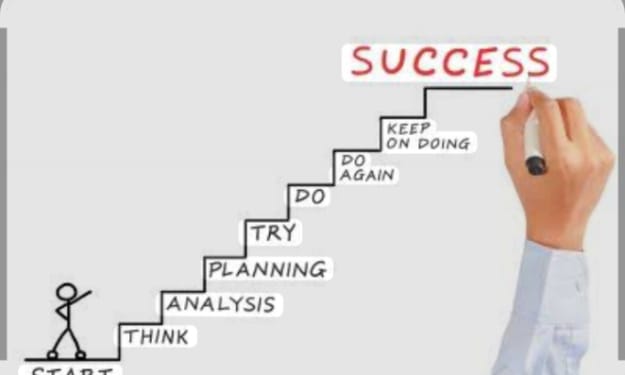
Beginner’s Success in Life Success is a word that carries different meanings for different people. For some, it may be wealth or fame; for others, it may be peace of mind, happiness, or the ability to help others. No matter how we define it, success does not come overnight. It is a gradual process that begins with small steps, lessons, and experiences. For beginners in life—students, young professionals, or anyone just starting their journey—the road to success may seem confusing. However, with the right mindset, habits, and values, anyone can move closer to their dreams.
By MoneyOrbitabout a year ago in Education
The Power of Motivation: Turning Dreams Into Reality
The Power of Motivation: Turning Dreams Into Reality Motivation is the driving force that pushes us to take action, overcome challenges, and achieve our goals. Without motivation, even the most talented people may struggle to reach their true potential. It is like fuel for the human spirit — giving us the energy and determination to keep moving forward.
By Article Master about a year ago in Education
The Path to Success: Lessons from Elon Musk"
"A journey of innovation, risk-taking, and relentless ambition." "Inside the mind of the billionaire who reshaped tech and space." "From PayPal to SpaceX: The making of a modern visionary." "The challenges, failures, and breakthroughs that built his empire." "How bold ideas and persistence turned dreams into reality." Do you want the subtitle to sound more inspirational (motivating readers) or more informative (giving a clear summary of his journey)? e fiction. But behind the billionaire who runs companies like Tesla and SpaceX is a story of ambition, relentless work ethic, and a willingness to take risks that many others would shy away from. Musk’s success was not built overnight—it was shaped by curiosity, bold decisions, and a mindset that refused to accept limits. Early Life and Curiosity Elon Musk was born in Pretoria, South Africa, in 1971. From an early age, he showed signs of being different. While many kids spent their free time playing outside, Musk was often found reading books or tinkering with computers. By the age of 12, he had already taught himself how to code and even sold a video game he created called Blastar. This combination of curiosity and self-learning became a theme throughout his life. At 17, Musk moved to Canada and later attended the University of Pennsylvania in the United States, where he studied physics and economics. His education gave him knowledge, but more importantly, it opened his eyes to opportunities in technology and business. Musk was not just interested in earning a degree; he wanted to solve big problems. First Ventures: Building Wealth through Startups Musk’s entrepreneurial journey began in the 1990s when the internet was just starting to transform the world. His first company, Zip2, helped businesses create an online presence. At a time when many people did not yet understand the internet’s potential, Musk saw its future and seized the opportunity. In 1999, Compaq bought Zip2 for nearly $300 million, giving Musk his first real wealth. Instead of retiring or playing it safe, Musk took the money and invested it in another risky venture—X.com, an online banking company. This later became PayPal, which revolutionized how people transfer money online. In 2002, PayPal was sold to eBay for $1.5 billion, and Musk walked away with over $100 million. For most people, this would have been enough. But for Musk, it was only the beginning. Taking Risks Others Wouldn’t What sets Musk apart is not just his intelligence, but his willingness to take extreme risks. After PayPal, he could have lived comfortably for the rest of his life. Instead, he invested almost all his money into three areas that many thought were too risky: space exploration (SpaceX), electric cars (Tesla), and renewable energy (SolarCity). SpaceX was especially bold. At the time, only governments had successfully launched rockets into space. Musk’s goal was to make space travel cheaper and eventually help humans live on other planets. The company nearly failed several times, with rockets exploding during early launches. At one point, Musk had enough money left for just one more attempt. Thankfully, the rocket succeeded, and NASA soon partnered with SpaceX, saving the company from collapse. Tesla also faced major challenges. Electric cars were considered impractical and boring, but Musk proved otherwise. He pushed Tesla to create sleek, powerful vehicles that could compete with gasoline cars. Despite constant criticism and financial struggles, Tesla eventually became the world’s most valuable car company. Vision Beyond Money One of the reasons Musk became so successful is that his vision goes beyond personal profit. His companies aim to solve massive global problems: climate change, energy shortages, and even the survival of humanity. Whether it’s developing solar power, making cars sustainable, or building rockets to Mars, Musk sets goals that inspire people. This doesn’t mean the journey has been easy. Musk has faced failures, criticism, and enormous pressure. He has admitted to sleeping in factories, working 100-hour weeks, and sacrificing personal comfort for his companies. But this dedication is part of what makes him different from most business leaders. Lessons from Musk’s Journey Elon Musk’s success is not the result of luck—it is a combination of traits that anyone can learn from: Curiosity and Learning: He taught himself skills and constantly seeks knowledge. Risk-Taking: Musk invested his own fortune into ideas others doubted. Persistence: Even when facing repeated failures, he refused to give up. Big Vision: His goals are not small; they aim to change the future of humanity. Conclusion Elon Musk’s journey from a curious boy in South Africa to one of the most influential entrepreneurs in the world shows that success often comes from taking risks, staying persistent, and thinking bigger than others dare to. His story is a reminder that failure is not the end, but part of the path to greatness. Whether it’s launching rockets, building electric cars, or dreaming about Mars, Musk’s success comes from one key quality: never being afraid to push the boundaries of what is possible.
By Kashif Khanabout a year ago in Education