Latest Stories
Most recently published stories in Education.
Why It Is Good To Learn Many Language
A 2011 study found that students in rigorous high school programs that contained at least three years of foreign language instruction were more likely to improve their grades in college and to drop out less often. Another study showed that students of high school with two or more years of foreign language instruction performed better on the English performance tests than students without foreign language skills. A study of 13,200 third and fifth graders in public schools in Louisiana found that children who participated in the English course of the Louisiana Basic Skills Test, regardless of race, gender or academic level performed better than those who didn’t.
By Kandel gita5 years ago in Education
Review of Unfair Advantage by Robert Kiyosaki
Before I begin my review, (which I am not good at), I want to make a few points. First, please read my other stories on financial education and read others when you get a chance. That will help me, other others and this site. Secondly, this is not an endorsement or anything even though I do feel it should be read. You can buy it directly or just read it at the library or bookstore. While Robert Kiyosaki is a good author and has a lot of knowledge, I have read from many reviews that he simply repeats himself. This book and Rich Dad, Poor Dad are the only ones I have read, and I have another one I plan to read later.
By Ferrari King5 years ago in Education
Notes On Transfer Of Property Act
Even if you are the sole owner of a property, transferring it to another person has tax ramifications because the transaction is likely to generate benefits for the seller. Even if this isn’t the case (as it is in the instance of donating property or transferring rights to another person through a will), the transfer must be performed in accordance with applicable tax regulations. In this post, we’ll look at the Notes on Transfer of Property Act, which lays out the rules for transferring property from one person to another.
By ankit sharma5 years ago in Education
Perseverance
With the landing of Perseverance on Mars today, and the next part of her journey just beginning, I am reminded that I have my own journey to continue. In my struggles with life change, I had been thinking about not continuing. But as she rolls out, I had best do the same and do a system's check and get on with it; there is not time to waste!
By Jack Drake5 years ago in Education
Study plan
The Importance of Creating a Good Study Plan Many students find themselves procrastinating a lot, especially when they are doing their studies, or they are not able to follow their current study plan sincerely. This leads to poor performance in the study of students. A study plan is a very significant tool that helps a student to have a sense of accountability and excellent organization. A study plan is not the only timetable. A study plan is broader than time table. It explains the method to deal with the challenges student is facing in each subject. One should draw an effective study plan to attain the target goals. All items should be attended in the order of priority.
By james kimaru5 years ago in Education
Struggling to complete a history project? Follow the below hacks
Writing a history assignment is a prime step towards stating your opinion about politics, society, environment, and every other aspect you have learned about the particular period or incident. It does not only enhance your grade, but a good history assignment can be a great step toward a better future in becoming a successful historian. Students in need of guidance for completing a history assignment may follow the mentioned steps for a better understanding. However, not all the students get time and space to complete the project, or not everyone gets proper guidance to understand the topic. For them, history assignment help services can play a key role in scoring good grades:
By Emily Moore5 years ago in Education
America's First Examples of Progressive Women Fighting Patriarchy & Racial Barriers
In Colonial and post-colonial times in America, marriage was a sure way of securing a well fitted social and economic class rather than freely loving someone and having the option to choose who to marry. Although the rhetoric of affectionate marriage in the early national period presents marriage as a matter of individual choice rooted in emotion, the two novels I analyze force the reader to recognize that marriage is, in the 18th century seduction novel Coquette, primarily a means of economic and social mobility, and in the 19th century historical romance Hobomok, a mechanism of settler-colonialism and racial preservation. These time periods birthed a new type of woman in society that pushes back against being drawn in and trapped by the archaic traditions of marriage that society has set in place for women. Two texts from this time period that exemplify and use the idea of marriage as a means of economic and social mobility is the Coquette by Hannah Webster Foster and Lydia Maria Child’s Hobomok. While each story portrays marriage in their own way, both women protagonists refuse, and fight their societies view of who they should marry. In the Coquette Eliza tries to assert free will but comes to see how her choices have repercussion and her free willed spirit becomes her downfall. As for Mary Conant the American rebel, in Hobomok her situation becomes a bit more complex with racial issues closely intertwined with marital issues. Mary goes against her empirical Puritan society traditions of marriage by marrying Hobomok an Indian before turning around and ending up marrying into a European middle-class family to Mr. Brown. Eliza and Mary are seen juggling relationships between two men and this love triangle dynamic gives a good insight on the complications and the stress of societies constraints on marriage and relationships. The Coquette shows us that marriage remains a primarily economic arrangement, despite the period's rhetoric of affectionate marriage. Hobomok shows us that marriage in the 19th century as a domestic frontier novel is primarily an arrangement meant to preserve racial purity in society over their faith.
By Ethan Holloway5 years ago in Education
Faking it in the Classroom?
Three weeks away from the mandatory teacher training before the beginning of the new school year and I once again ask myself, "Am I really qualified to do this?" It is a question I ask repeatedly throughout each academic year as a miasma of feelings overwhelm my time in the classroom. And I am not alone in this concern. I have had conversations with my colleagues where this exact sentiment is at the forefront of their own professional thoughts.
By Melodee Olson5 years ago in Education
Women’s Deception and Delusion in Daphne du Maurier’s Don’t Look Now
The works of Daphne du Maurier capture more than the mind of the reader; they cast a spell on the very soul of those who read just one of her entrancing stories. She is able to carefully omit information to create mind-blowing conclusions that are so skillfully harmonized. Her novels and stories were written over several decades when women were not expected to be at the forefront of a story, yet her collection of short stories profoundly tend to focus on a female lead. Du Maurier’s short stories “Indiscretion”, “Kiss Me Again, Stranger”, “La Sainte-Vierge”, “Spilt Second”, and “The Blue Lenses”, though different in context, share a common theme. From cheating to murder, ghastly encounters to the in-between, and all forms of hallucinations alike, deception and delusion dominate du Maurier’s works collected in her book Don’t Look Now.
By Alyssa Anderson 5 years ago in Education
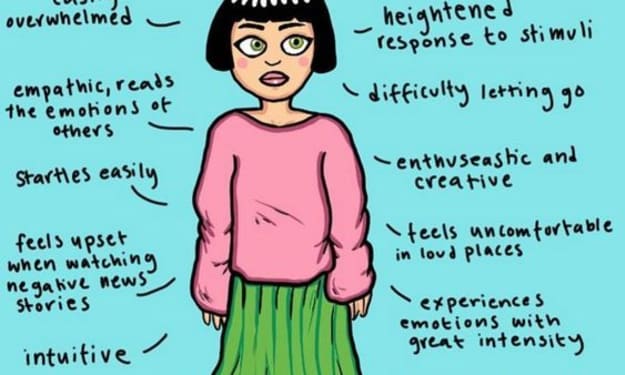
Brain Training for the Highly Sensitive Person
When you first read "Highly Sensitive Person" what are your first thoughts on the meaning of this label? Do you think you have to walk on eggshells? Do you feel like someone is a "sissy", "overly sensitive", "can't take bad news", etc?
By Vanessa R. Powell5 years ago in Education