
I Chose My College Because of One Line of Poetry
That small decision took me from a rainy Nanjing city wall to a Tibetan plateau substation, a river island at midnight, and a train I watched on TV years later.
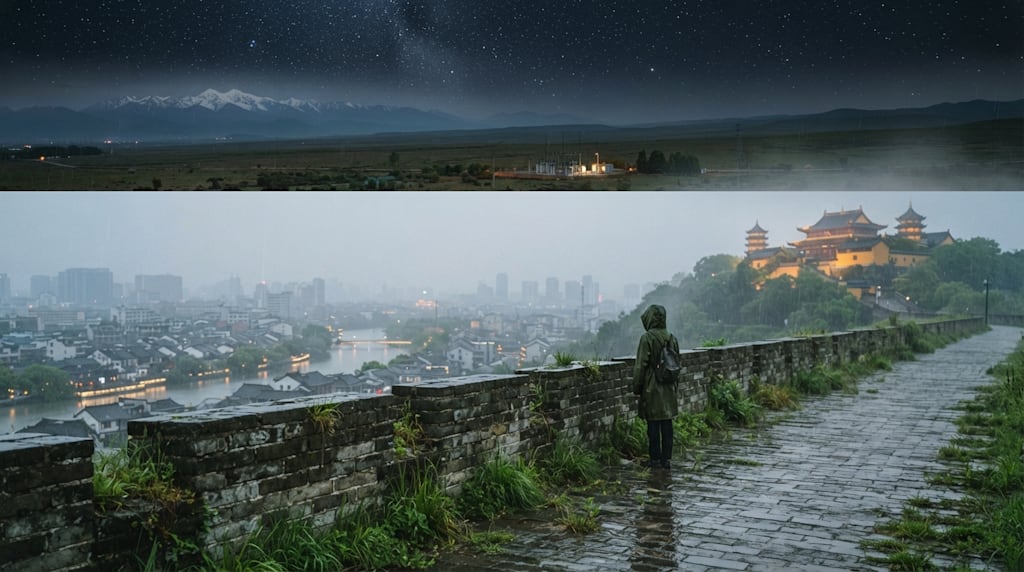
When the college entrance exam scores came out, I could apply to Fudan or Nanjing University. The majors were similar. The cities were both good. I wrote Fudan first on the application form. My pen stopped. I crossed it out and wrote Nanjing University. Because of one line: “Four hundred and eighty temples of the Southern Dynasties, how many towers and terraces in mist and rain?”
Shanghai had no four hundred and eighty temples of the Southern Dynasties. It had no line about where the dragon coiled on Zhongshan. That reason could not go into a brochure. I filled in the form anyway.
In April of my sophomore year, a rainy day. I walked on the Nanjing city wall. The rain was fine. The bricks shone. Jiming Temple sat in the mist, yellow walls, dark tiles. The bell did not ring. I stood on the wall. Tears came. Water got into my shoes. My socks were cold. I wiped my face and kept walking. The towers in the poem and the towers in front of me matched.
Later I worked at ABB. On the shuttle bus, a colleague from ABB High Voltage said that during the commissioning of a Qinghai-Tibet Railway substation, relay contacts burned out easily. I asked about the altitude. He said over four thousand meters. I said this was a classic high-altitude reaction of electrical equipment. Connect contacts of the same type in series, to eliminate the arc erosion caused by breaking. They asked me to go. I did not want to. Then I thought, it was for the railway. So I went.
The Qinghai-Tibet Railway was not open yet. I flew to Xining, took a special bus to Golmud, then an engineering vehicle to the substation. Several substations had the same problem. I only went to the first one. The fix was not hard. The hard part was sleepiness. The time difference twisted inside my body. After dinner, I took a banana and walked near the substation.
A Tibetan mother and her son passed. The mother put her palms together and said a blessing. I put my palms together too. I gave the boy the banana. He took it, did not peel it, and ate it in a few bites. I raised my hand to show him he should peel it. He had already finished. They put their palms together again, said a word of thanks, and walked slowly away into the sunset.
At night, my phone had no signal. The substation had a satellite phone. I did not use it. I looked up at the stars. There were many, very bright, as if I could reach up and touch them. At the end of the plain were snow mountains, but I could not see them clearly. The wind came across the empty ground in waves. It was cold. I went back inside, washed, and turned off the light.
The next day I kept working. We discussed, handled. A few days later, I took the return vehicle to Golmud.
The ABB colleague I worked with later went to the highest substation and stayed there for a year. When he came back, he had a low-altitude reaction. He had to go back, stay a week in some middle place, and return slowly. When I saw him again, a man in his twenties looked like a man in his forties or fifties. I almost did not recognize him.
On July 1, 2006, the Qinghai-Tibet Railway opened. I did not go to work. I stayed home and watched the live broadcast. When the opening ceremony appeared on TV, tears came. The remote control lay on the coffee table. A car passed outside the window. I had checked relay contacts. I had gone to the substation. That was my part.
Another time, I accompanied people from Anhui Electric Power Company to Chizhou for an inspection. At night we stayed on a river island in the Yangtze near Chizhou.
I went alone to the riverbank. Across the water, Chizhou was bright with lights. The river moved in long rolls. The wind was strong. Reeds knocked against each other in the dark, rustling. A boat moved away under the moon. I thought of Su Dongpo’s “First Ode on the Red Cliff”:
“Before long, the moon rose above the eastern mountain and lingered between the Dipper and the Ox. White dew spread across the river, and water and sky joined. I let a leaf of a boat go where it would, drifting over the vastness. Vast and boundless, as if riding the wind, not knowing where to stop; floating and alone, as if leaving the world, feathered and ascending.”
I stayed at the edge. The wind pressed my clothes against my body. Later I went back inside and slept.
I felt that again once, on a ferry crossing the Yangtze at Nantong, also at night. I took the bow. The river moved. Lights on both banks went from near to far, and at the horizon they merged with the rising moon. The ferry docked. I got off and walked away.
Later I went to the Nanjing city wall again. Still April, still rain. Grass grew in the cracks between the bricks. Jiming Temple sat in the mist. The bell did not ring. I stood for a while, and left.
About the Creator
Jin
Writer of reamstories
https://reamstories.com/jin
Enjoyed the story? Support the Creator.
Subscribe for free to receive all their stories in your feed. You could also become a paid subscriber, letting them know you appreciate their work.
Comments
There are no comments for this story
Be the first to respond and start the conversation.