
How to Reduce False Positives in AML Transaction Monitoring
Practical strategies for improving alert accuracy, prioritizing high-risk transactions, and reducing manual investigation workloads without compromising compliance.

Introduction
Anti-money laundering (AML) transaction monitoring is essential for fintech companies that need to identify potentially suspicious financial activity while meeting regulatory obligations. However, an effective monitoring process must do more than generate alerts. It must help compliance teams distinguish meaningful risk signals from routine transactions that happen to match predefined detection criteria.
When monitoring systems produce too many false positives, analysts spend valuable time investigating legitimate activity. Alert queues grow, response times increase, and genuinely suspicious transactions can become harder to identify among less relevant cases. For fintech businesses processing large transaction volumes, these problems can quickly affect both operational efficiency and compliance performance.
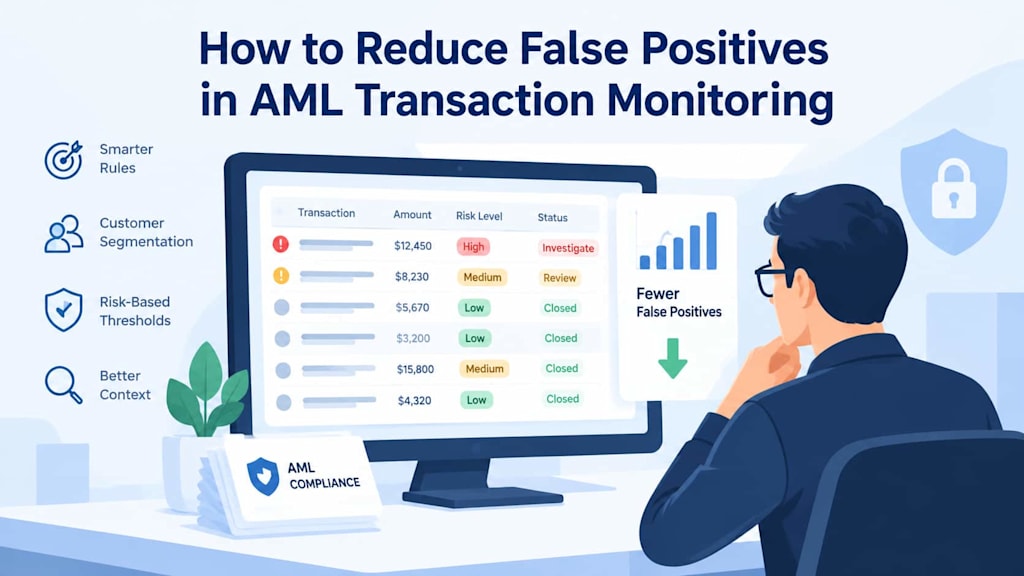
Reducing false positives requires a structured approach to optimizing existing monitoring processes. Rather than simply raising thresholds or disabling rules, fintech teams should evaluate detection performance, account for customer behavior, incorporate transaction context, and continuously test adjustments.
The objective is to improve alert quality while preserving the ability to identify suspicious patterns. Achieving that balance requires collaboration between AML analysts, compliance specialists, developers, and technical decision-makers.
Why AML Transaction Monitoring Generates Too Many Alerts
False positives can emerge from several weaknesses in an otherwise functional monitoring system. Understanding their causes is the first step toward making meaningful improvements.
One common problem is overly broad detection logic. A rule designed to identify unusual transaction amounts may generate alerts whenever a legitimate customer makes a large purchase, transfers funds between personal accounts, or receives an expected business payment. The rule identifies a condition that warrants attention in some circumstances, but it does not distinguish between different explanations for the same activity.
Poorly calibrated thresholds create another source of unnecessary alerts. A transaction limit that works for one customer segment may be inappropriate for another. A threshold suitable for an individual consumer, for example, may generate excessive alerts for a small business with frequent supplier payments.
Insufficient transaction context also reduces accuracy. A monitoring system might evaluate an individual payment without considering the customer's historical activity, transaction frequency, established counterparties, geographic exposure, or previous investigation outcomes. Consequently, normal behavior can appear suspicious when viewed in isolation.
Other contributing factors include duplicated alerts from overlapping rules, outdated assumptions about customer behavior, inconsistent treatment of recurring payments, and detection criteria that no longer reflect the actual risk profile of the business.
These problems cannot be solved through a single global adjustment. Each requires evidence-based analysis of where alerts originate, which ones prove useful, and why legitimate transactions repeatedly trigger investigations.
Identify Underperforming Detection Rules
Before changing monitoring settings, fintech teams should establish which rules contribute most to unnecessary investigations.
A useful starting point is a rule-level performance review. Instead of evaluating the monitoring system only by total alert volume, examine each rule's contribution to the workload and its effectiveness in identifying cases that require escalation.
Important questions include:
How many alerts does each rule generate over a representative period?
What proportion of alerts are closed as legitimate activity?
How frequently do alerts lead to escalation or further investigation?
How much analyst time does each rule consume?
Do multiple rules repeatedly flag the same transaction or customer?
Have the rule's results changed as transaction volumes and customer behavior have evolved?
A rule that generates thousands of alerts with very few meaningful escalations deserves investigation. However, a low escalation rate does not automatically mean the rule is ineffective. Some rules may be designed to identify rare but serious activity, making their value difficult to measure through routine alert outcomes alone.
Teams should also review samples of closed alerts, not just summary statistics. Analysts can identify recurring patterns that explain why legitimate transactions trigger a rule and determine whether the problem lies in the threshold, missing context, or the detection condition itself.
For example, a rule that repeatedly flags scheduled payments to established suppliers may benefit from contextual evaluation. A rule that detects unusual transaction sequences may instead need better segmentation or a review of how overlapping conditions interact.
The goal is to identify the underlying cause before selecting a corrective action.
Use Customer Segmentation to Improve Alert Relevance
Customer segmentation helps monitoring teams evaluate transactions against more appropriate expectations. Different customer groups have different transaction patterns, so applying identical criteria across the entire customer base can produce avoidable alerts.
A retail customer making occasional card payments behaves differently from a small business processing daily supplier transfers. Similarly, a freelancer receiving recurring international payments may have a different risk profile from a customer who primarily makes domestic purchases.
Fintech companies should identify meaningful segments based on factors such as customer type, expected transaction activity, business model, transaction frequency, and relevant risk indicators. Monitoring criteria can then reflect the characteristics of each segment without assuming that every customer within a group presents identical risk.
For example, a rule that flags frequent incoming payments might generate excessive alerts for merchants with established sales activity. Adding relevant information about the customer's business and historical payment patterns can help distinguish expected revenue from unusual transaction behavior.
Segmentation must not become a blanket exemption. Customers can change their behavior, and legitimate-looking transaction histories do not eliminate the possibility of suspicious activity. Monitoring should continue to identify deviations from expected patterns and other independent risk indicators.
This is particularly important when integrating KYC and AML checks into fintech applications. Customer information can provide valuable context for transaction monitoring, but that information must remain relevant, accurate, and sufficiently current to support risk assessment.
Calibrate Risk-Based Thresholds Carefully
Threshold calibration is one of the most direct ways to reduce unnecessary alerts. However, increasing thresholds indiscriminately can weaken detection and create blind spots.
Effective managing risk-based thresholds in AML monitoring starts with understanding the behavior of each rule across relevant customer segments and transaction types. Teams should examine the distribution of transaction values, frequencies, and amounts accumulated over specific periods to determine whether existing thresholds remain appropriate.
Consider a rule that flags customers who exceed a fixed number of transfers within one day. If legitimate customers regularly exceed this limit, the rule may generate substantial noise. Analysts could evaluate whether a different observation window, a more suitable segment-specific threshold, or additional contextual conditions would improve relevance.
The adjustment should preserve sensitivity to suspicious patterns. A high number of small transfers, for example, might be less informative on its own than a sequence of transactions that collectively differs from a customer's established behavior.
Threshold changes should therefore be assessed alongside related indicators rather than in isolation. Teams should also document the rationale for each adjustment, including the risk being addressed, supporting evidence, expected results, and any limitations.
Improve Transaction Context Without Weakening Detection
Transaction context can help distinguish routine activity from behavior that warrants closer examination. Useful signals may include customer history, counterparty relationships, transaction timing, payment channels, geographic exposure, and recent changes in activity.
Suppose a customer makes several transfers to the same established beneficiary every month. A monitoring rule might flag the transactions because their combined value exceeds a daily limit. Historical patterns and the known relationship between the parties may explain why the activity is expected.
However, if the same customer suddenly starts transferring funds to numerous new beneficiaries in a short period, the changed pattern may warrant investigation even when individual transfers remain below the original threshold.
This illustrates why contextual improvements should refine the interpretation of alerts rather than simply suppress familiar transactions.
When configuring detection rules for transaction monitoring, teams should assess whether additional conditions genuinely improve the distinction between expected and potentially suspicious behavior. They should also check whether contextual data is reliable, complete, and available when the alert is evaluated.
Where rules overlap, analysts can review whether multiple alerts relate to the same underlying activity. Appropriate deduplication and case grouping can reduce repetitive investigations without eliminating distinct risk signals that require separate attention.
Test Changes Against Historical Data
Every significant adjustment should be tested before deployment. Historical transaction data provides a practical way to estimate how a proposed change would affect alert volumes and detection outcomes.
A retrospective test should compare the existing rules with the proposed version using a representative dataset. Teams can measure how many alerts would disappear, which previously escalated cases would still be detected, and whether the change would affect known suspicious activity.
Where historical investigation outcomes are available, they can help identify potential weaknesses. However, previously closed alerts are not a perfect measure of ground truth: an activity classified as legitimate may not always have been fully understood, and suspicious activity may not have been detected at the time.
For this reason, testing should combine historical results with expert review and scenario-based testing. Analysts should examine cases that would no longer generate alerts, especially those involving elevated-risk customers, unusual transaction sequences, or previously escalated activity.
After deployment, teams should monitor the revised rules closely. A reduction in alert volume is useful only if detection quality remains acceptable. If escalation rates fall unexpectedly or new patterns of suspicious activity go undetected, the adjustment may require revision.
Changes should be traceable, documented, and reversible so that teams can respond quickly when monitoring performance deteriorates.
Measure Alert Quality and Operational Efficiency
A reliable optimization process depends on metrics that reveal both workload and detection effectiveness. No single indicator provides a complete picture.
The most useful measures include:
Alert volume: The total number of alerts generated during a defined period, including changes by rule and customer segment.
False positive rate: The proportion of reviewed alerts classified as false positives under the organization's defined methodology.
Investigation time: The average time required to review and resolve an alert, including repetitive or low-value investigations.
Escalation rate: The proportion of reviewed alerts that require further investigation or escalation under internal procedures.
Detection coverage: Whether relevant suspicious activity patterns continue to be identified after adjustments.
Backlog and resolution time: Whether analysts can review alerts promptly and consistently.
Metrics should be interpreted together. A declining alert volume combined with shorter investigation times may indicate improvement, but a simultaneous drop in meaningful escalations could signal excessive suppression.
Similarly, a high escalation rate does not necessarily indicate superior monitoring. It might reflect overly restrictive alert generation that leaves analysts with only a small number of high-priority cases, while other suspicious patterns go unnoticed.
Regular reporting should make these trade-offs visible to compliance leaders and technical teams. Establishing baselines before changes makes it easier to distinguish genuine improvements from fluctuations caused by transaction growth, seasonality, or changes in customer composition.
Make Monitoring Optimization a Continuous Process
Reducing false positives is not a one-time cleanup exercise. As customer behavior, payment products, fraud patterns, and transaction volumes change, previously effective rules can become less useful.
Fintech companies should establish regular review cycles, supported by clear ownership of rule performance, documented change approvals, and feedback from analysts who investigate alerts every day.
Practical improving transaction monitoring and compliance workflows involves turning investigation outcomes into actionable insights. Analysts should be able to identify recurring causes of unnecessary alerts, while developers and compliance technology specialists translate those findings into controlled improvements.
Automation can also help prioritize alerts by combining relevant risk indicators, identifying duplicate cases, and directing higher-risk activity to appropriately trained investigators. Nevertheless, automated prioritization should not become an unreviewed substitute for sound compliance judgment.
Every optimization should preserve appropriate oversight, auditability, and escalation procedures. Teams must also ensure that operational targets do not encourage analysts to close cases prematurely or that efficiency initiatives do not undermine regulatory obligations.
Conclusion
Reducing false positives in AML transaction monitoring requires a disciplined combination of rule performance analysis, customer segmentation, contextual evaluation, threshold calibration, and ongoing measurement. The most effective improvements address the specific causes of unnecessary alerts instead of applying broad changes that might weaken detection.
By testing adjustments against historical data, reviewing alert quality, monitoring performance after deployment, and measuring both operational efficiency and detection effectiveness, fintech companies can make investigations more focused and manageable.
Ultimately, successful optimization is not about generating the fewest alerts. It is about directing compliance resources toward the transactions that deserve attention while maintaining reliable identification of potentially suspicious activity.
About the Creator
Chudovo
Chudovo is a custom software development company, focused on complex systems implementation.
Enjoyed the story? Support the Creator.
Subscribe for free to receive all their stories in your feed.
Comments
There are no comments for this story
Be the first to respond and start the conversation.