
How to Integrate KYC and AML Checks into a Fintech Application
A practical guide to building secure, compliant, and user-friendly identity verification and transaction monitoring workflows.

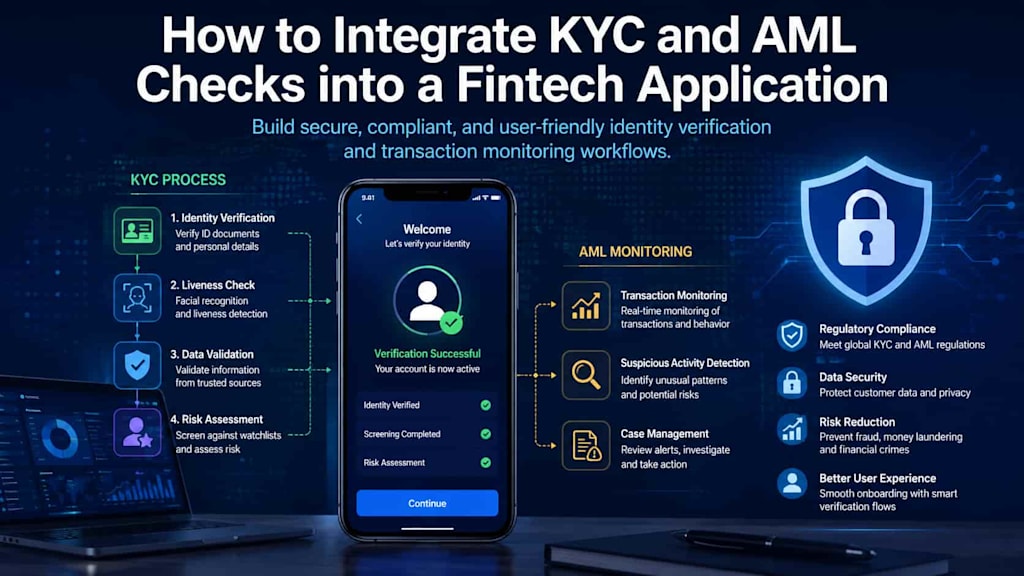
Fintech applications handle some of the most sensitive activities in the digital economy: opening accounts, transferring money, issuing loans, processing payments, trading digital assets, and managing investments. As a result, they are attractive targets for identity fraud, money laundering, account takeovers, and other forms of financial crime.
Know Your Customer (KYC) and Anti-Money Laundering (AML) controls are essential for reducing these risks. However, integrating them into a fintech application is not simply a matter of adding an identity verification form or connecting to a third-party API. A successful implementation requires careful planning around user onboarding, data security, risk assessment, workflow automation, transaction monitoring, and ongoing compliance.
This article explains how to integrate KYC and AML checks into a fintech application and build a scalable compliance architecture.
Understanding the Difference Between KYC and AML
Although KYC and AML are often discussed together, they serve different purposes.
KYC focuses primarily on establishing and verifying the identity of a customer. Depending on the type of fintech product and the applicable regulatory requirements, the process may include collecting personal information, verifying identity documents, performing biometric checks, confirming addresses, and screening customers against relevant lists.
AML has a broader scope. Its purpose is to identify and prevent financial activity associated with money laundering, terrorist financing, sanctions violations, fraud, and other financial crimes. AML processes can include customer risk assessment, sanctions screening, politically exposed person screening, transaction monitoring, suspicious activity detection, and ongoing customer reviews.
In practice, KYC is often one component of a broader AML framework. A fintech platform must first understand who its customers are before it can effectively assess whether their behavior or transactions represent an unacceptable level of risk.
Start with a Compliance and Risk Assessment
Before selecting an identity verification provider or building integrations, fintech companies should define their compliance requirements.
The exact requirements depend on several factors, including:
The countries and regions where the application operates
The types of financial services provided
The customer segments being served
Transaction volumes and values
Whether the platform handles cross-border payments
The level of exposure to high-risk industries or jurisdictions
Applicable licensing and regulatory obligations
A digital wallet used for low-value domestic payments may require a different verification flow than a cryptocurrency exchange or an international money transfer platform.
A risk-based approach helps organizations avoid treating every customer in exactly the same way. Low-risk users may complete a simplified onboarding process, while higher-risk customers can be subject to additional verification and enhanced due diligence.
This approach can improve both compliance efficiency and user experience.
Design the KYC Workflow Around the Customer Journey
KYC should be integrated into the overall product experience rather than treated as an isolated compliance process.
A typical digital KYC workflow may include the following steps:
Customer registration
Collection of personal information
Identity document submission
Document authenticity verification
Selfie or biometric verification
Liveness detection
Database or identity source checks
Sanctions and watchlist screening
Customer risk scoring
Account approval, rejection, or manual review
The order of these steps can vary depending on the product.
For example, a fintech application may allow users to create an account before completing full identity verification. However, certain features, such as withdrawing funds or exceeding a transaction threshold, can remain unavailable until the KYC process is completed.
This progressive approach can reduce onboarding friction while still allowing the company to apply appropriate controls before higher-risk activities take place.
Choose Between Third-Party Providers and In-House Development
Fintech companies generally have two options: build verification and monitoring capabilities internally or integrate specialized third-party services.
Building everything in-house provides greater control over the system, data flows, and user experience. However, developing reliable document verification, biometric matching, sanctions screening, and transaction monitoring capabilities requires significant expertise and continuous maintenance.
Third-party providers can offer APIs and SDKs for functions such as:
Identity document verification
Facial recognition
Liveness detection
Address verification
Sanctions screening
PEP screening
Adverse media checks
Business verification
Transaction monitoring
For many fintech companies, a hybrid architecture is the most practical solution. External providers perform specialized verification tasks, while the fintech application maintains its own orchestration layer, risk engine, customer profiles, audit records, and case management workflows.
When selecting AML compliance solutions, organizations should evaluate not only API functionality but also geographic coverage, data quality, response times, pricing models, scalability, security standards, and the provider's ability to support future regulatory requirements.
Build a Flexible Compliance Architecture
A scalable compliance system should avoid tightly coupling business logic to a specific third-party provider.
Instead, the application can use an abstraction layer between the fintech platform and external verification services.
For example, the architecture might include:
Frontend application: Collects customer information and verification materials.
API gateway: Handles secure communication between frontend services and backend systems.
KYC orchestration service: Controls verification workflows and provider interactions.
Customer profile service: Stores verified customer information and account status.
Risk engine: Calculates customer and transaction risk scores.
Screening service: Performs sanctions, PEP, and other relevant checks.
Transaction monitoring engine: Analyzes payment and behavioral activity.
Case management system: Supports manual investigations and compliance decisions.
Audit log: Records verification events, decisions, data changes, and user actions.
This modular approach makes it easier to replace providers, introduce new compliance tools, or adapt workflows when regulations change.
It also reduces the risk of having the entire application architecture dependent on a single vendor's API.
Integrate Identity Verification Securely
Identity verification involves highly sensitive personal data. Therefore, security and privacy must be considered from the beginning.
The application should use encrypted communication channels and strong authentication for all API interactions. Sensitive documents and biometric information should be protected both during transmission and at rest.
Access to KYC information should also follow the principle of least privilege. For example, a customer support employee may need to see the verification status but should not necessarily have access to the complete identity document.
Additional security measures may include:
Encryption of sensitive data
Tokenization where appropriate
Role-based access control
Multi-factor authentication for internal users
Secure secrets management
API request signing
Audit logging
Data retention policies
Automated deletion or anonymization processes where required
The company should also clearly understand where customer data is processed and stored, particularly when using international cloud infrastructure or external verification providers.
Add Customer Screening and Risk Scoring
Identity verification alone does not provide a complete picture of customer risk.
After a customer's identity has been established, the system may need to perform screening against relevant sanctions lists and identify whether the customer is a politically exposed person or associated with other higher-risk categories.
The results should not always trigger an automatic rejection.
For example, a potential name match may be a false positive. The system should therefore support matching confidence levels and escalation workflows for manual investigation.
Risk scoring can combine multiple factors, including:
Country of residence
Nationality
Customer type
Source of funds information
Occupation or business activity
PEP status
Sanctions screening results
Transaction behavior
Device and behavioral signals
Geographic transaction patterns
The resulting score can determine which controls apply to the customer.
A low-risk customer may be monitored through standard automated rules, while a higher-risk customer may require enhanced due diligence and more frequent reviews.
Implement Transaction Monitoring
KYC is primarily focused on establishing who the customer is. Transaction monitoring focuses on what happens after the account becomes active.
A transaction monitoring system can analyze events in real time or through scheduled batch processing.
Potentially suspicious patterns may include:
Unusually large transactions
Sudden increases in transaction frequency
Rapid movement of funds through multiple accounts
Repeated transactions just below reporting thresholds
Transactions involving high-risk jurisdictions
Activity inconsistent with the customer's expected profile
Multiple accounts connected through shared devices or other identifiers
A modern monitoring architecture should combine rules with risk scoring.
Simple rules remain useful because they are transparent and easier for compliance teams to review. More advanced analytics can supplement them by identifying unusual behavior that does not match predefined scenarios.
However, automated detection should not eliminate human oversight. High-risk alerts may require investigation by trained compliance personnel who can review customer history, supporting information, and the broader context of the activity.
Create Effective Manual Review and Case Management
Automation is essential for scaling a fintech platform, but some cases will require human decisions.
The system should provide compliance teams with a centralized interface for reviewing alerts and verification results. A case management workflow can include:
Alert creation
Assignment to an investigator
Collection of supporting information
Communication with the customer when appropriate
Investigation notes
Decision recording
Escalation procedures
Approval workflows
Complete audit trails
Manual reviewers should have access to the information needed to make a decision without exposing unnecessary customer data.
Consistency is also important. Clearly defined review procedures and decision criteria can help reduce differences between investigators and improve the quality of compliance operations.
Plan for Ongoing KYC and Continuous Monitoring
Customer verification should not be viewed as a one-time onboarding event.
A customer's risk profile can change over time. New sanctions may be introduced, a customer may become a politically exposed person, identity information may expire, or transaction behavior may change significantly.
For this reason, fintech applications should support ongoing monitoring.
This may include periodic rescreening, document expiration checks, event-based reviews, and risk reassessments triggered by changes in customer activity.
The frequency of reviews can depend on the customer's risk level. Higher-risk customers may require more frequent assessments than customers classified as low risk.
A continuous approach helps fintech companies maintain a more accurate understanding of their customer base throughout the business relationship.
Monitor Performance and Reduce False Positives
An ineffective compliance system can create unnecessary friction for legitimate users and overwhelm compliance teams with alerts.
Fintech companies should continuously measure metrics such as:
KYC completion rates
Verification failure rates
Average verification time
Manual review volumes
Alert volumes
False positive rates
Investigation times
Customer abandonment during onboarding
These metrics can reveal where workflows need improvement.
For example, a high abandonment rate at the document upload stage may indicate usability problems. An excessive number of sanctions screening alerts may suggest that matching thresholds need refinement.
The goal is not simply to generate more alerts. The goal is to identify meaningful risks while minimizing unnecessary friction and operational workload.
Conclusion
Integrating KYC and AML checks into a fintech application requires much more than connecting to an identity verification API. A successful solution combines customer onboarding, identity verification, screening, risk assessment, transaction monitoring, manual investigation, data protection, and continuous monitoring.
The most effective approach is to build a flexible compliance architecture that can adapt to new providers, products, customer segments, and regulatory requirements. By combining automation with human oversight and using a risk-based approach, fintech companies can improve their ability to detect financial crime without creating unnecessary obstacles for legitimate customers.
As fintech platforms continue to expand across markets and introduce new financial services, scalable KYC and AML infrastructure will remain a critical part of building secure, trustworthy, and sustainable digital financial products.
About the Creator
Chudovo
Chudovo is a custom software development company, focused on complex systems implementation.
Enjoyed the story? Support the Creator.
Subscribe for free to receive all their stories in your feed.
Comments
There are no comments for this story
Be the first to respond and start the conversation.