
How to Prioritize Features When Every Stakeholder Says Everything Is Urgent
A practical framework for balancing business goals, customer needs, and development capacity.

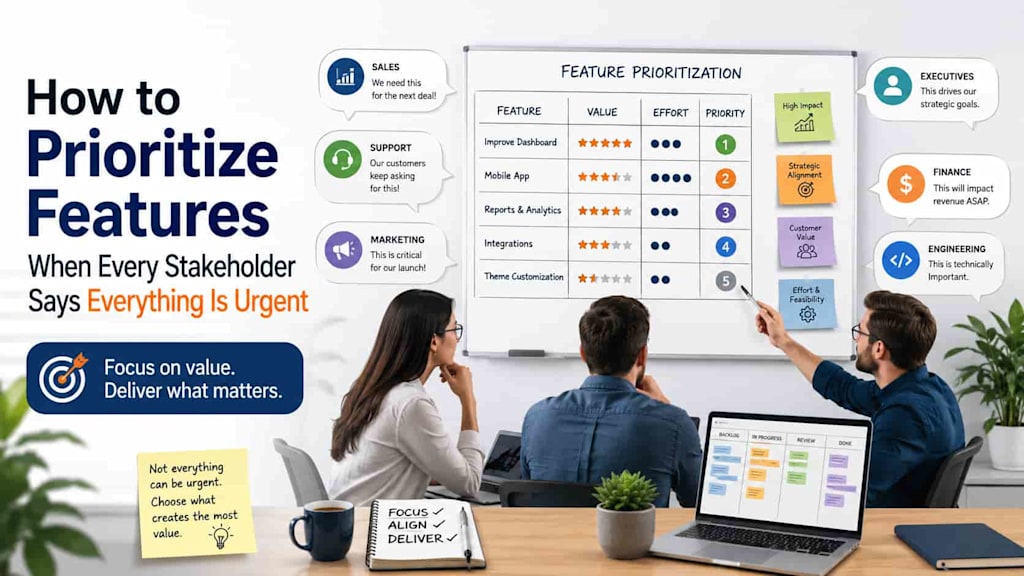
In almost every software project, there comes a moment when every stakeholder insists that their request is the highest priority. Sales teams need features to close deals, marketing wants functionality for upcoming campaigns, executives push strategic initiatives, customer support highlights recurring issues, and customers themselves expect rapid improvements. If every feature is considered urgent, teams quickly lose focus, deadlines become unpredictable, and product quality often suffers.
Successful product organizations understand that prioritization is not about saying "yes" to the loudest voice. Instead, it is about creating a transparent, repeatable process that aligns business objectives with customer value while respecting technical realities. Teams that master feature prioritization deliver more consistent results, reduce internal conflicts, and build products that achieve measurable outcomes.
This article explores practical techniques for prioritizing features when everyone believes their request should come first, along with strategies that improve communication, decision-making, and long-term product success.
Why Everything Feels Urgent
Urgency often reflects perspective rather than actual business importance. Every department views the product through a different lens.
Sales representatives naturally focus on opportunities that could increase revenue immediately. Customer support prioritizes reducing ticket volumes and improving user satisfaction. Marketing wants features that support launches and promotional campaigns. Engineering teams may advocate for technical improvements that reduce maintenance costs and improve scalability. Executive leadership often emphasizes strategic initiatives tied to broader company objectives.
None of these viewpoints are inherently wrong. The challenge arises when organizations lack a structured decision-making process. Without shared evaluation criteria, prioritization becomes a competition between personalities rather than an objective business exercise.
This is where strong project management best practices become essential. Instead of debating opinions, organizations should evaluate requests using agreed-upon metrics such as customer impact, business value, implementation effort, technical risk, and strategic alignment.
When everyone understands how priorities are determined, disagreements become more productive because discussions focus on evidence rather than influence.
Start With Business Objectives Before Features
One of the biggest prioritization mistakes is evaluating individual feature requests without considering larger organizational goals.
Every feature should answer a simple question:
"What business objective does this help achieve?"
Common objectives may include:
- Increasing customer retention
- Growing recurring revenue
- Reducing operational costs
- Improving product adoption
- Entering new markets
- Enhancing customer satisfaction
- Strengthening platform stability
When requests cannot be connected to measurable objectives, they become difficult to justify regardless of who requested them.
For example, imagine two competing feature requests:
- A dashboard enhancement requested by a major client.
- Backend performance improvements that reduce application response time by 40%.
Without context, choosing between them seems impossible.
However, if the company's primary objective is customer retention, performance improvements may benefit every customer rather than one account. If the objective is winning a strategic enterprise contract, the custom dashboard may become the higher priority.
Objectives provide context that transforms subjective decisions into strategic ones.
Create a Transparent Prioritization Framework
Consistency matters more than perfection.
Organizations should establish a scoring system that every stakeholder understands before prioritization meetings begin.
Typical evaluation criteria include:
- Customer impact
- Revenue potential
- Strategic alignment
- Development complexity
- Technical risk
- Time sensitivity
- Regulatory or compliance requirements
Assigning numerical values to each category helps remove emotional bias from discussions.
For example, a feature with moderate revenue impact but low implementation effort may rank above an ambitious initiative requiring six months of engineering resources.
The framework should also remain flexible. Market conditions change, customer expectations evolve, and competitive pressures emerge unexpectedly. A good prioritization model supports adaptation without abandoning consistency.
Documenting every decision further increases transparency. When stakeholders understand why requests were postponed, trust in the process improves significantly.
Separate "Urgent" From "Important"
Many organizations confuse urgency with importance.
Urgent work demands immediate attention, while important work delivers lasting value.
Examples of genuinely urgent work include:
- Critical security vulnerabilities
- Production outages
- Regulatory compliance deadlines
- Major customer-facing defects
Important but less urgent initiatives include:
- User experience improvements
- Platform modernization
- Performance optimization
- Technical debt reduction
- Accessibility enhancements
When everything enters the same priority queue, long-term improvements rarely receive attention because immediate requests continuously interrupt planned work.
Successful product teams intentionally reserve development capacity for strategic initiatives instead of allowing emergencies to dominate every sprint.
This balance prevents products from becoming increasingly difficult and expensive to maintain.
Use Data Instead of Opinions
The strongest prioritization discussions rely on measurable evidence.
Useful data sources include:
- Customer usage analytics
- Support ticket trends
- Feature adoption metrics
- Revenue reports
- Customer interviews
- Market research
- Product analytics
- Churn analysis
Suppose a stakeholder claims that a feature is "critical."
The next question should always be:
"What evidence supports this?"
Sometimes the answer reveals that only a handful of customers requested the feature. Other times, analytics show that thousands of users abandon an important workflow because of the missing functionality.
Objective evidence creates better conversations and reduces unnecessary conflict.
Organizations that consistently collect product metrics gain valuable insights for modern IT teams, enabling faster and more confident prioritization decisions.
Involve Stakeholders Without Giving Everyone Equal Voting Power
Inclusive collaboration is valuable, but consensus should not become the decision-making model.
Every stakeholder deserves an opportunity to explain business needs, customer concerns, or technical risks. However, final prioritization should remain the responsibility of clearly defined product leadership.
Without ownership, meetings often become lengthy negotiations where compromises satisfy nobody.
A practical approach includes:
- Gathering requests from every department.
- Evaluating each request using shared criteria.
- Reviewing trade-offs openly.
- Making final decisions through designated product owners or leadership.
Stakeholders are more likely to accept decisions when the process remains transparent, even if their preferred feature is postponed.
Communication is often more important than agreement.
Estimate Effort Early
Business value alone should never determine priority.
Implementation complexity matters.
Two features may generate similar customer value, but one may require three weeks while another needs six months.
Early engineering involvement helps product managers understand:
- Technical dependencies
- Infrastructure changes
- Security implications
- Testing requirements
- Integration complexity
- Maintenance costs
Simple effort estimation methods such as T-shirt sizing or story points allow product teams to compare opportunities more realistically.
Sometimes several smaller improvements deliver greater combined value than one large initiative consuming multiple quarters of development capacity.
These discussions become especially effective within mature Agile workflows, where iterative delivery enables continuous reassessment based on customer feedback.
Learn to Say "Not Now"
One of the hardest leadership skills is declining requests without damaging relationships.
Instead of saying:
"No."
Consider responses like:
- "This aligns with our roadmap for next quarter."
- "We'll revisit this after completing the current strategic initiative."
- "Additional customer validation is needed before prioritization."
- "Current business objectives place higher value on other initiatives."
These responses acknowledge stakeholder needs while reinforcing that prioritization follows organizational strategy rather than individual preference.
Maintaining a visible backlog also reassures stakeholders that rejected features have not been forgotten.
Balance Customer Requests With Product Vision
Listening to customers is essential, but product direction should not become entirely reactive.
Some customer requests solve isolated problems without benefiting the broader user base.
Great products emerge from balancing:
- Customer feedback
- Market trends
- Business strategy
- Technical sustainability
- Innovation opportunities
History offers countless examples of transformative products introducing capabilities customers never explicitly requested but quickly embraced.
Product leaders should therefore evaluate requests through the lens of long-term vision rather than immediate popularity.
Leverage AI Without Replacing Human Judgment
Artificial intelligence is becoming increasingly valuable during product planning.
Modern platforms can analyze customer feedback, cluster feature requests, identify recurring pain points, estimate implementation risks, summarize stakeholder discussions, and generate forecasting models.
Understanding the role of AI tools in software engineering helps organizations reduce manual analysis while improving consistency across prioritization decisions.
However, AI cannot fully replace experienced product managers.
Business context, competitive positioning, customer relationships, legal considerations, and organizational strategy require human judgment.
The most effective organizations combine AI-assisted analysis with experienced decision-makers who understand the broader business landscape.
Review Priorities Regularly
Prioritization is never a one-time exercise.
Markets evolve.
Competitors launch new products.
Customer expectations shift.
Technical constraints emerge.
Product teams should review priorities at predictable intervals—whether every sprint, monthly, or quarterly—to ensure roadmaps remain aligned with current business realities.
Regular reviews also provide opportunities to remove outdated requests that no longer support company objectives.
A dynamic roadmap reflects an adaptive organization rather than poor planning.
Regardless of industry or company size, every software development methodology benefits from periodic reassessment of priorities because business conditions rarely remain static for long.
Build a Culture That Values Trade-Offs
Healthy product organizations recognize that every "yes" is also a "no."
Choosing one feature inevitably delays another.
Instead of avoiding difficult conversations, successful teams openly discuss trade-offs.
Questions worth asking include:
- What customer problem does this solve?
- What happens if we delay this feature?
- What opportunity are we sacrificing by choosing this work?
- Is this request aligned with current strategic goals?
- How will success be measured?
These conversations shift attention away from urgency and toward value creation.
Over time, organizations that embrace disciplined prioritization experience better planning accuracy, stronger stakeholder trust, higher product quality, and improved customer satisfaction.
Conclusion
When every stakeholder claims that everything is urgent, prioritization becomes less about choosing features and more about choosing the future direction of the product. Effective teams avoid reacting to the loudest voices by relying on transparent frameworks, measurable business objectives, customer evidence, engineering input, and continuous evaluation.
Successful prioritization is built on consistency rather than perfection. Organizations that establish clear decision-making processes create stronger alignment across departments, reduce conflict, and deliver products that provide lasting value for both customers and the business. By combining structured evaluation methods, collaborative communication, data-driven insights, and modern technologies, product leaders can confidently navigate competing demands while maintaining focus on long-term success.
About the Creator
Markus Koch
I am a professional IT consultant with 5+ years of experience.
Enjoyed the story? Support the Creator.
Subscribe for free to receive all their stories in your feed.
Comments
There are no comments for this story
Be the first to respond and start the conversation.