
How to Choose the Right Software Development Methodology in 2026
A practical guide to selecting the best development approach for modern software projects

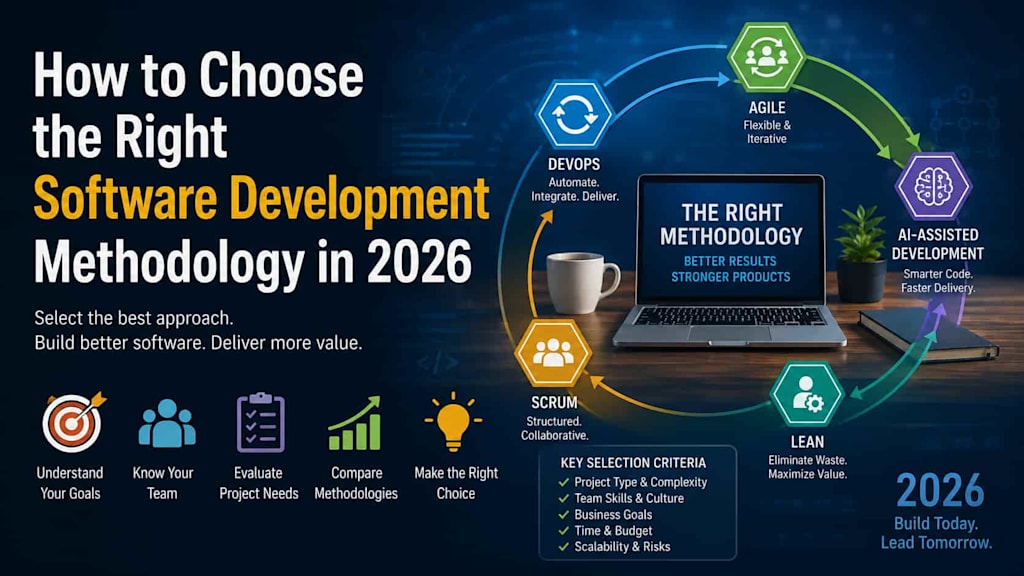
The software industry continues to evolve at a remarkable pace. Organizations in 2026 face increasing pressure to deliver high-quality products faster, adapt to changing customer expectations, integrate artificial intelligence, and remain competitive in a highly dynamic market. As a result, selecting the right software development methodology has become more important than ever.
A methodology influences how teams collaborate, plan, build, test, deploy, and maintain software products. Choosing the wrong approach can lead to delays, budget overruns, poor communication, and reduced product quality. Conversely, selecting a methodology that aligns with business goals, team structure, and project requirements can significantly improve productivity and customer satisfaction.
Today’s development landscape includes Agile frameworks, DevOps practices, Lean principles, AI-assisted workflows, and hybrid approaches that combine elements of multiple methodologies. Understanding the strengths and limitations of each model is essential for making informed decisions.
Understanding Modern Development Methodologies and Their Core Principles
Before selecting a methodology, organizations must understand the fundamental concepts behind today's development approaches. The types and principles of modern software development are largely focused on flexibility, continuous improvement, customer-centricity, and rapid delivery.
Historically, software projects often followed rigid sequential models such as Waterfall. While these approaches provided clear documentation and predictable planning, they struggled to accommodate changing requirements. Modern methodologies emerged to address these limitations.
The traditional SDLC (Software Development Life Cycle) remains the foundation of software engineering. However, modern methodologies interpret and implement SDLC phases differently. Requirements gathering, design, development, testing, deployment, and maintenance still exist, but many frameworks execute these stages iteratively rather than sequentially.
Several key principles dominate contemporary development:
- Continuous delivery of customer value
- Frequent feedback loops
- Cross-functional collaboration
- Automated testing and deployment
- Adaptability to changing requirements
- Data-driven decision-making
- Incremental product improvement
In 2026, organizations are increasingly combining methodologies rather than relying on a single framework. The emphasis has shifted from strict adherence to predefined rules toward selecting practices that best support business objectives and technical realities.
Successful teams focus less on methodology labels and more on creating an effective software development process that enables sustainable delivery and innovation.
Agile, Scrum, and Lean: Choosing the Right Iterative Approach
Agile remains one of the most widely adopted methodologies worldwide. However, many organizations continue to confuse Agile with Scrum, despite important distinctions between the two.
The debate surrounding Agile vs Scrum is common among development leaders evaluating project management approaches. Agile is a broader philosophy based on the Agile Manifesto, emphasizing adaptability, collaboration, and customer feedback. Scrum, by contrast, is a specific framework that implements Agile principles through defined roles, ceremonies, and iterative sprints.
Agile works particularly well for:
- Rapidly changing requirements
- Customer-driven products
- Startups and innovative businesses
- Projects requiring frequent releases
- Teams that benefit from flexibility
Scrum provides additional structure through:
- Product Owners
- Scrum Masters
- Sprint planning
- Daily standups
- Sprint reviews
- Retrospectives
Organizations that need more governance and predictable delivery cycles often find Scrum easier to implement than Agile principles alone.
Lean development offers another alternative. Originating from manufacturing concepts, Lean focuses on eliminating waste and maximizing customer value. Teams continuously analyze workflows to identify inefficiencies, unnecessary processes, and bottlenecks.
Lean is particularly effective when organizations aim to:
- Reduce development costs
- Improve operational efficiency
- Accelerate delivery times
- Eliminate unnecessary work
- Optimize resource allocation
Many successful companies now combine Agile and Lean principles to create highly adaptive development environments. This hybrid approach helps teams maintain flexibility while continuously improving efficiency.
The key is understanding organizational maturity. Highly experienced teams may thrive with lightweight Agile practices, while less experienced teams often benefit from the structure provided by Scrum.
The Rise of DevOps and AI-Assisted Development
Software delivery in 2026 extends far beyond coding. Development and operations are now deeply interconnected, making DevOps a critical component of modern software delivery strategies.
DevOps is not merely a methodology but a cultural and technical movement that promotes collaboration between development, operations, quality assurance, and security teams. Its primary objective is to accelerate software delivery while maintaining reliability and quality.
Key DevOps practices include:
- Continuous Integration (CI)
- Continuous Delivery (CD)
- Infrastructure as Code (IaC)
- Automated testing
- Monitoring and observability
- Automated security checks
- Cloud-native deployment
Organizations adopting DevOps typically experience shorter release cycles, improved system stability, and faster recovery from failures.
One of the most significant developments shaping the industry is AI-assisted development. Artificial intelligence tools now support nearly every phase of the development lifecycle.
AI can help with:
- Code generation
- Automated testing
- Bug detection
- Documentation creation
- Code reviews
- Project estimation
- Requirement analysis
These capabilities are among the most influential progressive IT trends in 2026, fundamentally changing how software teams operate.
However, AI-assisted development does not eliminate the need for sound methodologies. Instead, it enhances existing processes by automating repetitive tasks and improving developer productivity.
Organizations should view AI as a force multiplier rather than a replacement for established development practices. Teams still require governance, architectural oversight, quality assurance, and strategic planning.
The most successful organizations combine Agile principles, DevOps automation, and AI-enhanced workflows to create highly efficient delivery ecosystems.
Matching Methodologies to Different Project Types
Selecting a methodology should always begin with project analysis rather than industry trends.
Different projects have different needs, constraints, and risk profiles. A methodology that performs exceptionally well in one environment may fail in another.
For startup products and innovation-driven initiatives, Agile approaches are often ideal. These projects typically involve uncertainty, evolving customer feedback, and rapid market changes. Frequent iterations allow teams to adjust priorities quickly.
Enterprise software projects frequently benefit from Scrum combined with DevOps practices. The additional structure helps coordinate larger teams while maintaining iterative delivery.
Projects involving strict regulatory requirements, such as healthcare, finance, or government systems, may require hybrid approaches that combine Agile flexibility with more rigorous documentation and governance controls.
Large-scale digital transformation initiatives often benefit from scaled Agile frameworks supported by extensive DevOps automation.
When evaluating methodologies, organizations should consider:
- Project complexity
- Team size
- Stakeholder involvement
- Regulatory requirements
- Budget constraints
- Technical risk
- Time-to-market expectations
- Product lifecycle length
Methodology selection should also align with broader business goals. Companies seeking rapid growth often prioritize adaptability, while organizations focused on operational stability may emphasize predictability and governance.
The most effective efficient IT strategies are those that align technology delivery methods with business objectives rather than blindly following industry trends.
Additional Considerations: SEO, Business Goals, and Long-Term Scalability
Many modern software projects directly support digital marketing, e-commerce, and online customer acquisition initiatives. Consequently, methodology selection can indirectly influence business performance beyond software delivery itself.
For organizations building web platforms, mobile applications, or digital products, SEO concerns should be integrated into planning and prioritization processes. Agile methodologies often facilitate ongoing SEO improvements because teams can continuously refine technical performance, site architecture, user experience, and content optimization.
Scalability is another important consideration. Methodologies should support not only current requirements but also future growth. As organizations expand, development practices must evolve accordingly.
Key scalability factors include:
- Team expansion
- Increased deployment frequency
- Growing infrastructure complexity
- Security requirements
- Customer growth
- Data volume increases
Organizations should also evaluate cultural readiness. A methodology succeeds only when supported by leadership, team members, and organizational processes.
Training requirements, communication practices, and management expectations should all be considered before implementing significant methodological changes.
Ultimately, no single methodology is universally superior. The best choice depends on balancing technical requirements, business objectives, organizational culture, and long-term strategic goals.
Conclusion
Software developers in their careers for sure have worked with Agile, making it one of the most familiar and influential approaches in modern software delivery.
Choosing the right software development methodology in 2026 requires a thoughtful assessment of project requirements, team capabilities, business priorities, and emerging technologies. While Agile, Scrum, Lean, DevOps, and AI-assisted development each offer unique advantages, their effectiveness depends on how well they align with organizational needs.
Modern software delivery increasingly relies on hybrid approaches that combine the flexibility of Agile, the efficiency of Lean, the automation of DevOps, and the productivity gains provided by artificial intelligence. Rather than searching for a perfect methodology, organizations should focus on building adaptable processes that support continuous improvement and customer value.
By carefully evaluating project complexity, regulatory requirements, scalability needs, and strategic objectives, businesses can establish development practices that enhance productivity, reduce risk, and position them for long-term success in an increasingly competitive digital landscape.
About the Creator
Markus Koch
I am a professional IT consultant with 5+ years of experience.
Enjoyed the story? Support the Creator.
Subscribe for free to receive all their stories in your feed.
Comments
There are no comments for this story
Be the first to respond and start the conversation.