
How to Build a Career Roadmap from Developer to Software Architect
A practical guide to growing from coding specialist to strategic technology leader

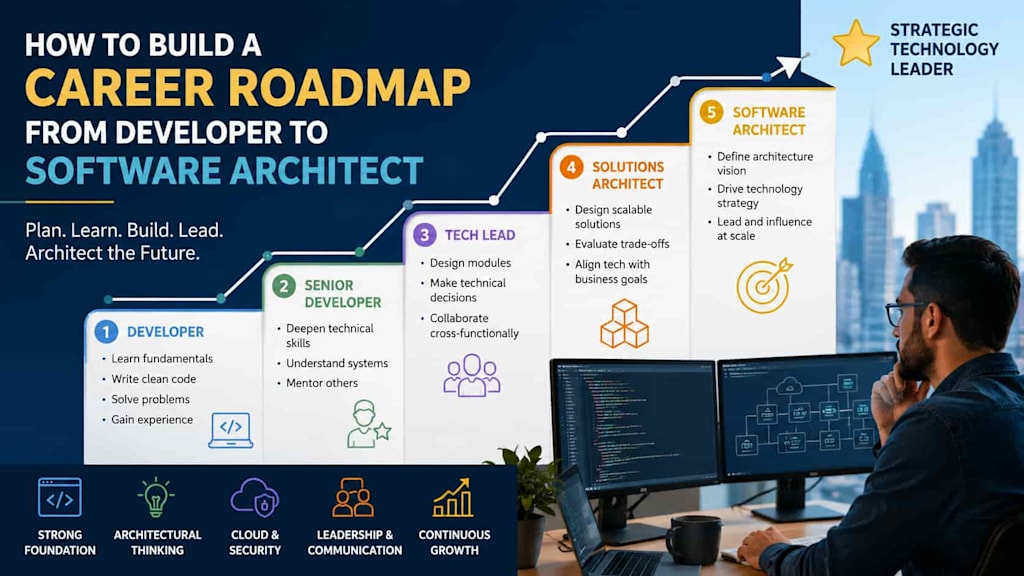
Software development offers multiple career paths, but one of the most rewarding journeys is progressing from developer to software architect. While developers focus primarily on implementing features and solving technical problems, software architects are responsible for designing systems, making strategic technology decisions, and ensuring long-term scalability and maintainability.
The transition does not happen overnight. It requires a combination of technical expertise, business understanding, communication skills, and architectural thinking. As technology ecosystems become increasingly complex, organizations need professionals who can bridge the gap between business requirements and technical implementation.
This article outlines a practical roadmap that developers can follow to grow into software architects and build a sustainable, long-term career in technology.
Build a Strong Technical Foundation
Every successful software architect begins as a skilled developer. Before focusing on architecture, professionals should establish deep expertise in software engineering fundamentals.
Strong architects understand programming languages, development frameworks, databases, networking principles, operating systems, and software development methodologies. They know not only how systems work but also why specific technologies are chosen.
Developers aspiring to become architects should gain experience in multiple areas rather than specializing too narrowly. Exposure to backend development, frontend applications, databases, APIs, cloud platforms, and DevOps practices creates a broader perspective that becomes invaluable later.
At this stage, one of the most important career best practices for software developers is to continuously expand technical knowledge beyond daily project requirements. Reading technical books, contributing to open-source projects, participating in architecture discussions, and experimenting with emerging technologies all help build a stronger foundation.
It is equally important to understand software quality principles such as testing strategies, maintainability, code reviews, and refactoring techniques. Architects are expected to make decisions that affect entire systems, so a solid engineering background is essential.
Developers should also learn how business goals influence technical decisions. The ability to connect software solutions to organizational objectives becomes increasingly important as responsibilities grow.
Master Software Architecture Principles
The transition from senior developer to architect begins when professionals start thinking beyond individual features and components.
Software architects focus on system-level design. They evaluate trade-offs, identify risks, and ensure that solutions can evolve as business needs change.
A crucial area of study is software architecture and design patterns. Understanding architectural styles such as monolithic systems, microservices, event-driven architectures, service-oriented architectures, and domain-driven design helps developers evaluate different approaches to system design.
Design patterns provide proven solutions to recurring software problems. Familiarity with patterns such as Factory, Strategy, Observer, Repository, and Dependency Injection improves architectural decision-making and system maintainability.
Developers should also become comfortable creating architectural documentation. Diagrams, technical specifications, decision records, and system maps help communicate complex concepts across teams.
Learning to evaluate non-functional requirements is another critical step. Scalability, reliability, maintainability, availability, and security often determine architectural choices more than functional requirements.
Architects must be able to answer questions such as:
- How will the system handle growth?
- What happens during failures?
- How will components communicate?
- How can future changes be accommodated?
- What are the long-term operational costs?
These considerations distinguish architectural thinking from traditional software development.
Expand Your Knowledge of Cloud and Security
Modern software architecture is increasingly cloud-centric. Organizations across industries rely on cloud platforms to accelerate development, improve scalability, and optimize infrastructure costs.
Future architects should gain hands-on experience with major cloud providers such as Amazon Web Services (AWS), Microsoft Azure, and Google Cloud Platform (GCP). Understanding cloud services, deployment models, containerization, orchestration, and infrastructure automation is becoming a standard requirement.
Equally important is learning cloud security best practices for developers. Security can no longer be treated as a separate concern managed exclusively by security teams. Architects must integrate security into every layer of system design.
Key security topics include:
- Identity and access management
- Authentication and authorization
- Encryption in transit and at rest
- Secure API design
- Network segmentation
- Vulnerability management
- Compliance requirements
Architects are often responsible for balancing business requirements with technical constraints while ensuring systems remain secure.
At the same time, they must evaluate various performance and security aspects when designing large-scale applications. Decisions involving caching, database optimization, load balancing, monitoring, and fault tolerance all have significant architectural implications.
Developers who actively participate in cloud migrations, infrastructure modernization projects, and security initiatives gain valuable experience that supports their architectural growth.
Develop Leadership and Communication Skills
Technical expertise alone is not enough to become a successful software architect. Communication and leadership abilities are equally important.
Architects frequently collaborate with developers, project managers, executives, business stakeholders, product owners, security teams, and operations personnel. They must translate technical concepts into language that different audiences can understand.
One of the most significant career shifts occurs when developers move from solving problems individually to enabling others to solve problems effectively.
Future architects should seek opportunities to:
- Mentor junior developers
- Lead technical discussions
- Present architectural proposals
- Participate in project planning
- Facilitate cross-functional collaboration
- Conduct design reviews
Leadership does not necessarily require formal management responsibilities. Technical leadership often involves influencing decisions through expertise, credibility, and effective communication.
Architects must also become comfortable making decisions under uncertainty. Not every architectural choice has a perfect solution. Many decisions involve trade-offs between cost, complexity, scalability, speed, and risk.
Developing business awareness is another critical skill. Architects who understand organizational goals can design solutions that provide measurable business value rather than focusing solely on technical elegance.
Adapt to Industry Transformation and Continuous Learning
Technology evolves rapidly, and software architecture evolves with it. Successful architects remain lifelong learners.
Organizations today are rethinking software delivery, team structures, cloud adoption strategies, and development workflows. Understanding how modern teams are transforming helps architects design systems that support new ways of working.
Several trends continue to influence architectural roles:
- AI-assisted software development
- Platform engineering
- Cloud-native architectures
- DevSecOps practices
- Event-driven systems
- Edge computing
- Low-code and automation platforms
- Data-driven decision-making
Future architects should stay informed through technical conferences, architecture communities, certification programs, industry publications, and professional networks.
Building a portfolio of architectural experience is equally important. Participating in system redesigns, cloud migrations, modernization initiatives, and scalability projects provides practical evidence of architectural capability.
Many organizations also value certifications in cloud platforms, security, enterprise architecture, and project management. While certifications alone do not create architects, they can strengthen professional credibility and demonstrate commitment to continuous learning.
Over time, developers should gradually expand their influence from individual components to entire systems, from technical implementation to strategic decision-making, and from personal productivity to organizational impact.
Conclusion
The journey from developer to software architect is a gradual process that combines technical mastery, architectural knowledge, cloud expertise, leadership skills, and continuous learning. While there is no single path that guarantees success, developers who consistently broaden their perspective beyond coding tasks position themselves for long-term growth.
By building a strong engineering foundation, mastering architecture principles, embracing cloud technologies and security practices, developing communication skills, and adapting to industry changes, professionals can successfully transition into architectural roles. The most effective software architects are not simply technical experts—they are strategic thinkers who align technology decisions with business objectives and help organizations build systems that can thrive in an evolving digital landscape.
About the Creator
Markus Koch
I am a professional IT consultant with 5+ years of experience.
Enjoyed the story? Support the Creator.
Subscribe for free to receive all their stories in your feed.
Comments
There are no comments for this story
Be the first to respond and start the conversation.