
How to Modernize Legacy Correctional Healthcare Software Without Downtime
Practical strategies for upgrading mission-critical healthcare platforms while maintaining uninterrupted operations.

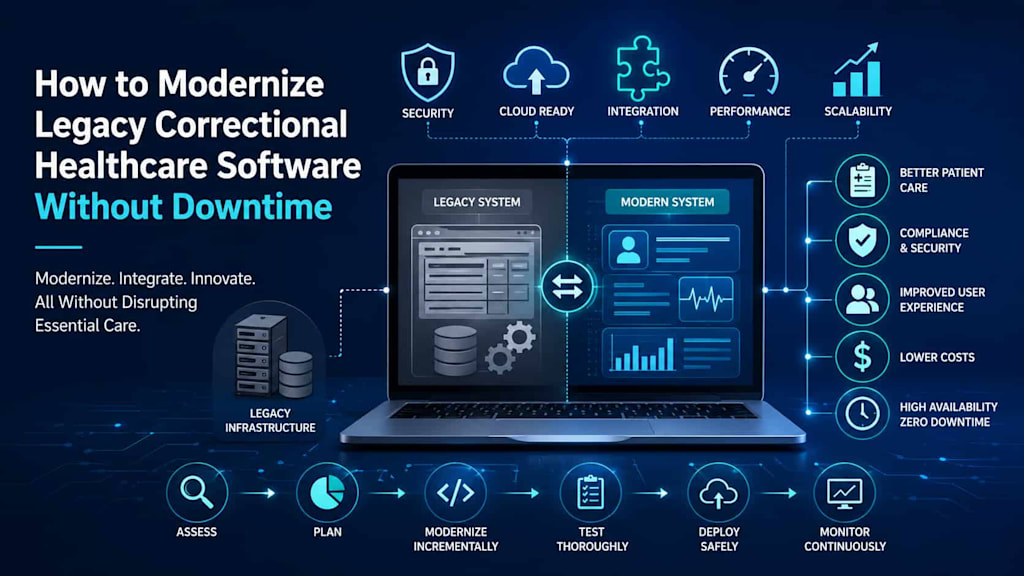
Modernizing mission-critical healthcare systems is one of the most challenging technology initiatives any organization can undertake. Facilities that provide medical services within secure environments often depend on software that has evolved over decades. While these systems continue to support daily operations, they frequently rely on aging architectures, outdated programming languages, and infrastructure that is increasingly difficult to maintain.
The challenge is not simply replacing old technology. These platforms manage sensitive medical records, medication schedules, appointment coordination, compliance documentation, reporting, and countless operational workflows. Even a brief outage can disrupt healthcare delivery, create administrative bottlenecks, and increase operational risks.
As regulations evolve and digital healthcare standards continue to advance, organizations face growing pressure to improve system security, performance, interoperability, and scalability. However, many decision-makers hesitate because they fear downtime, data loss, or costly implementation failures.
Fortunately, modernization no longer requires shutting down an entire platform or rebuilding everything from scratch. With the right strategy, organizations can gradually transform legacy applications while keeping essential services fully operational.
Why Legacy Healthcare Systems Become a Liability
Many healthcare applications currently in production were designed years before cloud computing, mobile access, API-driven integrations, and modern cybersecurity practices became standard. Over time, these systems accumulate technical debt that becomes increasingly expensive to manage.
Common problems include:
Slow performance caused by aging infrastructure.
Limited integration with newer healthcare technologies.
High maintenance costs.
Difficulty recruiting developers familiar with outdated programming languages.
Increased cybersecurity vulnerabilities.
Complex deployment processes.
Limited scalability as organizational needs grow.
Despite these challenges, many organizations postpone modernization because the existing software still "works." Unfortunately, waiting often increases both technical complexity and financial risk.
Downtime Is the Biggest Concern
For organizations providing continuous healthcare services, downtime is not simply an inconvenience.
Medical professionals rely on uninterrupted access to patient histories, treatment plans, medication records, laboratory results, and scheduling information. Administrative teams also depend on these systems for documentation, reporting, inventory management, and compliance tracking.
Any interruption can create cascading operational issues that affect multiple departments simultaneously.
This is why modernization strategies today focus on incremental transformation rather than complete replacement.
Understanding Modernization Versus Migration
One of the most common misconceptions is that modernization always means moving an application to a different environment. In reality, these are separate concepts with different goals.
Understanding legacy modernization vs. legacy migration helps organizations make better strategic decisions.
Migration typically involves transferring an application from one environment to another, such as moving from on-premises infrastructure to the cloud. The application's core architecture often remains largely unchanged.
Modernization, on the other hand, improves the application's architecture, codebase, security model, integrations, user experience, and maintainability. It may include migration, but it extends far beyond relocating infrastructure.
Choosing the right approach depends on business goals, available resources, regulatory requirements, and the current condition of the software.
Assess Before Making Changes
Successful modernization begins with a comprehensive assessment rather than immediate development.
Organizations should document:
Existing business processes.
Software dependencies.
Infrastructure components.
Security vulnerabilities.
Third-party integrations.
Database architecture.
User workflows.
Compliance requirements.
Performance bottlenecks.
This discovery phase often reveals hidden risks that would otherwise emerge during implementation.
A detailed software inventory also helps identify which components should be modernized first.
Prioritize High-Value Components
Attempting to replace an entire application in one project significantly increases risk.
Instead, organizations should identify modules that provide the highest return on investment.
Examples include:
Authentication services
Reporting engines
Appointment scheduling
Notifications
Data integration services
Analytics dashboards
Document management
Modernizing one component at a time allows teams to validate improvements without disrupting critical operations.
Use a Strangler Pattern Approach
One of the safest modernization strategies is the Strangler Pattern.
Rather than replacing the entire system immediately, new functionality is gradually introduced alongside the existing application.
As each new module becomes stable, the corresponding legacy component is retired.
Benefits include:
Minimal operational disruption.
Continuous validation.
Lower implementation risk.
Easier rollback if problems occur.
Faster delivery of business value.
Over time, the original application becomes progressively smaller until it can be completely retired.
Introduce APIs Before Rewriting Code
Many older applications were designed as monolithic systems with tightly coupled components.
Creating an API layer around existing functionality enables gradual modernization without immediately rewriting business logic.
API-first modernization provides several advantages:
Easier integration with modern healthcare platforms.
Better security controls.
Simplified mobile application development.
Support for cloud-native services.
Greater flexibility for future enhancements.
APIs also reduce dependencies between new and legacy components.
Modernize Databases Carefully
Database modernization often represents the highest-risk portion of any transformation initiative.
Healthcare databases typically contain years of patient information, audit logs, medication records, historical reports, and regulatory documentation.
Rather than performing one massive migration, organizations should consider:
Data replication
Incremental synchronization
Read replicas
Parallel databases
Continuous validation
Running old and new databases simultaneously during transition minimizes operational risk.
Implement Continuous Data Synchronization
One effective approach to avoiding downtime is maintaining synchronization between legacy and modern systems throughout the transition.
Whenever data changes in one environment, those updates are replicated to the other.
This enables:
Live testing.
Gradual user adoption.
Immediate rollback if necessary.
Reduced migration windows.
Improved confidence before final cutover.
Synchronization technologies have become increasingly reliable, making phased deployments much more practical.
Adopt Cloud Services Selectively
Cloud adoption does not require moving every application at once.
Organizations often begin by migrating supporting services such as:
Backup systems
Reporting platforms
Analytics
Notification services
Disaster recovery
Identity management
Gradually expanding cloud adoption allows technical teams to build expertise while minimizing disruption.
Strengthen Cybersecurity Throughout the Process
Modernization creates an ideal opportunity to improve security.
Instead of simply recreating existing vulnerabilities within a newer environment, organizations should incorporate:
Multi-factor authentication
Zero Trust principles
Encryption at rest
Encryption in transit
Role-based access controls
Security monitoring
Automated patch management
Centralized logging
Security improvements should be integrated into every modernization phase rather than treated as a separate project.
Automate Testing
Manual testing alone cannot adequately validate a complex healthcare platform.
Automated testing should cover:
Functional workflows.
API behavior.
Database consistency.
Performance.
Security.
User interface stability.
Regression testing.
Continuous testing enables development teams to deploy updates with significantly greater confidence.
Deploy Using Blue-Green or Canary Strategies
Modern deployment techniques greatly reduce implementation risk.
Blue-Green deployments involve maintaining two production environments.
One environment handles live traffic while the second receives updates.
After validation, traffic switches to the updated environment almost instantly.
Canary deployments take a different approach by releasing updates to a small percentage of users before expanding availability.
Both strategies reduce the likelihood of widespread disruption.
Train Users Before Full Deployment
Technology modernization is not solely a technical initiative.
Staff members must understand new workflows before large-scale implementation.
Training should include:
Interactive demonstrations.
Practice environments.
Updated documentation.
Frequently asked questions.
Role-specific guidance.
Early user involvement often uncovers usability improvements before organization-wide deployment.
Monitor Everything in Real Time
Visibility is essential during modernization.
Organizations should continuously monitor:
Application performance.
Infrastructure health.
Database activity.
Error rates.
Response times.
Security events.
User behavior.
Integration status.
Comprehensive monitoring enables rapid issue detection before users experience significant problems.
Maintain Compliance Throughout Every Phase
Healthcare environments operate under strict regulatory requirements.
Modernization efforts should preserve:
Audit trails.
Data integrity.
Record retention.
Access controls.
Privacy protections.
Reporting accuracy.
Compliance teams should participate throughout the project rather than reviewing the finished solution after deployment.
Plan for Rollback
Even the best-planned modernization projects may encounter unexpected issues.
Every deployment should include a documented rollback procedure.
Rollback planning includes:
Database recovery procedures.
Configuration backups.
Infrastructure snapshots.
Automated deployment reversal.
Communication plans.
Validation checklists.
A reliable rollback strategy reduces deployment anxiety and enables faster decision-making.
Build for Future Adaptability
Modernization should not simply replace old technology with newer technology that will become outdated in a few years.
Organizations should design systems that support continuous evolution through:
Modular architecture.
Containerization.
Microservices where appropriate.
API-driven integrations.
Infrastructure as code.
Continuous integration and continuous deployment (CI/CD).
Automated monitoring.
Scalable cloud infrastructure.
These architectural principles make future enhancements faster, safer, and less expensive.
A modern platform also improves resilience by allowing individual components to evolve independently rather than requiring organization-wide upgrades.
The result is a software ecosystem that remains adaptable as healthcare regulations, technologies, and operational requirements continue to change.
For organizations relying on correctional healthcare software, this long-term flexibility is particularly valuable because it supports evolving clinical workflows, stronger cybersecurity, and seamless integration with future digital health solutions without requiring disruptive system replacements.
Conclusion
Modernizing legacy healthcare software no longer requires lengthy outages or risky "big bang" implementations. By adopting incremental modernization strategies, introducing APIs, synchronizing data, automating testing, strengthening cybersecurity, and deploying changes gradually, organizations can significantly reduce operational risk while improving system performance and reliability.
Success depends on careful planning, continuous monitoring, and a commitment to gradual transformation rather than complete replacement. With a phased approach, organizations can modernize mission-critical healthcare platforms while maintaining uninterrupted services, protecting sensitive data, and preparing their technology infrastructure for future innovation.
About the Creator
Chudovo
Chudovo is a custom software development company, focused on complex systems implementation.
Enjoyed the story? Support the Creator.
Subscribe for free to receive all their stories in your feed.
Comments
There are no comments for this story
Be the first to respond and start the conversation.