
How to Modernize a Hosting Platform Without Disrupting Operations
A practical approach to evolving hosting infrastructure while protecting uptime, customer experience, and business continuity.

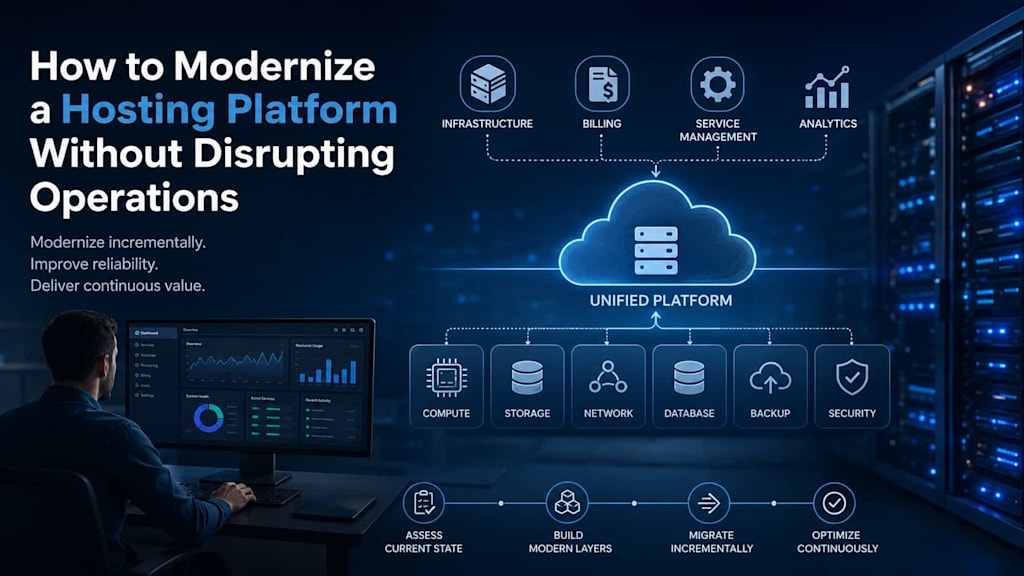
Modernizing a hosting platform is rarely as simple as replacing outdated infrastructure with newer technology. Hosting providers operate systems where availability, predictable performance, customer isolation, billing accuracy, and operational continuity are closely connected. A poorly planned migration can affect thousands of tenants, interrupt workloads, create billing inconsistencies, or introduce new operational complexity.
The goal of modernization should therefore not be to rebuild everything at once. Instead, providers should evolve the platform incrementally, introducing better infrastructure, automation, observability, and service management while keeping existing workloads stable.
Start With the Platform's Current Architecture
Before changing infrastructure, organizations need a clear picture of how the existing hosting environment actually works. Mature platforms often contain years of accumulated integrations, scripts, provisioning workflows, custom configurations, and dependencies.
Documentation may describe the intended architecture, while production behavior reflects something considerably more complicated.
A modernization initiative should begin with an inventory of:
Hosting products and service tiers
Customer and tenant structures
Compute, storage, and networking resources
Provisioning and deprovisioning workflows
Billing and subscription integrations
Monitoring and alerting systems
Identity and access management
Infrastructure APIs
Backup and disaster recovery mechanisms
External provider dependencies
This assessment helps identify which components are business-critical, which can be replaced, and which should remain untouched during the first stages of modernization.
Modernize Around Stable Platform Boundaries
One of the most important architectural decisions is defining clear boundaries between tenants, infrastructure resources, services, and platform management functions. These boundaries should support current customers while leaving room for future growth.
A scalable hosting architecture should design tenant boundaries that remain manageable as the platform grows. Tenant isolation can be implemented through separate resource pools, namespaces, accounts, networks, projects, or combinations of these approaches depending on the underlying infrastructure.
However, isolation is not only a security concern. It also affects quotas, billing, monitoring, access control, support operations, and resource allocation.
The platform should make tenant ownership explicit and enforce it consistently across APIs and internal services. This prevents individual infrastructure components from developing their own interpretations of customer boundaries.
Introduce a Unified Control Plane
Legacy hosting environments frequently manage infrastructure through multiple disconnected systems. A customer might purchase a service through one system, have resources provisioned through another, and receive invoices from a third. Operations teams then need separate tools to monitor and troubleshoot each layer.
A modern control plane can provide a common management layer above the underlying infrastructure.
The objective is to bring infrastructure, billing, and service management under one platform without necessarily replacing every underlying system. The control plane can coordinate provisioning, subscription changes, resource allocation, usage collection, monitoring, and lifecycle operations through standardized APIs.
This approach creates an abstraction between customer-facing services and the infrastructure used to deliver them. It also gives operations teams a single place to understand what customers own, what resources are running, and how those resources relate to commercial services.
Decouple the Core From Infrastructure Providers
Hosting companies often support multiple infrastructure technologies or gradually migrate from one provider to another. Problems arise when provider-specific concepts become deeply embedded in the platform's core logic.
For example, application code might directly depend on a particular provider's networking model, storage terminology, identity system, or API behavior. Such dependencies make future migrations increasingly expensive.
A better architecture should remove provider-specific assumptions from the platform core. Infrastructure adapters or service-specific integration layers can translate generic platform operations into provider-specific API calls.
For example, the platform might expose generic operations such as:
Create virtual machine
Allocate storage
Create network
Configure firewall
Attach volume
Collect usage metrics
Individual infrastructure adapters can then implement these operations for different providers or technologies.
This design makes it possible to introduce new infrastructure without rewriting the customer, billing, or orchestration layers.
Modernize Incrementally Rather Than Rebuilding Everything
A complete replacement may appear attractive because it promises a clean architecture. In production hosting environments, however, a big-bang migration creates significant operational risk.
A safer strategy is the strangler approach: build modern capabilities around existing systems and gradually move workloads from the old architecture to the new one.
For example, a provider might modernize the platform in the following sequence:
Introduce a unified API layer.
Centralize identity and authorization.
Add automated infrastructure provisioning.
Standardize monitoring and logging.
Integrate billing and usage data.
Migrate selected services to the new orchestration layer.
Retire legacy components only after their workloads have moved.
This approach allows teams to validate every architectural change against real workloads before expanding it across the platform.
Use Automation to Reduce Operational Risk
Manual operations become increasingly dangerous as a hosting platform grows. Creating resources manually, modifying configurations through administrative consoles, or relying on undocumented scripts introduces inconsistency and makes troubleshooting harder.
Infrastructure as Code, automated provisioning, configuration management, and CI/CD pipelines can turn infrastructure changes into repeatable processes.
Automation should cover the entire service lifecycle, including provisioning, scaling, configuration changes, backups, upgrades, suspension, and decommissioning.
Importantly, automation should include validation and rollback mechanisms. A platform modernization project should make it easier—not harder—to reverse a problematic deployment.
Build for Extensibility
Modern hosting platforms rarely remain static. Customers may demand new compute configurations, additional storage options, managed databases, container platforms, edge capabilities, or new security services.
The architecture should therefore expand hosting capabilities without rebuilding the entire platform.
This requires modular service definitions and well-designed APIs. New capabilities should be introduced as platform services or modules rather than requiring changes throughout the entire system.
Event-driven architecture can also help. For example, a subscription event could trigger provisioning, while a resource event could update monitoring and billing systems automatically. This reduces direct dependencies between services and makes future extensions easier.
Protect Existing Customers During Migration
The most important modernization metric is not how quickly the new platform is built. It is whether customers continue receiving reliable services throughout the transition.
Organizations should establish migration safeguards such as:
Parallel operation of old and new components
Automated health checks
Canary deployments
Gradual customer migration
Backward-compatible APIs
Database replication where appropriate
Automated rollback
Detailed audit logs
Capacity reserves for unexpected demand
Customer-facing changes should also be separated from infrastructure changes whenever possible. A provider can modernize internal orchestration while keeping the customer's service interface stable.
This reduces both technical and communication risks.
Improve Observability Before Scaling the New Architecture
Modernization often increases the number of services, APIs, infrastructure layers, and automated workflows. Without strong observability, this can make problems more difficult to diagnose.
Centralized logs, metrics, traces, infrastructure health data, service-level indicators, and customer-impact monitoring should be established early in the modernization process.
Teams should be able to answer questions such as:
Which tenants are affected by an infrastructure problem?
Which service generated the failed provisioning request?
How long does provisioning normally take?
Where are resource shortages occurring?
Are billing records consistent with actual usage?
Did a recent deployment increase failure rates?
Observability turns the hosting platform into a measurable system rather than a collection of independent components.
Design for Changing Infrastructure Demands
Infrastructure requirements will continue to change as technologies, workloads, and customer expectations evolve. A platform that works well today can become restrictive when new compute models, storage technologies, cloud providers, or deployment patterns emerge.
The architecture should therefore make it possible to adapt hosting services to changing infrastructure requirements without forcing customers through disruptive migrations every time the underlying technology changes.
Abstraction, automation, modular APIs, standardized service definitions, and infrastructure adapters all contribute to this flexibility.
The goal is not to hide every infrastructure difference. Instead, the platform should expose only the differences that are meaningful to customers or operators while keeping implementation details isolated behind appropriate interfaces.
Measure Modernization by Business Outcomes
Technical modernization should ultimately improve business and operational performance.
Useful metrics include provisioning time, deployment frequency, infrastructure utilization, incident frequency, recovery time, support workload, migration success rate, and customer-impacting downtime.
Financial metrics also matter. A modernized platform should make infrastructure costs easier to understand and allocate while reducing the operational effort required to manage customers and services.
The best modernization programs therefore combine technical and business KPIs. Faster provisioning is valuable, for example, but it becomes significantly more meaningful when it also reduces support costs and improves customer satisfaction.
Conclusion
Modernizing a hosting platform without disrupting operations requires a gradual, architecture-driven approach. Rather than replacing the entire environment at once, providers should establish clear tenant boundaries, introduce a unified control plane, separate the platform core from infrastructure providers, automate operational processes, and build extensible service interfaces.
The most successful modernization strategies preserve what already works while systematically replacing fragile dependencies and manual processes. With incremental migration, strong observability, automation, and carefully designed abstraction layers, hosting providers can evolve their infrastructure without putting existing customers at unnecessary risk.
About the Creator
Chudovo
Chudovo is a custom software development company, focused on complex systems implementation.
Enjoyed the story? Support the Creator.
Subscribe for free to receive all their stories in your feed.
Comments
There are no comments for this story
Be the first to respond and start the conversation.