
How to Build a Multi-Tenant Hosting Platform for Cloud Service Providers
Designing a unified control plane for secure tenant management, automated provisioning, billing, monitoring, and scalable cloud infrastructure.

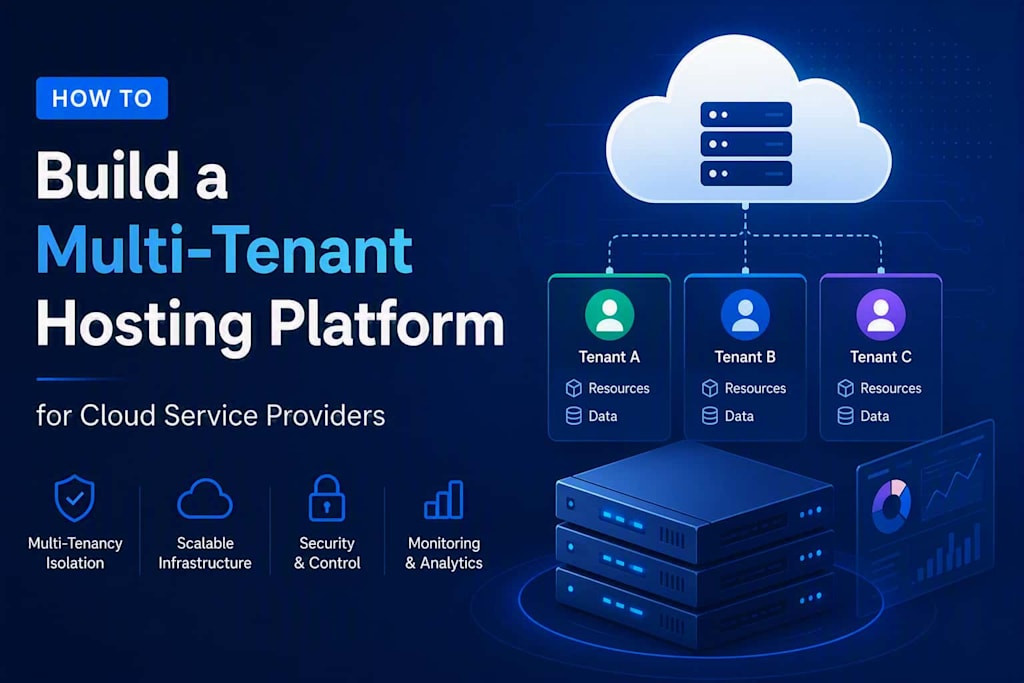
Cloud service providers increasingly need to serve multiple customers from a shared infrastructure platform without sacrificing security, performance, flexibility, or operational control. Building a multi-tenant hosting platform is therefore not simply a matter of adding customer accounts to an existing hosting environment. It requires a carefully designed architecture in which a centralized control plane manages many tenants while enforcing isolation, permissions, quotas, automation, and observability.
A successful platform should allow customers to provision and manage resources independently while enabling the provider to maintain consistent governance across the entire infrastructure. This article explains the core architectural decisions involved in building such a platform.
Start with a Centralized Control Plane
The foundation of a multi-tenant hosting platform is the control plane. Instead of building separate management systems for every customer, the provider creates one centralized layer responsible for coordinating infrastructure operations across all tenants.
The control plane typically manages:
Tenant accounts and organizations
Users, teams, and roles
Infrastructure provisioning
Resource quotas and limits
Authentication and authorization
Billing and usage tracking
APIs and integrations
Monitoring and alerts
Audit logs
Lifecycle management
The actual infrastructure resources belong to the data plane. These may include virtual machines, containers, storage volumes, databases, networks, load balancers, or other cloud services.
Separating the control plane from the data plane is essential. The control plane determines who can perform an action and what resources should be created, while the data plane performs the actual workload execution.
For example, when a customer requests a new virtual machine, the platform should not rely on a manual administrator workflow. The request should pass through the control plane, where the system validates permissions, checks quotas, selects the appropriate infrastructure environment, and triggers automated provisioning.
This approach makes the platform easier to scale because the same management architecture can support hundreds or thousands of tenants.
Design Tenant Isolation from the Beginning
Tenant isolation is one of the most important requirements of a multi-tenant architecture. Customers must have confidence that their applications, data, credentials, and infrastructure resources are protected from other tenants.
Isolation should exist at several levels.
Identity Isolation
Every request should be associated with a tenant identity. The platform must always know which organization owns a resource and which user is attempting to access it.
A common approach is to include a tenant identifier in the identity and authorization context rather than trusting information supplied directly by the client application.
The authorization layer should answer questions such as:
Which tenant owns this resource?
Does this user belong to that tenant?
What role does the user have?
Is the requested operation allowed?
Is the resource located within the user's permitted scope?
Strong identity isolation prevents accidental cross-tenant access caused by application bugs or incorrectly designed APIs.
Infrastructure Isolation
Different providers may require different levels of infrastructure separation.
Some platforms can use logical isolation, where multiple tenants share underlying compute or storage systems but remain separated through namespaces, virtual networks, access policies, and resource boundaries.
Other customers may require stronger isolation through dedicated virtual machines, clusters, networks, or physical infrastructure.
The platform architecture should therefore support multiple isolation models. A small customer may use shared infrastructure, while an enterprise tenant may purchase dedicated capacity.
Data Isolation
Every database query, storage operation, and metadata lookup must enforce tenant boundaries.
Depending on the application, the platform may use:
Separate databases per tenant
Separate schemas
Shared databases with tenant identifiers
Dedicated storage buckets
Encrypted tenant-specific data stores
The right choice depends on regulatory requirements, performance expectations, operational complexity, and the number of tenants.
Automate the Provisioning Lifecycle
Manual infrastructure provisioning becomes unsustainable as the number of customers grows. A multi-tenant platform should treat provisioning as an automated workflow.
A typical provisioning process may include:
A customer submits a request through a portal or API.
The control plane authenticates the request.
Authorization policies are evaluated.
The quota system verifies available capacity.
A provisioning workflow is created.
Infrastructure APIs create the required resources.
Configuration and networking are applied.
Monitoring and logging are automatically enabled.
The new resource is registered with billing and inventory systems.
The customer receives the final status.
Provisioning should ideally be asynchronous. Infrastructure operations can take time, and the user interface should not need to wait for every underlying task to complete.
Instead, the control plane can create an operation record and allow clients to track its status through an API.
Infrastructure-as-code principles are particularly valuable here. Provisioning templates should be versioned, repeatable, and tested. This reduces configuration drift and makes it easier to reproduce environments.
A well-designed automation layer is also a major part of hosting platform modernization, especially when providers are replacing manual operational processes with API-driven infrastructure management.
Implement Roles, Permissions, and Quotas
Not every user within a tenant should have the same level of access.
A hosting platform may support roles such as:
Organization owner
Administrator
Infrastructure operator
Developer
Billing manager
Read-only auditor
Role-based access control is a useful starting point, but larger platforms may also need attribute-based or policy-based authorization.
For example, an administrator may be allowed to create servers but only within a specific region. A developer may manage application environments but not modify networking. A billing manager may view invoices without accessing infrastructure resources.
Quotas are equally important.
Without quota controls, a tenant could accidentally or intentionally consume excessive compute, storage, IP addresses, or other limited resources.
Quotas may include:
Maximum number of virtual machines
CPU and memory limits
Storage capacity
Number of public IP addresses
API request limits
Maximum number of users
Monthly spending limits
Quota validation should occur before provisioning begins. The system should also track actual usage continuously to prevent inconsistencies between allocated and consumed resources.
Build Infrastructure APIs as a Core Product Layer
Modern hosting platforms should be API-first.
The web dashboard is important, but it should generally be another client of the same underlying APIs rather than the only way to manage infrastructure.
A consistent API layer enables customers to integrate the platform with their own automation systems, DevOps pipelines, monitoring tools, and internal portals.
Infrastructure APIs should support operations such as:
Creating and deleting compute resources
Managing storage
Configuring networks
Managing DNS
Creating backups
Retrieving usage data
Managing users and permissions
Viewing invoices and consumption
Checking provisioning status
API design should include versioning, authentication, rate limiting, idempotency, pagination, and detailed error responses.
Idempotency is particularly important for provisioning operations. If a client retries a request because of a network failure, the platform should avoid creating duplicate resources.
Connect Billing to Real Usage
Billing cannot be treated as a separate monthly spreadsheet process. In a scalable hosting platform, billing should be connected directly to resource usage.
The platform should collect metering data from infrastructure systems and convert that information into billable events.
Examples include:
CPU hours
Memory allocation
Storage consumption
Network traffic
Backup storage
Public IP usage
Managed service consumption
A useful architecture separates raw usage collection from rating and invoicing.
First, the metering system records what happened. Then the billing engine applies pricing rules, discounts, contracts, taxes, and other business logic.
This separation makes pricing changes easier to implement without changing the infrastructure systems themselves.
Customers should also have access to near-real-time usage information. Cost visibility can help prevent unexpected invoices and gives customers greater control over their cloud spending.
Make Monitoring and Observability Tenant-Aware
A multi-tenant platform needs observability at both the provider and customer levels.
The provider needs a global view of infrastructure health, capacity, failures, and security events. At the same time, each customer should see only the metrics and logs associated with their own resources.
Monitoring should cover:
Infrastructure availability
CPU, memory, and storage usage
Network performance
Provisioning failures
API errors
Security events
Capacity utilization
Service-level indicators
Logs and metrics should carry tenant and resource metadata where appropriate. This makes troubleshooting easier while supporting access controls.
Alerting should also operate at different levels. A provider may receive an alert when a cluster approaches capacity, while a customer receives an alert when their application exceeds a resource threshold.
Centralized observability becomes increasingly important as the platform grows because operational teams can no longer investigate every customer environment manually.
Design for Horizontal Scaling
A successful platform should not depend on a single application server or centralized provisioning worker.
The control plane itself should be designed as a scalable distributed system.
Key architectural principles include:
Stateless API services where possible
Load balancing
Distributed task queues
Horizontally scalable workers
Highly available databases
Caching for frequently accessed metadata
Event-driven communication
Retry and recovery mechanisms
Idempotent operations
Asynchronous processing is especially useful for long-running infrastructure tasks. A request to create a resource can generate an event that is processed by specialized workers.
The platform should also avoid global bottlenecks. For example, provisioning locks should be scoped to individual tenants or resources whenever possible rather than blocking the entire system.
Capacity planning should include both customer workloads and the platform itself. The control plane may become a bottleneck long before the underlying compute infrastructure reaches its limits if API traffic, provisioning events, or monitoring data grow rapidly.
Conclusion
Building a multi-tenant hosting platform requires much more than placing multiple customers on shared infrastructure. The key is to create a centralized control plane that consistently manages tenant identities, permissions, quotas, provisioning workflows, billing, APIs, and observability.
Strong tenant isolation must be built into every layer, from authentication and databases to networking and infrastructure access. Automated provisioning should replace manual operations, while API-first design enables customers and internal teams to integrate the platform with modern DevOps workflows.
As the number of tenants grows, scalability, asynchronous processing, reliable billing, and tenant-aware monitoring become increasingly important. By separating the control plane from the underlying infrastructure and designing clear boundaries between tenants, cloud service providers can build a platform that supports efficient operations today while remaining flexible enough to grow with future customer and infrastructure demands.
About the Creator
Chudovo
Chudovo is a custom software development company, focused on complex systems implementation.
Enjoyed the story? Support the Creator.
Subscribe for free to receive all their stories in your feed.
Comments
There are no comments for this story
Be the first to respond and start the conversation.