
How to Master the Essential Skills Every .NET MAUI Developer Needs
A practical roadmap to building cross-platform expertise and advancing your .NET MAUI development career.

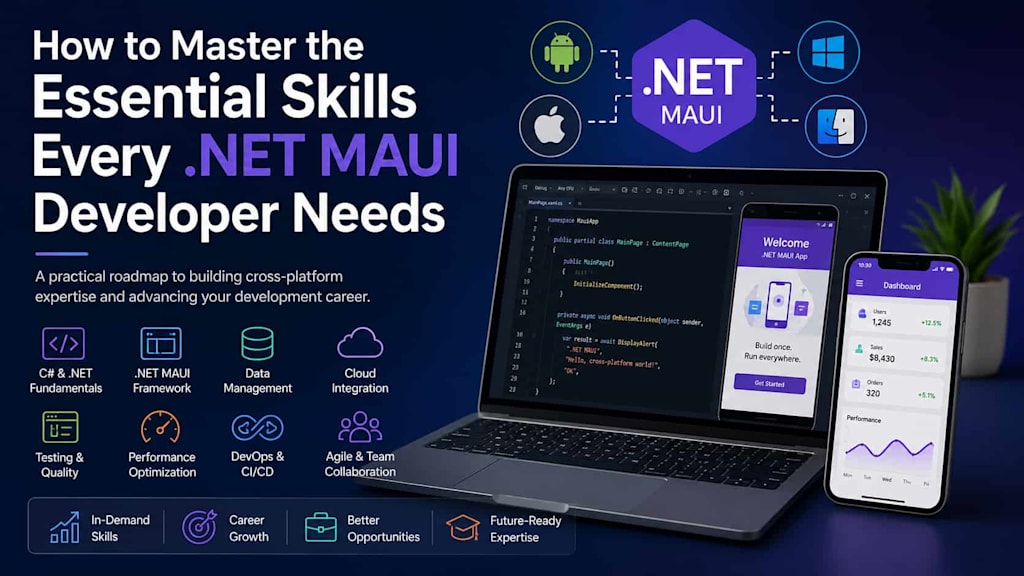
The demand for cross-platform applications continues to grow as businesses seek faster development cycles, lower maintenance costs, and consistent user experiences across multiple devices. Microsoft's .NET Multi-platform App UI (.NET MAUI) has become one of the leading frameworks for building native applications for Android, iOS, Windows, and macOS from a single codebase. As organizations increasingly adopt this technology, developers who possess a well-rounded skill set are becoming highly sought after.
Whether you are beginning your journey with .NET MAUI or looking to advance your expertise, mastering the right technical and soft skills is essential. Employers no longer look solely for coding ability—they expect professionals who understand application architecture, testing, collaboration, cloud technologies, and modern development practices.
This guide explores the main skills of .NET MAUI developers, explains how those skills evolve throughout different career stages, and offers practical advice for staying competitive in an ever-changing technology landscape.
Understand the .NET Ecosystem
Every successful .NET MAUI developer starts with a solid understanding of the broader .NET platform.
You should be comfortable with:
- C# programming
- Object-oriented programming principles
- Asynchronous programming with async/await
- LINQ
- Dependency Injection
- Collections and Generics
- Exception handling
- File I/O
- Reflection
- .NET runtime fundamentals
A strong foundation in C# makes learning .NET MAUI significantly easier because the framework relies heavily on existing .NET libraries and development patterns.
Developers should also stay up to date with the latest versions of .NET, as Microsoft continuously introduces performance improvements and new APIs.
Master the .NET MAUI Framework
Knowing C# is only the beginning.
Developers should thoroughly understand the framework itself, including:
- XAML layouts
- MVVM architecture
- Data binding
- Shell navigation
- Custom controls
- Dependency services
- Resource dictionaries
- Styling and theming
- Gesture recognizers
- Platform-specific implementations
Understanding how .NET MAUI abstracts native platform capabilities while still allowing platform-specific customization enables developers to create applications that feel natural on every operating system.
Practice building applications that combine multiple UI components, navigation patterns, and responsive layouts.
Learn Mobile Design Principles
Users expect applications to look polished and perform consistently regardless of the device.
Developers should understand:
- Responsive layouts
- Accessibility
- User experience design
- Material Design concepts
- Apple Human Interface Guidelines
- Dark mode support
- Adaptive controls
- Animation
- Touch interactions
A technically perfect application can still fail if the user experience is poor.
Collaborating closely with designers helps developers better translate interface mockups into intuitive applications.
Become Comfortable with Data Management
Almost every application stores or retrieves data.
Essential skills include:
- Entity Framework Core
- SQLite
- REST APIs
- GraphQL basics
- JSON serialization
- Local storage
- Secure storage
- Offline synchronization
- Caching strategies
Knowing when to store information locally and when to retrieve it from cloud services improves both performance and user experience.
Developers should also understand data security best practices when handling sensitive information.
Understand Cloud Integration
Modern mobile applications rarely operate independently.
Cloud services often provide:
- Authentication
- Push notifications
- File storage
- Analytics
- Logging
- Messaging
- API management
Experience with Microsoft Azure is particularly valuable because it integrates naturally with the .NET ecosystem.
Understanding authentication methods such as OAuth and OpenID Connect is also becoming increasingly important.
Build Strong Testing Skills
Testing remains one of the most overlooked developer skills.
Professional .NET MAUI developers should know how to create:
- Unit tests
- Integration tests
- UI automation tests
- Performance tests
- Regression tests
Testing frameworks like xUnit or NUnit help ensure application reliability while reducing future maintenance costs.
Automated testing also supports continuous integration pipelines.
Improve Application Performance
Users quickly abandon applications that load slowly or consume excessive battery power.
Performance optimization involves:
- Reducing startup time
- Efficient memory management
- Image optimization
- Lazy loading
- Network optimization
- Background processing
- Efficient rendering
Profiling tools should become part of every developer's workflow.
Understanding bottlenecks before release significantly improves application quality.
Learn DevOps and CI/CD
Today's developers are expected to participate throughout the software delivery lifecycle.
Important topics include:
- Git
- GitHub or Azure DevOps
- Branching strategies
- Continuous Integration
- Continuous Delivery
- Automated builds
- Package management
- Deployment pipelines
A developer who understands deployment processes contributes more effectively to project success.
Stay Current with Industry Developments
Technology evolves rapidly, making continuous learning essential.
Among the most important IT trends on the market in 2026 are AI-assisted software development, cloud-native architectures, intelligent code generation, low-code integrations, enhanced cybersecurity practices, edge computing, and increasingly sophisticated cross-platform development frameworks.
Developers who actively monitor emerging technologies are better prepared to adapt their skills and recommend modern solutions to employers and clients.
Following Microsoft's official documentation, technical blogs, conferences, and community discussions helps maintain a competitive edge.
Develop Effective Communication Skills
Technical knowledge alone is not enough.
Successful developers communicate clearly with:
- Product owners
- UX designers
- QA engineers
- Project managers
- Clients
- Fellow developers
Strong communication reduces misunderstandings, improves planning, and accelerates problem resolution.
Documentation skills are equally valuable, especially for large enterprise applications.
Thrive in an Agile Team
Most software projects today are developed within an Agile team environment.
Developers should understand:
- Sprint planning
- Daily stand-ups
- Backlog refinement
- User stories
- Retrospectives
- Incremental delivery
- Continuous feedback
Being an effective team member means contributing ideas, accepting constructive feedback, and collaborating openly throughout the development process.
Agile methodologies reward flexibility and continuous improvement rather than rigid planning.
Understand Different Career Levels
One of the most common questions new developers ask concerns the skills that junior, middle, and senior engineers should handle.
Junior developers typically focus on learning the framework, fixing bugs, implementing features under supervision, and following established coding standards.
Middle-level developers work more independently. They design components, optimize performance, review code, mentor junior colleagues, and participate in architectural discussions.
Senior developers assume broader responsibilities that extend beyond coding. They design scalable architectures, make technology decisions, solve complex technical problems, mentor teams, coordinate cross-functional initiatives, and ensure long-term maintainability.
Understanding these expectations helps developers create realistic learning plans and measure their professional growth.
Prepare for Technical Interviews
Landing a great position requires more than technical ability.
Many companies evaluate candidates through coding challenges and interview questions that assess both technical knowledge and problem-solving skills.
Common interview topics include:
- C# language features
- MVVM implementation
- XAML layouts
- Dependency Injection
- REST API integration
- Threading
- Memory optimization
- Performance tuning
- Unit testing
- Design patterns
Practical experience building real applications often proves more valuable than memorizing theoretical concepts.
Creating personal projects or contributing to open-source repositories demonstrates initiative and practical expertise.
Learn Software Architecture
As developers gain experience, they naturally become more involved in system design.
Understanding architectural concepts such as:
- SOLID principles
- Clean Architecture
- Domain-Driven Design
- Microservices
- Event-driven architecture
- API design
- Design patterns
allows developers to build maintainable applications that remain scalable as business requirements evolve.
For many experienced developers, mastering architecture also opens opportunities for a career as a software architect, where strategic technical decision-making becomes the primary responsibility.
Embrace Lifelong Learning
The technology industry never stands still.
Successful .NET MAUI developers continually invest in learning through:
- Official Microsoft documentation
- Online courses
- Technical conferences
- Community forums
- Open-source contributions
- Side projects
- Technical books
Building increasingly complex applications remains one of the fastest ways to strengthen practical skills.
Rather than chasing every new technology, developers should focus on mastering core principles that remain valuable regardless of changing frameworks.
Conclusion
Becoming an outstanding .NET MAUI developer requires much more than learning a framework. Success comes from combining strong programming fundamentals with expertise in user interface development, architecture, cloud integration, testing, performance optimization, DevOps, and collaboration. As organizations continue investing in cross-platform solutions, developers who continuously refine both their technical and interpersonal skills will remain highly competitive.
The journey from junior developer to senior engineer is built through consistent practice, curiosity, and real-world experience. By mastering the essential competencies outlined in this guide and staying informed about industry developments, you can build high-quality applications, contribute effectively to modern development teams, and enjoy long-term success in the evolving world of .NET MAUI.
About the Creator
Markus Koch
I am a professional IT consultant with 5+ years of experience.
Enjoyed the story? Support the Creator.
Subscribe for free to receive all their stories in your feed.
Comments
There are no comments for this story
Be the first to respond and start the conversation.