
How to Integrate Continuous Glucose Monitors (CGMs) into Diabetes Management Software
Best practices for building secure, reliable, and scalable CGM integrations for modern diabetes care.

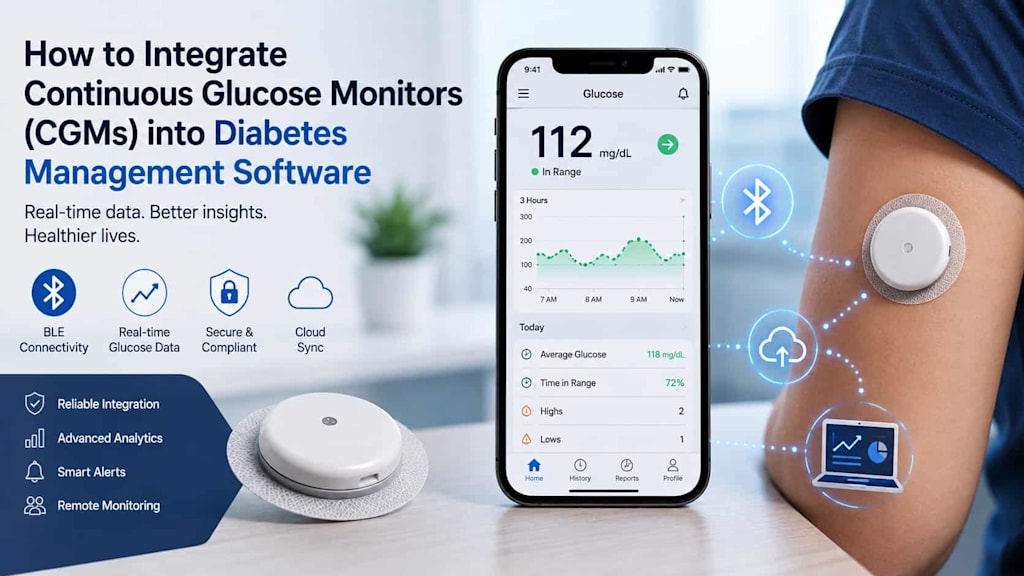
Continuous Glucose Monitors (CGMs) have transformed diabetes care by providing real-time insights into glucose levels without requiring frequent fingerstick testing. Instead of relying on isolated measurements, patients and healthcare providers can monitor glucose trends throughout the day, enabling more informed treatment decisions and improved long-term outcomes.
As the adoption of wearable medical devices continues to grow, software developers are increasingly tasked with integrating CGMs into mobile applications, cloud platforms, and healthcare ecosystems. However, successful integration goes far beyond reading sensor data. It requires secure communication, reliable synchronization, regulatory compliance, scalable architecture, and an excellent user experience.
This article explores the essential considerations and best practices for integrating Continuous Glucose Monitors into diabetes management software.
Understanding the CGM Ecosystem
Continuous Glucose Monitoring systems typically consist of three primary components:
A wearable glucose sensor
A transmitter that sends glucose readings
A receiver, smartphone, or cloud-connected application
Modern CGMs measure glucose levels in interstitial fluid every few minutes, providing a continuous stream of data that helps users identify trends, predict glucose fluctuations, and respond quickly to abnormal readings.
Unlike traditional glucose meters, CGMs generate thousands of data points every week. Managing this continuous data flow requires software capable of handling high-frequency updates while maintaining accuracy and reliability.
Why CGM Integration Matters
Healthcare providers increasingly rely on digital health platforms to support patient monitoring, remote consultations, and personalized treatment planning.
Integrating CGMs into diabetes software provides numerous advantages, including:
Real-time glucose visualization
Historical trend analysis
Automated alerts for hypo- and hyperglycemia
Improved therapy adherence
Remote patient monitoring
Better clinical decision support
Reduced manual data entry
For patients, seamless synchronization eliminates the need to manually transfer readings, resulting in greater convenience and more accurate health records.
Choosing the Right Integration Approach
CGM manufacturers typically provide one or more integration options.
Bluetooth Communication
Most consumer CGMs communicate directly with smartphones using Bluetooth Low Energy (BLE). Applications receive glucose measurements from nearby devices with minimal battery consumption.
A well-designed BLE integration layer should isolate Bluetooth-specific functionality from business logic, making the application easier to maintain and extend.
Manufacturer APIs
Many CGM vendors also offer cloud APIs that allow authorized applications to retrieve patient data after synchronization.
API-based integration simplifies development but introduces dependencies on internet connectivity and vendor infrastructure.
Healthcare Data Standards
To improve interoperability, many healthcare organizations use standards such as HL7 FHIR for exchanging patient information across electronic health record (EHR) systems, telemedicine platforms, and analytics solutions.
Supporting industry standards makes future integrations significantly easier.
Designing a Reliable Architecture
Successful CGM software typically follows a modular architecture that separates device communication from data processing.
Key architectural layers include:
Device Communication Layer
Responsible for:
Device discovery
Authentication
Pairing
Connection management
Reconnection handling
Error detection
Separating these responsibilities simplifies future support for additional devices.
Data Processing Layer
Incoming glucose measurements should be:
Validated
Time-stamped
Normalized
Stored securely
Prepared for analytics
A consistent internal data model allows applications to work with multiple CGM manufacturers using the same business logic.
Application Layer
This layer delivers user-facing functionality such as:
Dashboards
Reports
Notifications
Trend analysis
Daily summaries
Therapy recommendations
Keeping presentation separate from device communication improves maintainability and testing.
Handling Continuous Data Streams
Unlike traditional medical devices that provide occasional readings, CGMs continuously transmit new measurements.
Developers should design systems capable of processing thousands of incoming events without performance degradation.
Recommended practices include:
Event-driven processing
Asynchronous communication
Local caching
Efficient database indexing
Incremental synchronization
Background processing
These techniques help maintain smooth application performance even during extended monitoring sessions.
Building Stable Bluetooth Connections
Bluetooth communication remains one of the most challenging aspects of CGM integration.
Users expect devices to reconnect automatically after temporary signal interruptions.
Best practices include:
Automatic Reconnection
Applications should detect connection losses and reconnect without requiring manual intervention.
Exponential backoff strategies help reduce battery consumption while avoiding excessive connection attempts.
Background Operation
Users rarely keep diabetes applications open all day.
Applications should continue receiving glucose updates while running in the background, following platform-specific guidelines for Android and iOS.
Notification-Based Updates
Instead of repeatedly polling devices, applications should rely on Bluetooth notifications whenever possible.
This approach minimizes latency while reducing battery usage.
Device State Monitoring
Applications should continuously monitor:
Battery status
Signal strength
Sensor expiration
Calibration status
Communication quality
Providing this information helps users identify issues before they interrupt glucose monitoring.
Managing Data Quality
Reliable software must distinguish between valid measurements and potential anomalies.
Validation should include:
Duplicate detection
Missing reading identification
Timestamp verification
Range validation
Sensor error handling
When data gaps occur, applications should clearly communicate them instead of displaying misleading trends.
Maintaining high data quality improves both clinical confidence and user trust.
Security and Privacy Considerations
Healthcare applications process highly sensitive personal information.
Developers should implement security at every level of the system.
Essential measures include:
Secure Bluetooth pairing
End-to-end encryption
Encrypted local storage
Secure cloud communication
Multi-factor authentication
Role-based access control
Comprehensive audit logging
Compliance with regulations such as HIPAA, GDPR, or other regional healthcare frameworks should be considered from the earliest stages of development rather than added later.
Delivering an Excellent User Experience
Technology should simplify diabetes management—not complicate it.
Successful CGM applications prioritize usability alongside technical reliability.
Important UX principles include:
Clear Data Visualization
Users should immediately understand:
Current glucose level
Trend direction
Daily patterns
Time in range
High and low events
Interactive charts make complex glucose data easier to interpret.
Intelligent Alerts
Notifications should be timely without becoming overwhelming.
Adaptive alert systems allow users to customize thresholds based on individual treatment plans.
Fast Synchronization
Patients expect glucose readings to appear within seconds after transmission.
Reducing synchronization delays improves confidence in the application.
Accessibility
Applications should support:
Large fonts
High-contrast themes
Screen readers
Voice assistance
Simple navigation
Accessible design benefits users of all ages and abilities.
Testing Across Multiple Devices
Testing is one of the most critical phases of CGM integration.
Medical software should undergo extensive validation using real hardware whenever possible.
A comprehensive testing strategy includes:
Unit Testing
Verify individual software components independently.
Integration Testing
Validate communication between mobile applications and physical CGM devices.
Long-Term Stability Testing
Run continuous monitoring sessions lasting several days to identify memory leaks, connection failures, or synchronization issues.
Field Testing
Evaluate performance under realistic conditions, including:
Walking outdoors
Switching between Wi-Fi and cellular networks
Device restarts
Battery-saving modes
Bluetooth interruptions
Multiple connected devices
Real-world testing frequently uncovers issues that laboratory testing cannot reproduce.
Preparing for Future Device Expansion
The diabetes technology market continues to evolve rapidly.
New sensors, insulin pumps, smart pens, and wearable devices appear every year.
Software should therefore be designed for extensibility rather than supporting only today's devices.
Using abstraction layers, adapter patterns, and modular service architecture makes adding new manufacturers significantly easier while reducing maintenance costs.
Future-ready platforms also simplify integration with emerging technologies such as AI-powered decision support, predictive glucose analytics, and personalized treatment recommendations.
Developers should also consider BLE connectivity for diabetes management apps as part of a broader connected healthcare ecosystem that supports multiple medical devices rather than isolated integrations.
Cloud Synchronization and Remote Monitoring
Many healthcare providers require remote access to patient glucose data.
Cloud synchronization enables:
Telemedicine consultations
Population health analytics
Caregiver monitoring
Automated reporting
Clinical dashboards
AI-driven health insights
Reliable synchronization should include conflict resolution, offline support, retry mechanisms, and secure authentication to ensure data consistency across devices.
Conclusion
Integrating Continuous Glucose Monitors into diabetes management software requires much more than establishing a Bluetooth connection. Successful solutions combine reliable device communication, scalable software architecture, secure data handling, intuitive user experiences, and rigorous testing.
By implementing modular architectures, robust Bluetooth communication, efficient data processing, comprehensive security measures, and interoperability standards, development teams can build platforms that deliver accurate, real-time glucose insights while remaining flexible enough to support future innovations. As diabetes technology continues to advance, organizations that invest in reliable CGM integration will be better positioned to deliver high-quality digital healthcare solutions that improve patient outcomes and enhance clinical decision-making.
About the Creator
Chudovo
Chudovo is a custom software development company, focused on complex systems implementation.
Enjoyed the story? Support the Creator.
Subscribe for free to receive all their stories in your feed.
Comments
There are no comments for this story
Be the first to respond and start the conversation.