
How to Build BLE Connectivity for Diabetes Management Apps
A practical guide to reliable, secure, and scalable Bluetooth Low Energy integration for connected diabetes care.

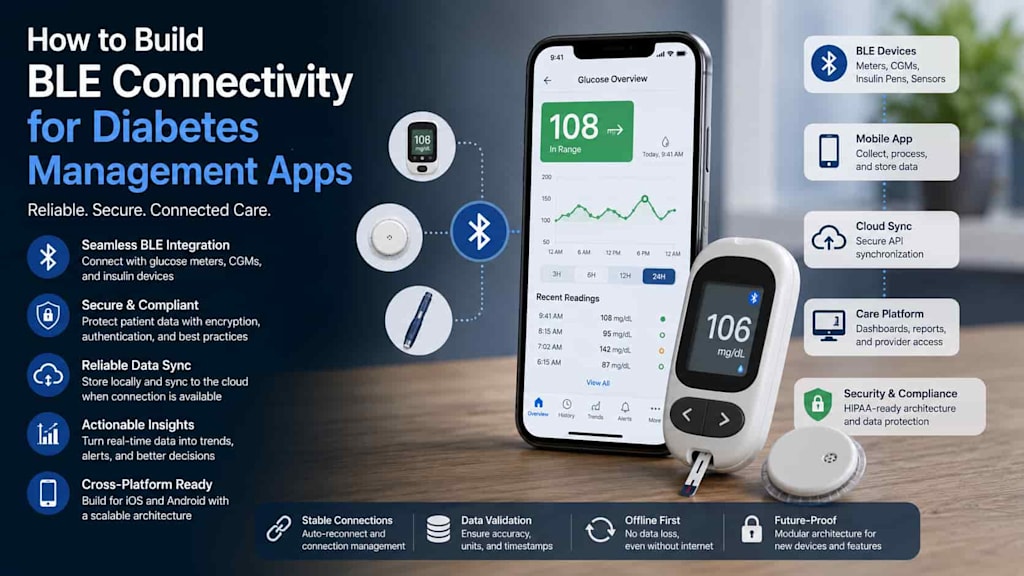
Bluetooth Low Energy (BLE) has become an important connectivity technology for modern diabetes management applications. Glucose meters, continuous glucose monitoring (CGM) devices, insulin pumps, smart pens, and wearable sensors can use BLE to exchange information with smartphones and tablets while consuming relatively little power.
However, building dependable BLE connectivity is more complicated than simply pairing a medical device with an app. Developers must account for device compatibility, Bluetooth services and characteristics, mobile operating-system restrictions, intermittent connections, data synchronization, security, and medical data accuracy.
A well-designed BLE architecture allows an application to collect device data reliably and transform it into useful information for patients, caregivers, and healthcare professionals.
Start With Clear Connectivity Requirements
Before writing BLE code, development teams should define exactly which devices the application needs to support and what information should be exchanged.
Important questions include:
Which glucose meters, CGM systems, or other devices are supported?
Is communication one-way or bidirectional?
What measurements and metadata are required?
How frequently should information be synchronized?
Does the application need background data collection?
What happens when the smartphone is offline?
How should duplicate or incomplete readings be handled?
Which mobile platforms and operating-system versions are supported?
These requirements determine the architecture and help prevent expensive changes later in development.
It is also important to obtain technical documentation from device manufacturers as early as possible. BLE is a communication technology, but manufacturers can implement device-specific services, characteristics, commands, and data formats differently.
Understand the BLE Communication Model
A typical BLE interaction involves a central device, such as a smartphone, and a peripheral device, such as a glucose meter.
The mobile application scans for nearby peripherals and establishes a connection with the selected device. It then discovers available services and characteristics. Characteristics may contain measurement data or provide mechanisms for sending commands to the device.
In simplified form, the workflow looks like this:
Scan → Connect → Discover Services → Discover Characteristics → Subscribe/Read → Decode → Validate → Store → Synchronize
Developers should avoid placing all these operations directly into the user-interface layer. BLE communication should be isolated in a dedicated service or module.
This separation makes the application easier to test and allows the same business logic to work with multiple supported devices.
Design a Device Abstraction Layer
One of the most important architectural decisions is how to support different medical devices.
A glucose meter from one manufacturer may use different services, characteristics, authentication procedures, or data formats from another device. If device-specific code is distributed throughout the application, adding a new device can become expensive and risky.
A better approach is to create a device abstraction layer.
The integration layer can translate manufacturer-specific information into a common internal model. For example, regardless of the source device, the application might represent a glucose reading with:
Measurement value
Unit
Timestamp
Device identifier
Measurement identifier
Measurement status
Optional contextual metadata
The rest of the application then works with the normalized model rather than individual BLE protocols.
This approach makes BLE medical device integration more maintainable and provides a foundation for supporting additional devices in the future.
Handle Connections and Disconnections Gracefully
BLE connectivity is not guaranteed to remain stable. A patient can move outside the device's communication range, turn off Bluetooth, restart the smartphone, or encounter radio interference.
The application should therefore treat connection loss as a normal operating condition rather than an exceptional event.
A robust connection manager can implement:
Connection timeouts
Automatic reconnection
Controlled retry intervals
Bluetooth-state monitoring
Device availability detection
Connection-state notifications
Clean disconnection handling
Repeated reconnection attempts should be carefully controlled. Excessive scanning or retries can drain the smartphone or medical device battery.
The user interface should also communicate connectivity problems clearly. Instead of displaying a technical error such as "GATT connection terminated," an application might explain that the device is temporarily disconnected and provide a simple action for reconnecting it.
Plan for Background Operation
Diabetes applications may need to collect information without requiring the user to keep the app open.
This introduces additional complexity because iOS and Android manage background execution differently. Applications cannot assume that a BLE process will behave identically when running in the foreground, background, or after the operating system suspends it.
Developers should investigate platform-specific BLE capabilities early in the project.
Background behavior should be tested across supported operating-system versions and device models. The application should also avoid unnecessary scanning and processing because battery consumption directly affects the user experience.
Build Reliable Data Synchronization
BLE connectivity is only one part of the overall data pipeline. After receiving a reading, the application must store and process it correctly.
A useful architecture separates local data collection from cloud synchronization.
For example:
Medical device → BLE → Mobile app → Local database → Synchronization queue → Backend API → Cloud database
This design allows measurements to be retained even when the phone temporarily lacks internet access.
An offline-first approach can be particularly useful for patients who travel, work in areas with poor connectivity, or use the application in environments where network access is inconsistent.
The synchronization layer should also be idempotent. If the same measurement is transmitted more than once because of a network interruption, the backend should recognize the duplicate rather than creating multiple records.
Unique identifiers, timestamps, synchronization states, and retry mechanisms can help maintain data consistency.
Validate and Normalize Medical Data
Receiving bytes from a BLE characteristic does not automatically mean the information is correct.
Data should be validated before it enters the application's core business logic. Developers should verify expected ranges, units, timestamps, device identifiers, and message structures.
Unit conversion deserves particular attention. Different devices or systems may represent measurements differently, so the application should establish a consistent internal representation.
Timestamp handling is equally important. A glucose reading is meaningful partly because of when it occurred. The system should account for time zones, device clock differences, daylight-saving changes, and delayed synchronization.
When measurements are used alongside meals, medication, insulin administration, exercise, or other events, incorrect timestamps can affect the interpretation of trends.
Protect Patient Data
BLE security should be considered together with the security of the complete application architecture.
A typical data flow may include:
Medical device → Bluetooth connection → Smartphone → Local storage → API → Cloud platform → Healthcare interface
Each stage requires appropriate safeguards.
Developers should consider secure pairing, authentication, encryption, access control, secure local storage, encrypted network communication, and appropriate secrets management.
Applications should also avoid placing sensitive patient information in debugging logs. BLE troubleshooting can generate extensive technical logs, but production logging should be carefully controlled.
Security testing should cover both the mobile application and backend infrastructure. Threat modeling can help identify potential attack scenarios before the application reaches production.
Test Real-World Conditions
BLE functionality should be tested in conditions that reflect actual patient behavior.
A test plan should include:
Device moving out of range
Bluetooth being disabled
Smartphone restarting
Medical device restarting
Low battery conditions
Temporary network outages
Application suspension
Background operation
Multiple nearby BLE devices
Repeated connection and disconnection
Duplicate measurements
Delayed synchronization
Unsupported or corrupted data
Testing should also cover different smartphones, operating-system versions, device firmware versions, and BLE hardware.
Automated tests can validate data parsing and business logic, but physical-device testing remains essential because wireless behavior cannot always be reproduced accurately in a simulated environment.
Consider Cross-Platform Development Carefully
Many diabetes applications need to support both iOS and Android. Cross-platform technologies can reduce development effort, but Bluetooth functionality often requires platform-specific implementation.
A practical architecture can keep common business logic shared while encapsulating native BLE functionality behind a consistent interface.
For example, the application could expose generic operations such as:
Scan for devices
Connect to device
Read measurement
Subscribe to notifications
Disconnect
Report connection status
Platform-specific components can then implement these operations using the appropriate native APIs.
This approach reduces coupling and allows developers to respond more effectively to differences between mobile platforms.
Integrate BLE With the Broader Healthcare Architecture
BLE should not be considered a standalone feature. In a mature diabetes management system, device connectivity is one component of a larger ecosystem that may include patient profiles, medication tracking, analytics, alerts, cloud services, healthcare-provider dashboards, and electronic health records.
The BLE layer should therefore communicate with business logic through well-defined interfaces.
This separation makes it possible to modify device integrations without changing unrelated application functionality. It also makes the architecture easier to scale when new medical devices or healthcare services are introduced.
Plan for Future Device Support
Medical-device ecosystems evolve continuously. New glucose meters, sensors, smart insulin devices, and wearables can become relevant after an application has already been launched.
The architecture should therefore make future integrations predictable.
A device registry, standardized internal data model, adapter pattern, automated protocol tests, and clear integration documentation can significantly reduce the effort required to add another device.
Teams should also monitor firmware updates and manufacturer documentation. Changes in device behavior can affect existing integrations and should be included in regression testing.
Conclusion
Building BLE connectivity for diabetes management applications requires much more than establishing a Bluetooth connection. Reliable solutions need a carefully designed architecture that addresses device diversity, connection stability, background operation, data validation, synchronization, security, and cross-platform behavior.
The strongest approach is to isolate device-specific protocols behind a well-defined integration layer, normalize incoming measurements, store data reliably on the device, and synchronize it safely with backend systems.
Real-world testing is equally important. A BLE integration that works perfectly in a developer's office may behave differently when patients use different smartphones, move between locations, lose network connectivity, or update their devices.
By treating BLE as a core part of the overall healthcare architecture rather than a simple connectivity feature, development teams can create diabetes applications that are reliable, secure, maintainable, and ready to support an expanding ecosystem of connected medical devices.
About the Creator
Chudovo
Chudovo is a custom software development company, focused on complex systems implementation.
Enjoyed the story? Support the Creator.
Subscribe for free to receive all their stories in your feed.
Comments
There are no comments for this story
Be the first to respond and start the conversation.