
How to Implement Secure AI-Assisted Development in Regulated Industries
Best Practices for Balancing Innovation, Compliance, and Security in AI-Driven Software Engineering

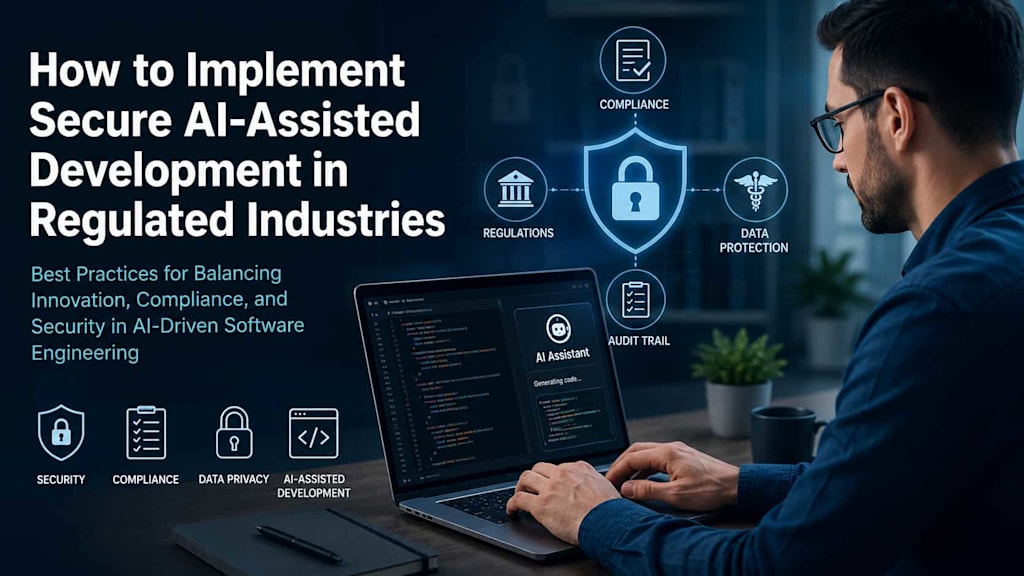
Artificial intelligence is rapidly transforming software engineering, enabling teams to build, test, and deploy applications faster than ever before. From code generation and automated testing to documentation and security analysis, AI-powered tools are becoming an integral part of modern development environments. However, organizations operating in highly regulated industries such as healthcare, finance, insurance, government, and pharmaceuticals face unique challenges when adopting these technologies.
While AI can significantly improve productivity and accelerate innovation, regulated industries must ensure that its implementation aligns with strict compliance requirements, data protection standards, and cybersecurity policies. A poorly governed AI strategy can introduce risks related to intellectual property, sensitive data exposure, auditability, and regulatory non-compliance.
This article explores how organizations can implement secure AI-assisted development practices while maintaining the highest standards of security, transparency, and compliance.
Understanding the Regulatory Landscape
Before integrating AI into software development processes, organizations must understand the regulatory frameworks governing their operations. Depending on the industry and geographic region, companies may need to comply with regulations such as HIPAA, GDPR, PCI DSS, SOX, FDA requirements, or industry-specific cybersecurity standards.
The primary concern is that AI tools often require access to code repositories, technical documentation, customer information, or proprietary business logic. If sensitive information is inadvertently shared with external AI services, organizations may violate data protection regulations and expose themselves to legal and financial risks.
A comprehensive compliance assessment should therefore be the first step in any AI adoption initiative. Security, legal, compliance, and engineering teams should collaborate to identify:
- Data classification requirements
- Permitted and restricted AI use cases
- Data residency obligations
- Audit and reporting requirements
- Third-party vendor risk considerations
- Intellectual property protections
By establishing clear governance policies from the outset, organizations can create a foundation for responsible AI adoption without compromising regulatory obligations.
Establishing Secure AI Governance Frameworks
Strong governance is essential for ensuring that AI tools support business objectives while minimizing operational and compliance risks. Governance should extend beyond tool selection and encompass the entire lifecycle of AI usage within development teams.
Organizations should create formal policies defining how developers can interact with AI systems. These policies should specify:
- Approved AI platforms and vendors
- Permitted data types for AI processing
- Human review requirements
- Code validation procedures
- Security testing expectations
- Documentation standards
Role-based access controls are particularly important. Not every employee should have unrestricted access to AI development tools or sensitive repositories. Access permissions should align with business responsibilities and follow the principle of least privilege.
Additionally, organizations should maintain detailed logs of AI-generated outputs, user interactions, and deployment decisions. This level of traceability supports compliance audits and provides accountability when AI-generated code contributes to production systems.
Many organizations are also establishing AI governance committees that include representatives from engineering, security, compliance, legal, and executive leadership. These cross-functional teams help evaluate risks, approve new AI use cases, and continuously monitor policy effectiveness.
Protecting Sensitive Data During AI-Assisted Development
Data protection remains one of the most significant concerns when integrating AI into development workflows. Developers frequently work with confidential information, including customer records, financial data, healthcare information, and proprietary source code.
To mitigate these risks, organizations should implement strict safeguards around data handling.
One effective approach is to deploy enterprise-grade AI platforms that offer private environments, data isolation, encryption, and contractual guarantees regarding data retention and model training. Organizations should avoid allowing sensitive information to be submitted to public AI systems without appropriate controls.
Additional security measures may include:
- Data masking and anonymization
- Secure API gateways
- Encryption in transit and at rest
- Network segmentation
- Continuous monitoring and threat detection
- Data loss prevention (DLP) solutions
Development teams should also receive regular training on secure AI usage. Employees must understand which information can be shared with AI tools and which data must remain protected.
Organizations seeking to establish efficient AI-assisted development workflows should integrate these security controls directly into their engineering pipelines rather than treating them as separate compliance activities. Embedding security into everyday development practices helps maintain productivity while reducing the risk of accidental data exposure.
Implementing Secure Development and Validation Processes
AI-generated code can accelerate development, but it should never bypass established security and quality assurance procedures. Every AI-generated output must be treated as untrusted until it has been thoroughly reviewed and validated.
A secure development process should include multiple layers of verification.
First, developers should conduct manual code reviews to assess functionality, security implications, and compliance requirements. Human expertise remains essential for identifying business-specific risks and validating that generated code aligns with organizational standards.
Second, organizations should integrate automated security tools into their software development lifecycle. These may include:
- Static application security testing (SAST)
- Dynamic application security testing (DAST)
- Software composition analysis (SCA)
- Dependency vulnerability scanning
- Infrastructure-as-code security validation
Third, teams should maintain comprehensive documentation of AI-generated contributions. Regulatory audits often require organizations to demonstrate how software decisions were made and validated.
When adopting a development with AI-assisted approach, companies should establish clear accountability structures that define who is responsible for reviewing, approving, and deploying AI-generated code. AI can assist developers, but accountability for software quality and compliance must remain with human professionals.
Organizations should also conduct regular penetration testing and security assessments to ensure that AI-generated components do not introduce hidden vulnerabilities into production environments.
Building a Culture of Responsible AI Adoption
Technology alone cannot guarantee secure AI implementation. Success ultimately depends on organizational culture, employee awareness, and continuous improvement.
Leaders should promote responsible AI usage through ongoing education and clear communication. Developers, security teams, compliance officers, and executives must share a common understanding of both the opportunities and risks associated with AI-assisted development.
Regular training programs should cover:
- Secure prompt engineering practices
- Data privacy requirements
- Regulatory obligations
- AI limitations and biases
- Security risk identification
- Incident reporting procedures
Organizations should also establish feedback mechanisms that allow employees to report concerns, suggest improvements, and share lessons learned from AI implementations.
Continuous monitoring plays a crucial role as well. Regulatory requirements, cybersecurity threats, and AI technologies evolve rapidly. Governance frameworks should therefore be reviewed regularly and updated as new risks emerge.
Forward-thinking organizations increasingly view AI security as an ongoing discipline rather than a one-time project. This mindset enables them to adapt to changing regulatory expectations while continuing to benefit from technological innovation.
Companies Across Different Industries Are Modernizing Legacy Applications with AI
Organizations across various industries are increasingly leveraging AI-assisted software development to modernize their legacy applications. Whether it's updating monolithic systems, migrating to microservices, or improving outdated codebases, companies aim to reduce technical debt, enhance maintainability, and accelerate delivery of new features. Despite differences in technology stacks and business objectives, these organizations face common challenges, including inefficient workflows, slow release cycles, and high maintenance costs.
AI-powered tools help streamline the modernization process by analyzing legacy code, suggesting refactoring opportunities, generating automated tests, and even assisting in rewriting outdated modules. This enables development teams to modernize applications faster, reduce manual effort, and ensure higher-quality software outcomes. By adopting AI-assisted development strategies, companies can extend the life of legacy systems while preparing for future scalability and innovation.
Some of the companies embracing AI-assisted legacy modernization include:
- Chudovo
- InnoGE
- 6thlabs
- Spiral Scout
- Mobiloud
Conclusion
AI-assisted development offers tremendous opportunities for regulated industries, enabling faster software delivery, improved productivity, and enhanced engineering efficiency. However, these benefits can only be realized when organizations implement robust governance, security, and compliance controls.
A successful strategy begins with understanding regulatory obligations and establishing clear policies for AI usage. Organizations must protect sensitive data, enforce secure development practices, maintain comprehensive audit trails, and ensure that human oversight remains central to all critical decisions.
By integrating security into every stage of the AI adoption journey, regulated organizations can confidently leverage AI technologies while preserving compliance, protecting customer trust, and reducing operational risk. As AI continues to evolve, those that balance innovation with responsible governance will be best positioned to achieve sustainable long-term success.
About the Creator
Eugene Afonin
Experienced IT Consultant specializing in software development strategy, legacy system modernization, and digital transformation.
Enjoyed the story? Support the Creator.
Subscribe for free to receive all their stories in your feed.
Comments
There are no comments for this story
Be the first to respond and start the conversation.