
How to Implement Micro-Frontends in Large Applications
A Practical Checklist for Scalable Frontend Architecture

Modern web applications are growing in both complexity and scale. As teams expand and products evolve, monolithic frontend architectures often become bottlenecks—slowing down development, complicating deployments, and creating tight coupling between features. This is where micro-frontends come into play.
Micro-frontends provide a powerful approach to scaling frontend development, enabling teams to build, deploy, and maintain independent parts of a user interface without interfering with each other. This article explores how to implement micro-frontends in large applications, covering architecture patterns, tooling decisions, and practical strategies.
Understanding Micro-Frontend Architecture
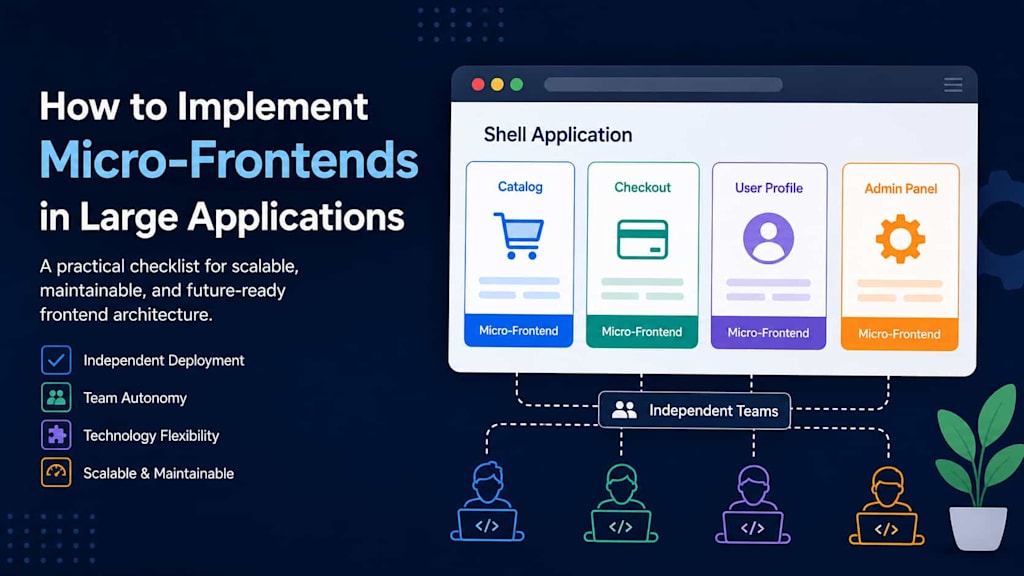
Micro-frontends extend the principles of microservices to the frontend layer. Instead of building a single, monolithic UI, the application is divided into smaller, self-contained units that can be developed and deployed independently.
Each micro-frontend typically represents a feature, domain, or business capability. For example, an e-commerce platform might separate its UI into product catalog, checkout, user profile, and admin dashboard micro-frontends.
- The key characteristics include:
- Independent deployment pipelines
- Decoupled codebases
- Team autonomy
- Technology flexibility
This flexibility is particularly useful when considering React vs Vue vs Angular, as different teams can choose frameworks that best suit their needs without affecting the entire application.
However, this freedom comes with trade-offs. Without proper governance, micro-frontends can lead to inconsistency in UI/UX, duplicated dependencies, and increased complexity in integration.
Core Architectural Patterns
There are several ways to implement micro-frontends:
1. Build-Time Integration
All micro-frontends are compiled into a single bundle during build. This approach is simple but reduces independence between teams.
2. Run-Time Integration via JavaScript
Micro-frontends are loaded dynamically in the browser. Tools like module federation enable sharing dependencies across applications.
3. Server-Side Composition
Fragments are rendered on the server and assembled into a complete page. This is useful for SEO-sensitive applications and can include SSR capabilities (mentioned once as required).
4. Edge-Side Includes (ESI)
Fragments are composed at the CDN level, improving performance but adding infrastructure complexity.
Each approach has its place, and the right choice depends on your scale, team structure, and performance requirements.
Planning the Transition from Monolith to Micro-Frontends
Moving to a micro-frontend architecture is not just a technical shift—it’s an organizational transformation.
Identify Domain Boundaries
Start by breaking your application into logical domains. These domains should align with business capabilities rather than technical layers.
For example:
- Authentication
- Payments
- Search
- User profiles
Avoid splitting by UI components alone. Instead, focus on cohesive functionality.
Define Team Ownership
Each micro-frontend should be owned by a dedicated team. This ensures accountability and faster decision-making.
Key responsibilities include:
- Development and maintenance
- Deployment pipelines
- Monitoring and error handling
Clear ownership reduces coordination overhead and speeds up delivery.
Establish Shared Standards
While teams work independently, consistency is critical. Define shared standards for:
- Design systems
- Accessibility
- API contracts
- State management patterns
Without these, the user experience may become fragmented.
Choose Integration Strategy Early
Your integration strategy will influence your entire architecture. Decide whether you’ll use:
- Client-side composition
- Server-side rendering
- Hybrid approaches
Changing this later can be costly and complex.
Tools and Technologies for Micro-Frontend Implementation
Selecting the right tools is crucial for success in frontend development at scale.
Module Federation
Webpack Module Federation is one of the most popular solutions for runtime integration. It allows applications to share code dynamically without rebuilding.
Benefits:
- Shared dependencies
- Reduced bundle size
- Independent deployments
Challenges:
- Version conflicts
- Debugging complexity
Single-SPA
Single-SPA is a framework for orchestrating multiple frontend applications. It supports multiple frameworks within the same application.
Use cases:
- Gradual migration from monolith
- Multi-framework environments
Web Components
Web Components provide a framework-agnostic way to build reusable UI elements.
Advantages:
- Encapsulation
- Interoperability
- Standardized APIs
However, they may require additional tooling for state management and routing.
Monorepos vs Polyrepos
Decide how to structure your repositories:
Monorepo
- Easier dependency management
- Shared tooling
- Faster onboarding
Polyrepo
- Greater independence
- Cleaner separation
- Flexible release cycles
Both approaches work, but your choice should align with team structure and deployment strategy.
Managing Communication and State Across Micro-Frontends
One of the biggest challenges in micro-frontends is handling communication between independent units.
Shared State Management
Avoid global state whenever possible. Instead:
Use local state within each micro-frontend
Share state only when necessary
Prefer event-driven communication
Event Bus
An event bus allows micro-frontends to communicate without direct dependencies.
Example:
User logs in → emit event
Other micro-frontends react accordingly
This decouples components and improves scalability.
URL-Based Communication
Routing can act as a communication mechanism. For example:
Query parameters
Path segments
This is simple and aligns well with browser behavior.
API Layer
A well-defined backend API reduces the need for frontend communication. Each micro-frontend can interact directly with backend services.
Benefits:
Reduced coupling
Clear data contracts
Easier testing
Handling Shared Dependencies
To avoid duplication:
Use shared libraries via module federation
Maintain version compatibility
Monitor bundle size
Dependency management becomes critical as the number of micro-frontends grows.
Deployment, Testing, and Performance Optimization
A robust deployment strategy ensures that micro-frontends deliver on their promise of independence.
Independent Deployment Pipelines
Each micro-frontend should have its own CI/CD pipeline. This allows:
Faster releases
Reduced risk
Easier rollback
However, coordination is still needed for breaking changes.
Testing Strategies
Testing becomes more complex in distributed systems.
Unit Testing
Focus on individual components
Integration Testing
Validate interactions between micro-frontends
End-to-End Testing
Ensure overall user experience
Automated testing is essential to maintain quality.
Performance Considerations
Micro-frontends can introduce performance overhead if not managed properly.
Key areas to optimize:
- Lazy loading
- Code splitting
- Shared dependencies
- Caching strategies
Avoid loading all micro-frontends at once. Instead, load them as needed.
Monitoring and Observability
Implement monitoring at both micro and macro levels:
- Error tracking
- Performance metrics
- User behavior analytics
Centralized logging helps identify issues across micro-frontends.
Security Considerations
With multiple independently deployed units, security becomes more complex.
Best practices:
- Enforce authentication at a central level
- Validate inputs rigorously
- Use secure communication protocols
Consistency in security policies is critical.
Governance, Team Scaling, and Long-Term Maintainability
As organizations adopt micro-frontends, the initial architectural decisions are only part of the journey. Long-term success depends heavily on governance, team coordination, and the ability to scale both technically and organizationally. Without a clear strategy in these areas, even the most well-designed micro-frontend system can degrade into fragmentation and inconsistency.
Establishing Governance Without Slowing Teams Down
One of the biggest misconceptions about micro-frontends is that they eliminate the need for coordination. In reality, they shift the nature of coordination from centralized control to structured governance.
Governance should focus on enabling teams rather than restricting them. This includes:
- Defining shared UI/UX guidelines
- Maintaining a centralized design system
- Establishing naming conventions and coding standards
- Creating clear API contracts
The goal is to avoid a situation where each micro-frontend feels like a completely different product. While independence is important, users should experience a unified interface.
A practical approach is to introduce a platform team responsible for shared concerns such as:
- Design systems
- Authentication mechanisms
- Shared libraries
- Performance optimization guidelines
This team does not control feature development but ensures consistency and quality across the ecosystem.
Design Systems as a Backbone of Consistency
A strong design system is essential in micro-frontend architectures. It acts as a contract between teams, ensuring that independently developed features still feel cohesive.
Key elements of a design system include:
- Reusable UI components
- Typography and color guidelines
- Accessibility standards
- Interaction patterns
These components should be distributed as versioned packages that teams can consume independently. This avoids duplication while allowing controlled updates.
However, strict versioning is important. Breaking changes in shared components can impact multiple micro-frontends simultaneously, so backward compatibility should be a priority.
Managing Versioning and Dependencies at Scale
As the number of micro-frontends grows, version management becomes increasingly complex. Each team may depend on shared libraries, APIs, and design components.
Best practices include:
- Semantic versioning for all shared packages
- Clear deprecation policies
- Automated dependency checks
In runtime-integrated systems (e.g., module federation), dependency conflicts can lead to unexpected behavior. To mitigate this:
- Define allowed versions of critical dependencies
- Use shared dependency configurations
- Monitor bundle duplication
A proactive approach to dependency management prevents technical debt from accumulating over time.
Scaling Teams Alongside Architecture
Micro-frontends are as much about organizational scalability as they are about technical architecture. They enable multiple teams to work in parallel, but this only works if team structures align with system boundaries.
The concept of “team per domain” is particularly effective. Each team owns a specific business capability and its corresponding micro-frontend.
Benefits include:
- Faster development cycles
- Clear accountability
- Reduced cross-team dependencies
However, challenges arise when features span multiple domains. In such cases:
Define clear ownership boundaries
Use API-driven integration
Avoid shared business logic across teams
Cross-functional collaboration is still necessary, but it should happen through well-defined interfaces rather than shared codebases.
Documentation as a First-Class Citizen
In a distributed architecture, documentation becomes critical. Without it, onboarding new developers and maintaining consistency becomes extremely difficult.
Important documentation areas include:
- Architecture overview
- Integration patterns
- API specifications
- Deployment processes
Documentation should be:
- Easily accessible
- Regularly updated
- Owned by responsible teams
Automated documentation generation (e.g., from code or API schemas) can help keep information accurate.
Handling Cross-Cutting Concerns
Certain concerns affect all micro-frontends and require centralized solutions:
Authentication and Authorization
Implement a single authentication mechanism that all micro-frontends rely on. Avoid duplicating login logic across applications.
Error Handling
Standardize how errors are captured and displayed. This improves user experience and simplifies debugging.
Logging and Monitoring
Centralized logging ensures that issues across multiple micro-frontends can be traced effectively.
Internationalization (i18n)
If your application supports multiple languages, ensure that translation mechanisms are consistent across all micro-frontends.
These cross-cutting concerns should be abstracted into shared services or libraries to maintain consistency.
Migration Strategies for Legacy Systems
Most large applications don’t start with micro-frontends—they evolve into them. Migrating from a monolithic frontend requires a careful, incremental approach.
A common strategy is the “strangler pattern”, where new features are built as micro-frontends while gradually replacing parts of the monolith.
Steps include:
- Identify a low-risk feature to extract
- Build it as a standalone micro-frontend
- Integrate it into the existing application
- Gradually replace more features
This approach minimizes disruption and allows teams to learn and adapt during the transition.
Balancing Flexibility and Standardization
One of the core promises of micro-frontends is technological freedom. Teams can choose their own frameworks, tools, and workflows. While this is empowering, it can also lead to fragmentation.
For example, discussions around React vs Vue vs Angular often arise in micro-frontend environments. While supporting multiple frameworks is technically possible, it introduces:
- Increased bundle size
- Higher maintenance overhead
- Steeper learning curves
- A balanced approach is recommended:
- Allow flexibility where it adds value
- Standardize where consistency is critical
For many organizations, this means limiting the number of supported frameworks while still enabling gradual migration or experimentation.
Performance at Organizational Scale
Performance optimization is not just a technical issue—it requires organizational discipline.
Teams should be accountable for:
- Bundle size limits
- Load time targets
- Performance budgets
Introduce performance monitoring tools that provide visibility across all micro-frontends. This ensures that no single team negatively impacts the overall user experience.
Continuous Improvement and Feedback Loops
Finally, micro-frontend architectures should evolve over time. What works today may not be optimal tomorrow.
Establish feedback loops through:
- Regular architecture reviews
- Developer feedback sessions
- Performance audits
Encourage teams to share lessons learned and best practices. This fosters a culture of continuous improvement and prevents repeated mistakes.
Conclusion
Micro-frontends represent a significant shift in how large-scale applications are built and maintained. By breaking down monolithic frontends into smaller, manageable pieces, organizations can achieve greater scalability, faster development cycles, and improved team autonomy.
However, success requires careful planning, strong governance, and the right tooling. From choosing an integration strategy to managing shared dependencies and ensuring performance, every decision impacts the overall system.
When implemented correctly, micro-frontends can transform how teams approach frontend development, making it more modular, flexible, and resilient to change. As applications continue to grow in complexity, adopting this architecture can provide a competitive advantage in both development speed and product quality.
About the Creator
Chudovo
Chudovo is a custom software development company, focused on complex systems implementation.
Enjoyed the story? Support the Creator.
Subscribe for free to receive all their stories in your feed.
Comments
There are no comments for this story
Be the first to respond and start the conversation.