
How to Choose Between Angular, Vue, and React for Startup vs Enterprise Development
Startup speed vs enterprise stability: a practical decision framework for modern frontend teams

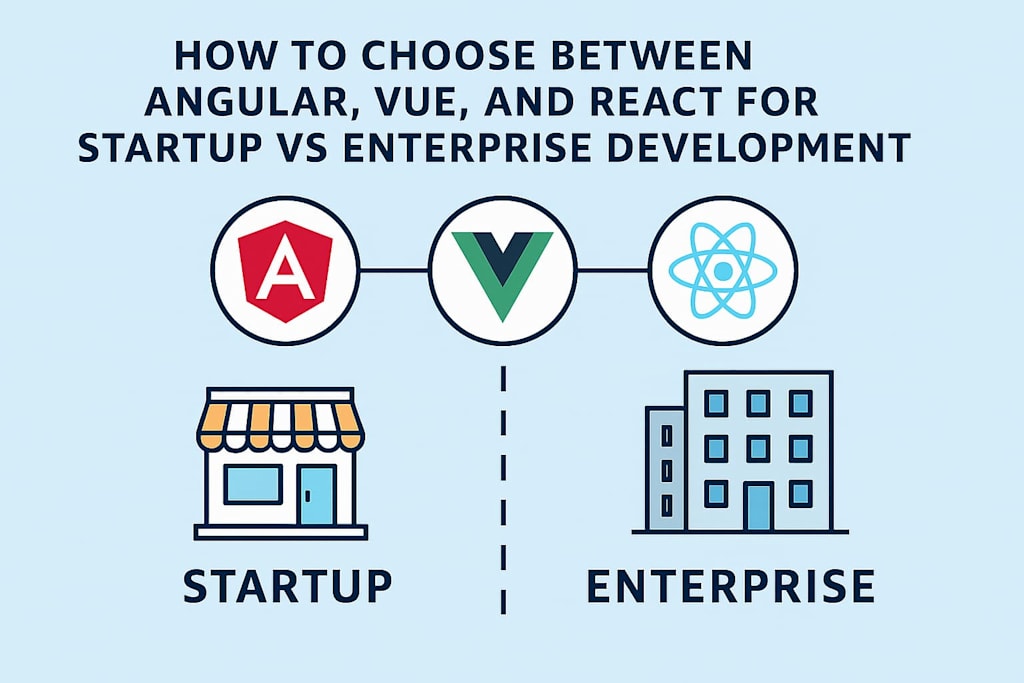
Choosing between Angular, Vue, and React is rarely a purely technical decision. It is a strategic one that reflects how a product will evolve, how teams will scale, and how much organizational structure will be imposed on development over time. The wrong choice does not usually break a project immediately—but it slowly compounds technical friction, hiring difficulty, and architectural inconsistency.
A useful way to approach this decision is through the lens of organizational context: startups prioritize speed and flexibility, while enterprises prioritize consistency, governance, and long-term stability. Angular, React, and Vue map differently onto these needs.
The Core Philosophies Behind Each Framework
Before mapping frameworks to company types, it is important to understand their design philosophies.
Angular: The Structured Enterprise Framework
Angular is a full-fledged framework with strong opinions about architecture. It includes built-in solutions for routing, state management, dependency injection, HTTP handling, and form validation. Its structure enforces consistency across large teams.
This opinionated nature is not accidental—it is designed for large-scale coordination, where multiple teams must work in parallel without breaking each other’s systems.
React: The Flexible Ecosystem
React is not a framework in the strict sense but a UI library. It focuses only on the view layer, leaving architecture decisions (routing, state management, data fetching) to external libraries.
This flexibility allows teams to tailor solutions precisely—but it also introduces variability and architectural divergence if not governed properly.
Vue: The Balanced Middle Ground
Vue sits between Angular and React in terms of structure. It provides a progressive framework with optional tooling and a more guided approach than React, but without Angular’s rigidity.
Vue is often described as “approachable but scalable,” which makes it attractive for teams that want structure without heavy overhead.
Startup Context: Speed, Iteration, and Uncertainty
Startups operate under conditions of uncertainty. Requirements change rapidly, product-market fit is unstable, and speed of iteration often outweighs architectural purity.
What Startups Typically Need
- Fast onboarding of developers
- Rapid iteration cycles
- Minimal architectural overhead
- Flexibility to pivot product direction
- Small to medium-sized engineering teams
React in Startups
React dominates startup environments for a reason: it allows teams to move quickly without forcing architectural constraints.
Because React does not dictate how applications should be structured, startups can:
- Adopt lightweight state management initially
- Swap libraries as needs evolve
- Build minimal viable products quickly
However, this flexibility becomes a double-edged sword. Without discipline, React codebases can become fragmented, especially as teams grow.
Vue in Startups
Vue is often the “quietly optimal” choice for startups that value simplicity.
It provides:
- Faster onboarding than React in some cases
- Cleaner default structure
- Less architectural decision fatigue
Vue’s opinionated templates and built-in patterns reduce early-stage complexity. For small teams without deep frontend specialization, this can significantly reduce cognitive load.
Angular in Startups
Angular is less common in early-stage startups for one key reason: overhead.
It introduces:
- Steeper learning curve
- More boilerplate
- Strong architectural constraints
For a startup iterating quickly, Angular can feel heavy. However, it is not inherently unsuitable. Startups building complex, enterprise-like systems from day one (for example, fintech platforms or B2B SaaS with strict domain modeling) may benefit from Angular’s structure.
Still, in most startup contexts, Angular slows down early experimentation.
Enterprise Context: Scale, Governance, and Stability
Enterprise environments are fundamentally different. The primary challenge is not speed, but coordination at scale.
What Enterprises Typically Need
- Consistent architecture across teams
- Long-term maintainability (5–10+ years)
- Strong typing and predictable structure
- Onboarding consistency for large teams
- Robust tooling and conventions
Angular in Enterprises
Angular is often the default choice in large enterprises for structural reasons.
Its advantages include:
- Strong opinionated architecture
- Built-in solutions reduce fragmentation
- TypeScript-first design improves reliability
- Consistent patterns across teams
Enterprises benefit from Angular because it reduces decision-making variance. When 10+ teams are working on the same platform, consistency matters more than flexibility.
Angular’s dependency injection system and module architecture also support large-scale modularization, making it suitable for complex internal systems, dashboards, and enterprise SaaS platforms.
However, Angular’s rigidity can slow innovation if the organization requires rapid UI experimentation or frequent redesigns.
React in Enterprises
React is widely used in enterprises, but typically with strict internal conventions.
Enterprises adopt React when they need:
- Large hiring pool
- High flexibility for product teams
- Integration with diverse tooling ecosystems
However, React alone is not enough at enterprise scale. It must be paired with:
- Strict architecture guidelines
- Standardized state management (e.g., Redux, Zustand, or similar)
- Design systems and component libraries
- Code governance tools
Without these, React can become inconsistent across teams.
The strength of React in enterprise settings is its ecosystem. The weakness is the burden of governance.
Vue in Enterprises
Vue is less common in very large enterprises, but it is growing in adoption for mid-sized enterprise systems.
It offers:
- A balance between structure and flexibility
- Lower onboarding friction than Angular
- Cleaner default patterns than React in unregulated environments
However, enterprises sometimes hesitate due to:
- Smaller talent pool compared to React
- Less standardized enterprise adoption patterns
- Fewer “batteries-included” enterprise conventions compared to Angular
Vue works well in enterprises that prioritize developer experience and incremental scaling over strict architectural enforcement.
Key Decision Factors (Startup vs Enterprise Lens)
Instead of asking “which framework is best,” the real question is:
What kind of organizational problems are you optimizing for?
1. Team Size and Coordination Complexity
- Small teams (1–10 developers): React or Vue
- Medium teams (10–50): Vue or structured React
- Large teams (50+): Angular or heavily governed React
2. Speed vs Stability Trade-off
- High-speed iteration: React or Vue
- Stability and consistency: Angular
3. Hiring Strategy
- React: largest talent pool, easiest hiring globally
- Angular: strong enterprise engineers, fewer junior entrants
- Vue: smaller but often highly productive niche talent pool
4. Architecture Control
- Minimal control: React
- Balanced control: Vue
- Strict control: Angular
5. Product Lifecycle Stage
- MVP / early-stage: React or Vue
- Growth stage: React with structure, or Vue
- Mature enterprise systems: Angular or governed React
Common Strategic Mistakes
Mistake 1: Choosing Based on Popularity Alone
React’s popularity often drives default adoption, but popularity does not equal suitability.
Mistake 2: Over-Engineering Early-Stage Startups
Startups choosing Angular too early often slow down iteration speed unnecessarily.
Mistake 3: Under-Structuring Enterprise React
Enterprises adopting React without strict conventions often face fragmentation across teams.
Mistake 4: Ignoring Long-Term Hiring Reality
Vue may feel efficient, but enterprise hiring pipelines are often more React- or Angular-heavy.
A Practical Decision Framework
A simplified decision model:
- If you are a startup building an MVP quickly → React or Vue
- If you are a startup building a complex domain-heavy system → Vue or Angular (selectively)
- If you are a mid-sized scaling product team → React with structure or Vue
- If you are a large enterprise with multiple teams → Angular or strictly governed React
Final Perspective: Frameworks Reflect Organizational Maturity
Angular, Vue, and React are not just technical tools—they encode assumptions about how teams operate.
- React assumes freedom and responsibility
- Vue assumes balance and simplicity
- Angular assumes structure and discipline
Startups benefit most from freedom. Enterprises benefit most from discipline. Mid-sized organizations often live in the tension between both.
The right choice is not the one that feels most modern or popular—it is the one that minimizes friction between your technical system and your organizational reality.
In that sense, choosing a framework is less about technology preference and more about understanding how your team will work when the product inevitably becomes more complex than it is today.
About the Creator
Markus Koch
I am a professional IT consultant with 5+ years of experience.
Enjoyed the story? Support the Creator.
Subscribe for free to receive all their stories in your feed.
Comments
There are no comments for this story
Be the first to respond and start the conversation.