
How to Identify Enterprise Workflows That Are Ready for AI Automation
A practical approach to assessing process stability, data readiness, business value, and operational risks before introducing AI-powered automation.

Why Workflow Assessment Should Come Before AI Automation
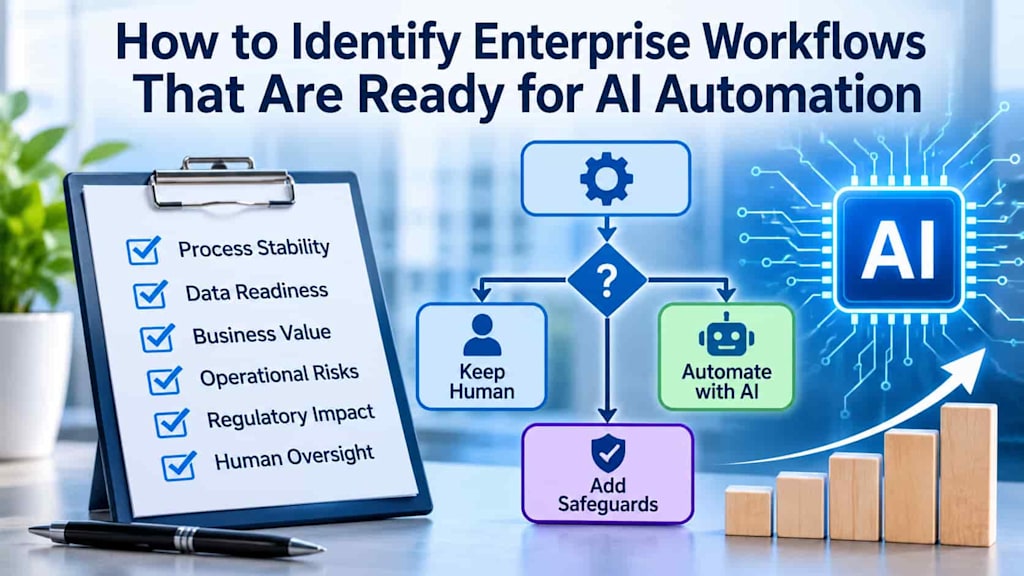
Enterprise organizations are increasingly exploring artificial intelligence to reduce manual work, improve decision-making, and accelerate business processes. However, successful automation begins long before selecting an AI solution. Companies must first determine which workflows are suitable for automation, which require human judgment, and which carry risks that outweigh their potential benefits.
Not every repetitive business activity is a good candidate for AI. Some processes depend on incomplete information, unpredictable exceptions, or decisions that require professional expertise. Automating these workflows without proper assessment can introduce errors, increase operational costs, and create additional compliance challenges.
For CTOs, solution architects, and enterprise software developers, the first step is to evaluate existing operations systematically. This involves examining how work moves between employees and departments, identifying recurring bottlenecks, measuring process performance, and understanding the consequences of incorrect decisions.
A structured assessment also helps organizations avoid investing in automation simply because a technology is available. The objective is to identify business processes where AI can deliver measurable improvements without introducing unacceptable operational risks.
Assess Process Stability and Complexity
Process stability is one of the strongest indicators of automation readiness. Workflows with clearly defined inputs, predictable steps, and consistent outcomes are generally easier to assess than activities that change significantly depending on circumstances.
Organizations should begin by documenting how a process operates in practice rather than relying exclusively on formal procedures. Employee interviews, workflow observations, and historical performance records can reveal differences between documented processes and everyday operations.
Several characteristics indicate that a workflow may be ready for AI automation:
Repeatability: The process handles similar tasks regularly and follows recognizable patterns.
Defined inputs: Employees receive information in reasonably consistent formats.
Measurable outcomes: Results can be evaluated using indicators such as processing time, error rates, or cost per transaction.
Manageable exceptions: Unusual cases occur infrequently or can be identified and redirected for review.
Stable procedures: Business rules and responsibilities do not change constantly.
Consider invoice processing in a large enterprise. Employees may repeatedly extract information from invoices, compare amounts against purchase orders, and identify missing documentation. These activities are relatively structured and offer clear opportunities for automation.
By contrast, negotiating a complex supplier contract involves changing commercial conditions, competing priorities, and contextual judgment. AI may help employees review documents or summarize proposed changes, but the overall decision-making process is less suitable for autonomous execution.
Complexity should not automatically disqualify a workflow. Instead, organizations should distinguish between individual tasks within a complex process. A business activity that requires substantial human expertise may still contain smaller, well-defined steps suitable for automation.
Evaluate Data Availability and Quality
AI automation depends on the information available to support a task. Even a stable workflow may be unsuitable if its inputs are incomplete, inconsistent, outdated, or difficult to interpret.
Before implementation, organizations should examine where process data originates, how consistently employees record information, and whether historical records accurately represent normal operations.
For example, a finance department might want to automate expense categorization. If employees use inconsistent descriptions, receipts are frequently missing, and expense categories change between departments, the process may require data cleanup before automation can produce reliable results.
A practical data-readiness assessment should address four questions:
Availability: Are the necessary records accessible for evaluating the workflow?
Completeness: Do the records contain the information required to perform the task?
Consistency: Are similar transactions represented in comparable ways?
Representativeness: Does the available data reflect routine cases as well as important exceptions?
Organizations should also consider whether their records capture the circumstances surrounding previous decisions. Historical outcomes alone may not explain why employees approved a transaction, rejected an application, or escalated a particular case.
When data quality is weak, improving information collection may deliver more value than immediately introducing AI. Companies should identify these limitations early and include the cost of addressing them in their automation assessments.
This step is particularly important when evaluating opportunities involving integrating generative AI into enterprise applications, because the usefulness of AI-generated summaries, classifications, and recommendations depends heavily on the relevance and reliability of the information being assessed.
Measure Expected Business Value
Automation readiness is not determined by technical feasibility alone. A workflow may be straightforward to automate but offer little financial or operational benefit.
Organizations should estimate the potential value of each candidate using measurable business indicators. These may include processing costs, employee time, transaction volumes, error rates, customer waiting times, and the frequency of repetitive administrative tasks.
A useful starting point is to estimate the current annual cost of performing a workflow manually and compare it with the expected cost after automation. The assessment should account for implementation expenses, ongoing maintenance, employee training, exception handling, and the time required for human review.
For example, suppose a finance department processes 20,000 invoices annually. Employees spend an average of eight minutes on each invoice, including routine data checks. If automation reduces average handling time by three minutes, the theoretical time saving is 1,000 hours annually.
However, this estimate should not automatically be treated as a direct financial saving. Employees may still need to review exceptions, verify selected transactions, and correct inaccurate results. The actual benefit depends on how much of the released capacity can be used productively.
Organizations should also consider benefits that are not immediately reflected in labor costs. Faster processing, fewer administrative errors, improved service levels, and better access to business information may justify automation even when direct savings are modest.
When integrating AI into existing enterprise systems is being considered, decision-makers should evaluate the business outcome rather than treating the number of automated tasks as the primary measure of success.
Compare Automation Opportunities by Risk
Operational risk is another essential factor in determining whether a workflow is ready for AI. An incorrect result in a low-impact administrative task may require only a minor correction. The same type of error in a healthcare, financial, or insurance process could have serious consequences.
Organizations should assess both the likelihood of an error and its potential impact. They should also consider how easily mistakes can be detected, reversed, and corrected before affecting customers or business operations.
The following comparison illustrates how different workflows can be prioritized.
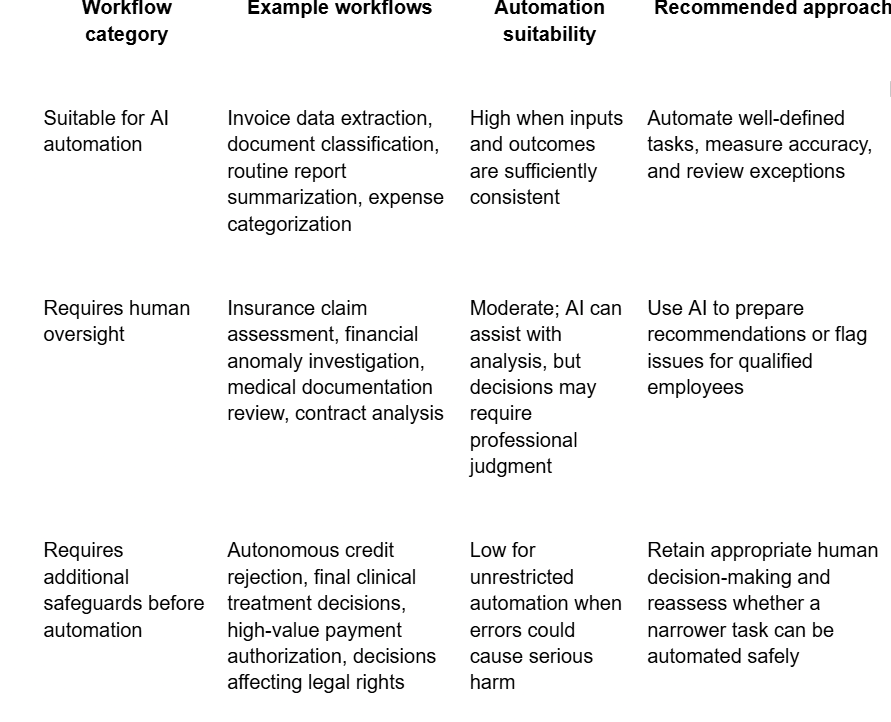
These categories are not permanent classifications. A workflow that initially requires extensive supervision may become more suitable for automation after process standardization, better data collection, and improved exception handling.
Conversely, a workflow that appears simple may become unsuitable if its responsibilities expand or the consequences of errors increase.
Account for Regulatory Requirements in Sensitive Industries
Regulatory requirements can significantly influence which automation opportunities should receive priority. In regulated industries, the consequences of an incorrect decision extend beyond operational inefficiency. Organizations may face legal exposure, financial penalties, customer harm, or damage to their reputation.
Healthcare provides a clear example. AI may help classify medical documents, summarize patient records, or identify missing information in administrative workflows. These activities can reduce paperwork and help professionals access relevant information more efficiently.
However, using AI to determine a diagnosis or recommend treatment involves a different level of risk. Such decisions require appropriate clinical expertise, consideration of individual circumstances, and careful assessment of the applicable legal and professional requirements.
Finance presents similar distinctions. Automating the extraction of information from loan applications may be a reasonable opportunity, provided accuracy and data handling are appropriately assessed. Automatically rejecting applicants, however, can raise concerns about fairness, explainability, and the ability to challenge consequential decisions.
Insurance companies must consider comparable issues when assessing claims, detecting potential fraud, or determining eligibility for benefits. AI can help identify inconsistencies and prioritize cases for investigation, but ambiguous or high-impact cases may require specialist review.
When evaluating automation risks in regulated industries, businesses should examine the sensitivity of the information involved, the consequences of incorrect outputs, the ability to explain decisions, and the applicable requirements for human involvement.
This assessment supports balancing compliance requirements with automation goals. Rather than abandoning automation entirely, organizations can prioritize lower-risk supporting activities while retaining human control over decisions that require accountability, professional judgment, or additional legal safeguards.
Regulatory obligations vary by jurisdiction, industry, and intended use. Requirements should therefore be assessed for each specific workflow instead of assuming that every application of AI is subject to identical restrictions.
Assess Organizational Readiness and Human Oversight
A workflow may be technically suitable and economically attractive while remaining difficult to automate in practice. Organizational readiness determines whether employees can accommodate changes, whether responsibilities are clearly assigned, and whether the business can manage exceptions effectively.
Decision-makers should examine the availability of process owners, the willingness of employees to adopt new procedures, and the organization's ability to measure performance after automation begins.
Human oversight deserves particular attention. Employees should remain involved wherever contextual judgment, sensitive decisions, or difficult-to-reverse actions make independent AI execution inappropriate.
The required level of supervision depends on the task. Routine document classification may need periodic quality checks, while a financial decision with substantial consequences may require individual approval by an authorized employee.
Organizations should define practical escalation criteria before deployment. These may include incomplete information, conflicting records, low confidence in an AI-generated result, unusual transaction values, or cases outside established business rules.
It is also important to consider how automation affects existing responsibilities. Employees need to understand when they should trust an automated recommendation, when they should question it, and how to report recurring problems.
The broader concept of AI as an operational layer across enterprise systems can help organizations recognize that automation affects multiple business activities rather than isolated tasks. Nevertheless, readiness should be assessed at the workflow level, where responsibilities, expected outcomes, and risks can be evaluated concretely.
Build a Prioritized Automation Roadmap
Once candidate workflows have been assessed, organizations need a consistent method for deciding which opportunities to pursue first.
A practical prioritization process should combine four dimensions: expected business value, process complexity, operational risk, and organizational readiness.
High-value workflows with stable procedures, reliable data, manageable risks, and clear ownership generally make strong initial candidates. They allow organizations to test assumptions, establish performance baselines, and demonstrate measurable results without exposing critical operations to unnecessary uncertainty.
Workflows with significant potential value but poor data quality may deserve a later position on the roadmap. Their immediate priority should be resolving the underlying information problems rather than rushing into automation.
Similarly, processes involving sensitive decisions may benefit from limited automation that supports employees without replacing their judgment.
A simple scoring model can help compare opportunities consistently. Organizations might rate each workflow from one to five across the following criteria:
Expected business value.
Process stability and repeatability.
Data availability and quality.
Operational risk, with higher scores indicating lower risk.
Organizational readiness.
The scores can be weighted according to business priorities. For example, a healthcare organization may assign greater importance to safety and professional oversight, while a shared-services department may emphasize processing efficiency and transaction volume.
The resulting ranking should guide discussion rather than dictate decisions automatically. Business leaders must still consider legal restrictions, strategic dependencies, and exceptional circumstances that a numerical score may not capture.
After selecting initial candidates, organizations should establish baseline performance measures and define the conditions under which automation should be expanded, modified, or suspended. This makes prioritization an ongoing process rather than a one-time exercise.
Conclusion
Identifying enterprise workflows ready for AI automation requires a careful balance of business value, process stability, data readiness, operational risk, and organizational capability. The most attractive opportunities are not necessarily the most complex or technologically ambitious. They are the workflows where automation can produce measurable improvements while maintaining appropriate control over important decisions.
By assessing processes before implementation, organizations can distinguish routine activities suitable for automation from tasks that benefit more from AI-assisted human judgment. They can also identify workflows that require better data, clearer procedures, or additional safeguards before automation becomes practical.
For CTOs, solution architects, and IT decision-makers, the priority is to establish a realistic automation roadmap grounded in business needs and operational constraints. A disciplined assessment process helps organizations direct investment toward the right opportunities, reduce avoidable risks, and build a sustainable foundation for enterprise AI adoption.
About the Creator
Chudovo
Chudovo is a custom software development company, focused on complex systems implementation.
Enjoyed the story? Support the Creator.
Subscribe for free to receive all their stories in your feed.
Comments
There are no comments for this story
Be the first to respond and start the conversation.