
How to Integrate Generative AI Into Existing Enterprise Systems
A Step-by-Step Playbook for Embedding Generative AI Into Your Enterprise Systems

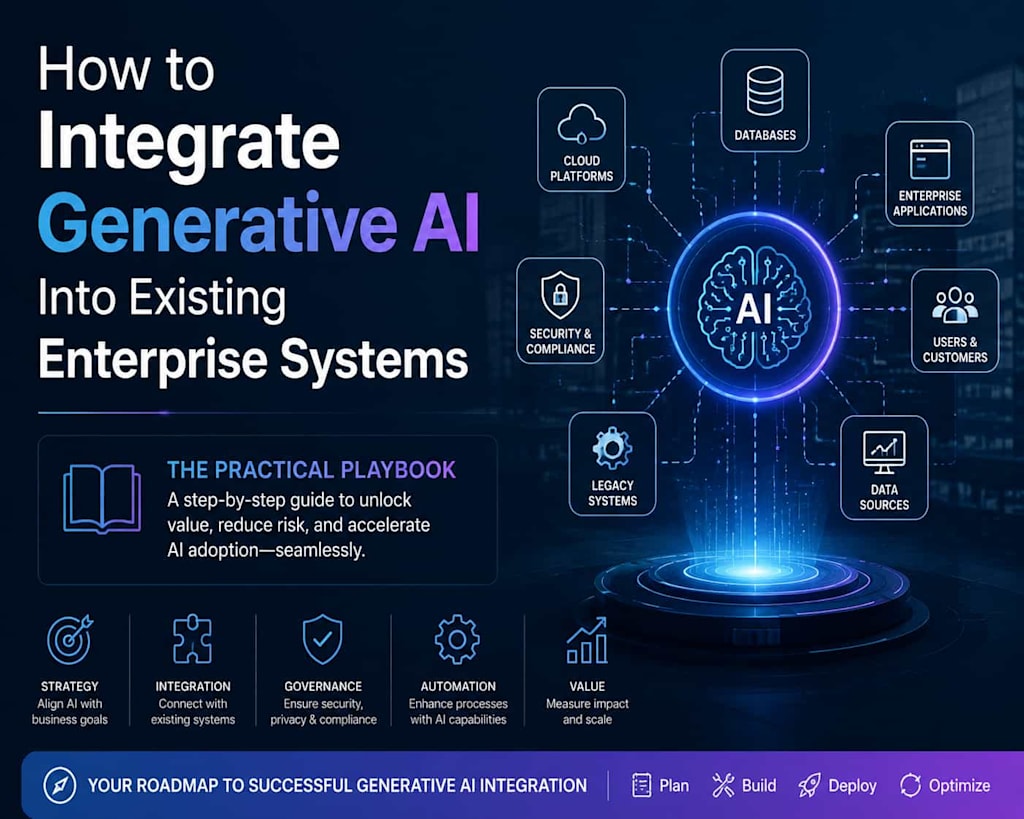
Generative AI is rapidly transforming the way businesses approach automation, data analysis, and customer engagement. From natural language processing to image and video generation, these AI models are unlocking efficiencies and new capabilities across industries. However, integrating generative AI into existing enterprise systems is more than a technical exercise—it requires strategic planning, technical alignment, and careful consideration of infrastructure, workflows, and human factors.
In this guide, we will explore the key steps, best practices, and strategic considerations for successfully integrating generative AI into enterprise environments, ensuring scalability, security, and measurable business impact.
Understanding Generative AI and Its Enterprise Potential
Generative AI refers to machine learning models that can create new content based on patterns learned from existing datasets. Unlike predictive models that only analyze or forecast, generative AI actively produces outputs—ranging from text, images, and audio to structured data. For enterprises, the benefits are substantial:
- Automating content creation: Generate reports, emails, and documentation automatically, reducing human effort.
- Data analysis and summarization: Extract insights from large volumes of unstructured data for strategic decision-making.
- Conversational AI: Enhance customer support through chatbots or virtual assistants that understand and respond intelligently.
- Creative applications: Design marketing materials, product prototypes, or data visualizations.
- R&D support: Model scenarios or suggest solutions for engineering, product design, or operational challenges.
The potential of generative AI is significant, but enterprises must integrate it thoughtfully to realize value. Deploying a large language model or image generator without aligning it to existing systems or workflows often leads to fragmented adoption, errors, or inefficiencies.
Step 1: Evaluate Your Current Enterprise Systems
Before integrating AI, enterprises need a clear understanding of their existing systems:
- Legacy software: Identify critical applications and whether they support modern APIs, microservices, or integration frameworks.
- Data infrastructure: Ensure data is clean, accessible, and in a format suitable for AI input. This includes data lakes, warehouses, and pipelines.
- Security and compliance: Map out access controls, encryption standards, and regulatory obligations such as GDPR, HIPAA, or SOC 2.
- Integration points: Determine where generative AI can deliver value—CRM systems, ERP platforms, BI dashboards, or operational tools.
A thorough audit prevents wasted effort and ensures AI solutions are deployed in areas with the highest potential impact.
Step 2: Define the Use Cases
Not every enterprise process benefits equally from generative AI. Enterprises should define clear use cases that align with business goals, such as:
- Automating customer support responses using AI chatbots.
- Generating predictive analytics reports for executives.
- Summarizing research papers or internal documentation.
- Creating content for marketing campaigns, social media, or product materials.
- Translating legacy data into actionable insights for decision-making.
Each use case should be prioritized based on ROI potential, technical feasibility, and organizational alignment. Starting with high-value, low-risk use cases often helps drive early adoption and confidence in AI tools.
Step 3: Select the Right Generative AI Models
Selecting suitable models is critical for performance, accuracy, and usability. Options include:
- Large Language Models (LLMs): Excellent for text-based tasks like summarization, content generation, and question-answering.
- Generative Adversarial Networks (GANs): Used for generating realistic images, video, or design prototypes.
- Diffusion Models: High-fidelity image, audio, and video generation.
- Fine-Tuned Models: Enterprises with proprietary data benefit from fine-tuning pre-trained models to their domain.
Factors to consider when choosing models include:
- Latency and performance: Real-time applications require fast inference.
- Scalability: Ensure the model can handle enterprise-scale workloads.
- Integration compatibility: Models must work with APIs, cloud services, or on-premises infrastructure.
Step 4: Plan Data Integration and Preparation
Data is the backbone of generative AI. Enterprises must:
- Establish structured access to relevant datasets via APIs, ETL pipelines, or direct database connections.
- Clean and normalize data to remove inconsistencies, duplicates, or biases.
- Annotate data for supervised learning or fine-tuning workflows.
- Implement data governance and compliance procedures, as generative AI often handles sensitive information.
Effective data preparation ensures higher model accuracy and reduces the risk of errors in production.
Step 5: Build the Integration Architecture
A robust integration architecture ensures AI models interact seamlessly with existing enterprise systems:
- API-Based Integration: Connect AI models to applications through REST or GraphQL APIs.
- Microservices Architecture: Deploy AI as modular services that communicate with core enterprise systems.
- Hybrid Cloud Deployment: Combine cloud-based AI services with on-premises infrastructure for security and performance.
- Workflow Orchestration: Coordinate AI tasks with business processes using platforms like Airflow, Prefect, or custom automation tools.
The goal is a seamless extension of workflows where generative AI becomes a natural part of operations rather than a disconnected tool.
Step 6: Ensure Security and Compliance
Generative AI introduces new security and compliance considerations:
- Access Control: Restrict who or what can access AI models and their outputs.
- Data Encryption: Protect inputs, outputs, and model weights in transit and at rest.
- Audit Trails: Maintain logs of AI-generated actions for accountability and traceability.
- Regulatory Compliance: Adhere to GDPR, HIPAA, or industry-specific standards.
Security is critical for enterprise adoption and ensures stakeholders trust AI outputs.
Step 7: Implement User Training and Change Management
Even the best AI tools fail without human adoption. Enterprises should:
- Train staff to interpret and validate AI outputs.
- Educate users on limitations, including model hallucinations or biases.
- Introduce AI gradually with low-risk workflows to build confidence.
- Establish feedback loops to refine outputs based on user experience.
Effective change management ensures that AI solutions are accepted, trusted, and used correctly.
Step 8: Monitor, Measure, and Optimize
Post-integration, continuous monitoring is key:
- Performance Metrics: Track latency, throughput, and error rates.
- Business Metrics: Measure efficiency gains, cost reduction, or customer satisfaction.
- Model Drift: Detect changes in AI behavior or output quality over time.
- Feedback Loops: Incorporate human oversight to correct errors and refine outputs.
Regular optimization ensures AI continues to deliver value as enterprise needs evolve.
Step 9: Scale AI Across the Enterprise
Once initial use cases are successful, scale AI integration:
- Expand into other departments or geographic locations.
- Deploy additional AI models to address new workflows.
- Automate complex, cross-department processes.
- Build internal AI platforms for self-service across teams.
Strategic scaling ensures maximum impact and long-term ROI.
Companies Working with Generative AI
Across different industries and regions, a number of development teams are actively working with generative AI on real-world enterprise projects. While their approaches may vary, they are typically involved in integrating AI models into existing systems, optimizing workflows, and ensuring scalable, secure, and maintainable deployments that deliver long-term business value. Some of these companies include:
- Chudovo
- Accenture
- Sciencesoft
- Webect Digitalagentur
- Enteas
Strategic Considerations
Integrating generative AI requires more than technical execution. Enterprises should think strategically about:
- Long-Term Upgradeability: Ensure AI components can evolve with business needs.
- On-Chain vs. Off-Chain Logic: Decide which processes require full automation and which are advisory.
- Modularity: Design AI modules to interact seamlessly with existing services.
- Risk Management: Implement governance and monitoring to prevent misuse or data breaches.
- Performance Optimization: Balance model complexity with infrastructure costs to maximize efficiency.
Strategic planning ensures AI becomes a transformative enabler rather than a disruptive addition.
Conclusion
Integrating generative AI into existing enterprise systems is a complex, multifaceted process that combines technical skill with strategic planning. From assessing current systems and defining use cases to choosing models, preparing data, building integration architecture, and scaling across the enterprise, success requires careful coordination.
With the right strategy, generative AI can automate routine tasks, enhance decision-making, and unlock creative potential across organizations. Partnering with expert companies and applying best practices ensures enterprises can leverage AI responsibly, efficiently, and effectively, transforming both operations and outcomes.
About the Creator
Chudovo
Chudovo is a custom software development company, focused on complex systems implementation.
Enjoyed the story? Support the Creator.
Subscribe for free to receive all their stories in your feed.
Comments
There are no comments for this story
Be the first to respond and start the conversation.