
How to Exchange Patient Data Between Correctional Facilities and Hospitals
A practical guide to secure, accurate, and interoperable healthcare data exchange across correctional and hospital systems.

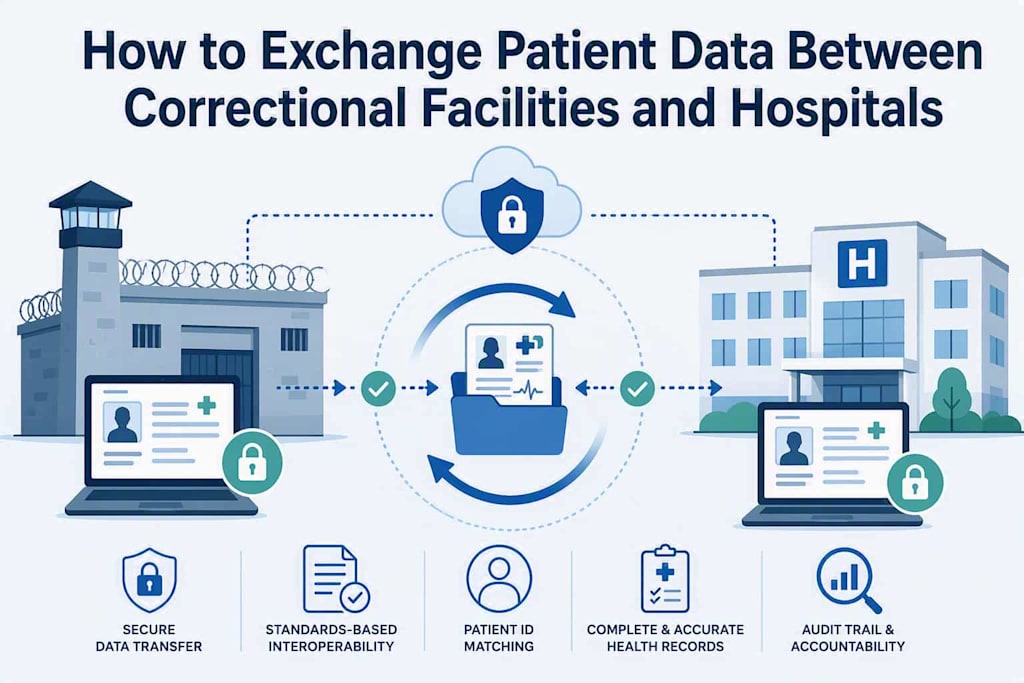
Healthcare data exchange between correctional facilities and hospitals is often more complex than communication between conventional healthcare providers. Patients may be transferred unexpectedly, require emergency treatment outside the facility, attend specialist appointments, or return to custody after hospitalization. In each situation, clinicians need timely access to accurate medical information.
Without effective interoperability, healthcare teams may rely on manual processes, phone calls, paper documents, scanned records, or incomplete data transfers. These methods can delay treatment and increase the risk of medication errors, duplicated tests, and missing clinical information.
A structured approach to patient data exchange can help correctional healthcare providers and hospitals share the right information securely and efficiently. This article explains the key challenges, technologies, and architectural principles involved.
Understand the Data Exchange Challenges
Correctional healthcare operates in a unique environment where clinical requirements intersect with security procedures and institutional boundaries.
A patient transferred from a correctional facility to a hospital may have an extensive medical history, including chronic conditions, medications, allergies, laboratory results, previous procedures, and mental or behavioral healthcare records. However, the hospital may use a completely different electronic health record system.
At the same time, correctional facilities may have additional requirements related to identity management, patient movement, access restrictions, and the separation of clinical and custodial information.
The first step is to determine exactly which information must be exchanged.
Common categories include:
Patient demographics and identifiers
Allergies and adverse reactions
Active and historical medications
Diagnoses and chronic conditions
Laboratory and diagnostic results
Procedures and treatment history
Clinical notes and discharge summaries
Care plans and follow-up instructions
Not every system or user needs access to every piece of information. A well-designed exchange process should provide clinically relevant data while applying appropriate privacy and access controls.
Establish a Reliable Patient Identification Process
Patient matching is one of the most important components of healthcare interoperability.
Correctional facilities and hospitals may use different patient identifiers. Names may also be recorded differently, and demographic information may change over time.
An exchange platform should therefore use a structured patient identity strategy. Depending on the healthcare environment, this may involve a master patient index, identifier mapping, demographic matching, or a combination of approaches.
The system should avoid relying solely on one identifier when matching records. Instead, it can compare multiple attributes, such as:
Full name
Date of birth
Sex
Internal patient identifiers
External healthcare identifiers
Historical demographic information
Potential matches should be handled carefully. Automatically merging records without sufficient confidence can create serious patient safety risks.
A clear patient identity strategy should also define how duplicate records, corrected demographic information, and conflicting identifiers are managed.
Use Standardized Healthcare Data Formats
Interoperability becomes significantly easier when participating systems use common standards.
HL7 and FHIR are among the most important technologies for exchanging healthcare information. Older systems may continue to use HL7 v2 messages, while modern applications increasingly use FHIR resources and APIs.
A typical integration architecture may support both approaches. For example, an integration layer can receive HL7 messages from a hospital system, transform relevant information into FHIR resources, and make that information available to an authorized correctional healthcare application.
This approach supports HL7 and FHIR interoperability in correctional healthcare by allowing organizations to modernize data exchange without requiring every existing system to be replaced immediately.
Relevant FHIR resources may include:
Patient
Encounter
Condition
AllergyIntolerance
MedicationRequest
Observation
DiagnosticReport
Procedure
CarePlan
DocumentReference
Standardized data structures reduce the need for custom point-to-point integrations and make it easier to connect additional systems in the future.
Build an Integration Layer Between Systems
Directly connecting every correctional healthcare application to every hospital system can create a difficult-to-maintain network of integrations.
A better approach is often to use a centralized integration layer or interoperability platform.
This layer can perform several functions:
Receive information from external systems
Transform data between different formats
Validate messages and resources
Route information to the correct destination
Apply security and authorization rules
Monitor data exchange activity
Record errors and failed transactions
For example, a hospital may send an admission or discharge notification to an integration platform. The platform can validate the message, identify the appropriate correctional healthcare organization, transform the information if necessary, and deliver it to the receiving system.
The integration layer should also support retries and error handling. Healthcare data exchange should not silently fail because of a temporary network interruption or unavailable endpoint.
Protect Clinical Data and Separate It from Custodial Information
Security is especially important when exchanging healthcare information involving correctional facilities.
Clinical data should be protected according to applicable healthcare privacy laws and organizational policies. Access should be based on legitimate clinical or operational needs.
One important principle is the separation of healthcare information from custodial or security data whenever possible.
A hospital clinician generally needs medical information required for treatment. Details that are relevant only to facility operations or security should not automatically become part of the clinical record.
Similarly, correctional staff should not receive unrestricted access to sensitive clinical information simply because they are involved in patient transportation or facility management.
The technical architecture should support:
Role-based access control
Strong authentication
Encryption in transit and at rest
Audit logging
Session controls
Data minimization
Secure API communication
Organizations should also define clear procedures for emergency access and document when exceptional access to patient information occurs.
Support Both Scheduled and Emergency Transfers
Patient data exchange workflows can differ significantly depending on the situation.
A scheduled specialist appointment provides time to prepare and transmit a clinical summary. An emergency hospital transfer may require immediate access to critical information.
For emergency scenarios, systems should prioritize information such as:
Allergies
Current medications
Major diagnoses
Recent clinical observations
Relevant laboratory results
Emergency contacts or authorized healthcare contacts, where appropriate
The architecture should be designed to deliver this information quickly without requiring manual compilation of records.
For scheduled transfers, a more complete package can be exchanged before or during the appointment. The hospital can later provide discharge information, medication changes, test results, and follow-up recommendations.
Automation can significantly reduce administrative work in both scenarios.
Enable Secure API-Based Data Exchange
Modern interoperability architectures increasingly use APIs to exchange healthcare information.
FHIR-based APIs can allow authorized applications to retrieve or submit specific clinical resources using standardized operations.
For example, an authorized hospital application could request a patient's current medication list, while the correctional healthcare system could receive an updated discharge summary after treatment.
API security should include strong authentication and authorization. OAuth 2.0 and OpenID Connect can support secure access, while healthcare-specific frameworks such as SMART on FHIR can help define application authorization patterns.
APIs should also implement:
Access scopes
Rate limiting
Input validation
Audit trails
Error monitoring
Versioning policies
The goal should not be to expose an entire patient database through an API. Instead, the API should provide controlled access to the information required for a specific clinical workflow.
Improve Continuity of Care After the Patient Returns
Data exchange should not end when a patient leaves the hospital.
When the patient returns to a correctional facility, the healthcare team may need updated information about diagnoses, procedures, medication changes, follow-up appointments, and discharge instructions.
Automated workflows can notify the correctional healthcare system when new information becomes available.
This is particularly important for patients with chronic diseases or complex treatment plans. Missing a medication change or follow-up recommendation can affect patient safety and lead to avoidable complications.
An EHR for correctional facilities should therefore support the complete care cycle rather than functioning only as an isolated repository of records. Integration capabilities should make it possible to maintain continuity of care before, during, and after treatment outside the facility.
Implement Monitoring, Governance, and Data Quality Controls
A successful interoperability solution requires continuous management.
Organizations should monitor:
Successful and failed transactions
API response times
Data transformation errors
Patient matching issues
Duplicate records
Unauthorized access attempts
Missing or incomplete information
Data quality rules can identify common problems before they affect clinical workflows.
Governance is also important when multiple organizations participate in data exchange. The involved parties should define responsibilities for data ownership, corrections, retention, security, and incident management.
Technical standards alone cannot solve organizational problems. Hospitals, correctional healthcare providers, IT teams, and administrators need clear agreements about how the exchange process operates.
Plan for Gradual Modernization
Many correctional healthcare environments operate with legacy applications that cannot immediately support modern APIs.
A gradual modernization strategy can reduce disruption.
For example, an organization may initially introduce an integration platform that connects existing HL7-based systems with newer FHIR services. Individual applications can then be modernized over time.
This approach avoids requiring a complete replacement of all systems before interoperability improvements can begin.
A phased implementation may include:
Identifying critical data exchange workflows.
Standardizing patient identity management.
Connecting the most important hospital and correctional healthcare systems.
Introducing an integration and validation layer.
Implementing secure APIs.
Expanding the number of supported resources and workflows.
Continuously monitoring performance and data quality.
Starting with high-value workflows allows organizations to demonstrate benefits while reducing implementation risk.
Conclusion
Exchanging patient data between correctional facilities and hospitals requires more than simply connecting two healthcare systems. A reliable solution must address patient identification, standardized data formats, security, workflow automation, data quality, and long-term governance.
HL7 and FHIR can provide the technical foundation for interoperability, while integration platforms and secure APIs can connect systems that were not originally designed to communicate with one another.
The most effective approach is to begin with clearly defined clinical workflows and prioritize the information required for safe patient care. By standardizing data exchange, protecting sensitive information, supporting emergency and scheduled transfers, and gradually modernizing legacy infrastructure, correctional healthcare organizations and hospitals can improve continuity of care and reduce the risks associated with fragmented patient records.
About the Creator
Chudovo
Chudovo is a custom software development company, focused on complex systems implementation.
Enjoyed the story? Support the Creator.
Subscribe for free to receive all their stories in your feed.
Comments
There are no comments for this story
Be the first to respond and start the conversation.