
How to Design Electronic Health Records for Correctional Healthcare Facilities
Building secure, interoperable, and patient-centered EHR systems for the unique demands of correctional medicine.

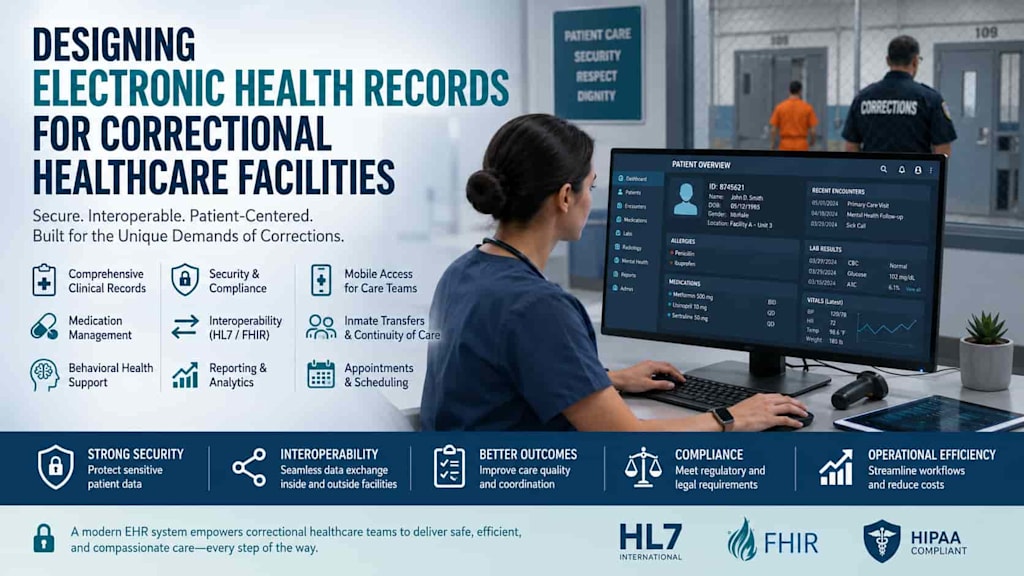
Electronic Health Records (EHRs) have become the foundation of modern healthcare, enabling providers to deliver more efficient, coordinated, and data-driven patient care. While hospitals and private healthcare organizations have widely adopted digital records, correctional healthcare facilities face a unique set of operational, legal, and security challenges that require specialized solutions. Healthcare providers working within prisons and detention centers must balance continuity of care, strict security protocols, regulatory compliance, and interoperability with external healthcare organizations.
Designing an EHR for correctional environments involves much more than adapting a traditional hospital information system. Developers must understand the workflows of correctional institutions, the movement of incarcerated individuals, complex medication management, behavioral health requirements, and strict privacy regulations. A well-designed platform improves patient outcomes, reduces administrative burden, and supports healthcare professionals in delivering timely and accurate medical services.
Understanding the Unique Nature of Correctional Healthcare
Healthcare delivery inside correctional facilities differs significantly from traditional clinical environments. Patients may enter or leave the institution unexpectedly, require transportation to external hospitals, or move between facilities while maintaining continuous medical treatment.
Unlike conventional healthcare organizations, correctional institutions must coordinate healthcare with security operations, inmate management systems, transportation schedules, and legal documentation requirements. As a result, EHR systems must integrate medical workflows with operational processes without compromising patient privacy.
Medical teams often include physicians, nurses, mental health specialists, pharmacists, dentists, and administrative staff working together under strict institutional procedures. The EHR must support collaboration while ensuring that each user only accesses information appropriate to their role.
Defining Core Functional Requirements
Before development begins, organizations should carefully analyze the daily workflows performed by healthcare professionals.
Typical functional modules include:
Patient registration and identification
Medical history management
Clinical documentation
Medication administration records
Laboratory orders and results
Radiology reports
Appointment scheduling
Chronic disease management
Mental health documentation
Dental records
Immunization tracking
Allergy management
Emergency care documentation
Discharge and transfer summaries
The system should also accommodate frequent inmate transfers while preserving a complete medical history.
Prioritizing Security from the Beginning
Correctional healthcare systems manage highly sensitive personal and medical information. Security must therefore be incorporated into every layer of the architecture rather than added later.
Essential security measures include:
Multi-factor authentication
Role-based access control
End-to-end encryption
Secure API communication
Comprehensive audit logs
Automatic session timeouts
Device management
Data encryption at rest
Intrusion detection
Continuous vulnerability monitoring
Every access to patient information should be fully traceable to support compliance and internal investigations when necessary.
Designing for Interoperability
Correctional healthcare rarely operates in isolation. Facilities regularly exchange information with hospitals, laboratories, pharmacies, emergency departments, and public health organizations.
Modern EHR platforms should support widely adopted healthcare standards, including:
HL7
FHIR
DICOM
ICD-10
SNOMED CT
LOINC
Interoperability enables healthcare providers to receive laboratory results automatically, exchange discharge summaries with hospitals, and synchronize medication records across multiple systems.
API-first architecture significantly simplifies future integrations while reducing long-term maintenance costs.
Creating an Intuitive User Experience
Healthcare professionals work in fast-paced environments where every minute matters. Poor interface design increases documentation time and contributes to user frustration.
An effective EHR interface should prioritize:
Minimal data entry
Logical navigation
Clear visual hierarchy
Mobile-friendly layouts
Fast search capabilities
Context-aware forms
Clinical decision support
Keyboard shortcuts
Accessibility compliance
Reducing unnecessary clicks allows clinicians to spend more time caring for patients instead of navigating software.
Supporting Mental and Behavioral Healthcare
Mental healthcare represents a significant component of medical services within correctional facilities.
The EHR should include dedicated tools for:
Behavioral health assessments
Psychological evaluations
Therapy notes
Risk assessments
Suicide prevention monitoring
Substance abuse treatment
Crisis intervention documentation
Care planning
These workflows often differ substantially from traditional physical healthcare documentation and require specialized templates.
Medication Management
Medication administration inside correctional facilities follows strict procedures.
An advanced EHR should support:
Electronic prescribing
Medication verification
Drug interaction alerts
Controlled substance tracking
Automated refill management
Medication administration records (MAR)
Inventory management
Barcode scanning
Accurate medication tracking reduces clinical errors while improving regulatory compliance.
Scalability and Future Growth
Correctional organizations often expand services over time or integrate additional facilities into a centralized healthcare network.
Cloud-native architecture enables organizations to scale infrastructure efficiently while maintaining high availability.
Containerization technologies such as Docker and Kubernetes support:
Elastic scaling
High availability
Simplified deployment
Disaster recovery
Continuous updates
Microservices architecture further improves flexibility by allowing independent updates to specific functional modules.
Leveraging Analytics and Reporting
Healthcare administrators require reliable insights into clinical operations and population health.
Modern reporting capabilities should include:
Chronic disease statistics
Medication utilization
Vaccination rates
Mental health metrics
Appointment utilization
Laboratory turnaround times
Population health trends
Quality improvement indicators
Interactive dashboards help leadership identify operational bottlenecks and allocate resources more effectively.
Compliance and Regulatory Considerations
Correctional healthcare software must comply with multiple legal and regulatory frameworks.
Depending on the jurisdiction, organizations may need to address:
HIPAA
GDPR
CJIS-related security considerations
State healthcare regulations
Medical documentation standards
Data retention requirements
Accessibility standards
Automated compliance features reduce administrative burden while improving audit readiness.
Supporting Mobile Healthcare Teams
Many correctional facilities rely on mobile healthcare staff who deliver services across multiple housing units.
Mobile applications connected to the EHR enable clinicians to:
Access patient records
Update treatment notes
Verify medications
Record vital signs
Capture digital signatures
View laboratory results
Schedule follow-up appointments
Offline functionality can be particularly valuable in environments with limited wireless connectivity.
Migration from Legacy Platforms
Many correctional institutions continue to operate aging healthcare applications that no longer meet modern interoperability, usability, or security requirements.
Successful migration requires a structured approach that includes:
System assessment
Data cleansing
Data mapping
Incremental migration
Validation testing
User training
Performance monitoring
Organizations should avoid replacing every component simultaneously whenever possible. Phased migration minimizes operational disruption while allowing healthcare professionals to adapt gradually.
Projects focused on the modernization of legacy systems in correctional healthcare often achieve the best results when modernization is aligned with long-term digital transformation goals rather than isolated software replacement efforts.
Building for Long-Term Maintainability
Healthcare software continues evolving as regulations, clinical practices, and technologies change.
Maintainability should therefore be a primary architectural objective.
Development teams should prioritize:
Modular architecture
Comprehensive documentation
Automated testing
CI/CD pipelines
API versioning
Code quality monitoring
Security updates
Continuous performance optimization
These practices reduce technical debt while making future enhancements significantly easier.
Emerging Technologies Shaping the Future
Several emerging technologies are expected to influence correctional healthcare EHR platforms over the coming years.
Artificial intelligence can assist with clinical documentation, predictive analytics, and patient risk assessment.
Machine learning models may help identify patients requiring additional medical attention or predict chronic disease progression.
Natural language processing can reduce physician documentation time by converting spoken notes into structured medical records.
Remote patient monitoring, wearable devices, and telemedicine platforms will continue expanding healthcare access within correctional facilities while improving continuity of care.
Best Practices for Successful EHR Design
Organizations planning new EHR initiatives should consider several guiding principles:
Engage healthcare professionals throughout development.
Design workflows around clinical practice rather than software limitations.
Prioritize interoperability from the beginning.
Implement security using a zero-trust approach.
Build modular, scalable architectures.
Automate testing and deployment.
Invest in user training and change management.
Continuously collect user feedback for future improvements.
These practices improve adoption rates and maximize long-term return on investment.
Conclusion
Designing Electronic Health Records for correctional facilities requires a deep understanding of clinical workflows, institutional operations, regulatory requirements, and modern software architecture. Unlike traditional healthcare environments, correctional facilities demand systems that combine exceptional security, seamless interoperability, intuitive usability, and long-term scalability.
By adopting standards-based integration, cloud-ready infrastructure, robust security controls, and user-centered design principles, organizations can create EHR platforms that improve clinical efficiency, support continuity of care, and adapt to future technological advancements. As digital healthcare continues to evolve, thoughtfully designed EHR systems will remain essential for delivering safe, efficient, and high-quality medical services within correctional environments.
About the Creator
Chudovo
Chudovo is a custom software development company, focused on complex systems implementation.
Enjoyed the story? Support the Creator.
Subscribe for free to receive all their stories in your feed.
Comments
There are no comments for this story
Be the first to respond and start the conversation.