
How to Detect Supply Chain Disruptions Before They Cause Delivery Delays
Learn how real-time shipment data and early warning signals help logistics teams prevent disruptions from becoming delivery delays.

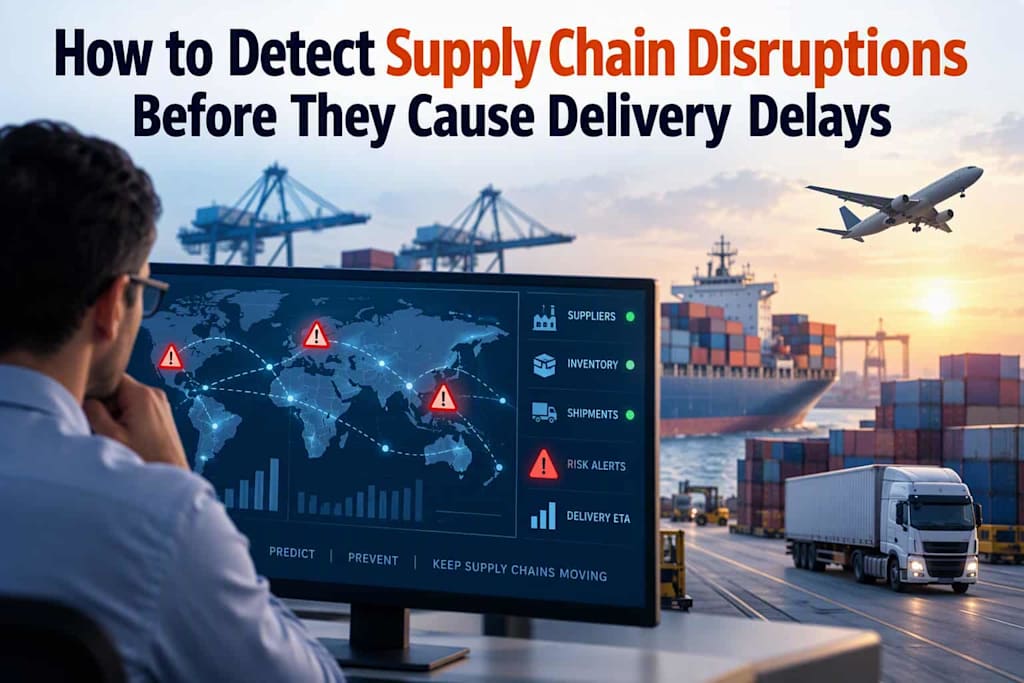
Supply chain disruptions rarely appear out of nowhere. A shipment may start moving later than planned, a carrier may revise an estimated arrival time, or a milestone may remain incomplete longer than expected. Individually, these events can look minor. Together, they can signal a growing problem that eventually affects customer deliveries, production schedules, inventory levels, or transportation costs.
For logistics teams, the challenge is not simply knowing that a shipment is delayed. By the time a missed delivery date is obvious, many opportunities to intervene may already have disappeared. The more useful approach is to identify changes in shipment behavior early, understand what they could affect, and give teams enough time to act.
This requires visibility across shipment events, estimated arrival times, milestones, data quality, and exceptions. With the right information available in real time, logistics operations can move from reacting to problems toward preventing them.
Watch Shipment Events for Early Warning Signs
Every shipment generates a sequence of events. These can include pickup confirmation, departure, arrival at a terminal, customs clearance, transshipment, loading, unloading, and final delivery.
A disruption may become visible through an unexpected event or through the absence of an expected one. For example, if a shipment was supposed to leave a distribution center at 10:00 but no departure event has appeared by noon, the missing update itself may be significant.
Logistics teams should establish expected event sequences for important transportation lanes and monitor deviations from them. This makes it easier to spot shipment risks before they turn into delays instead of waiting for a carrier to report a missed delivery.
The key is context. A two-hour delay at one stage may not matter if sufficient buffer exists later in the journey. The same delay on a shipment with a tight delivery window could require immediate intervention.
Track ETA Changes, Not Just Final Delivery Dates
Estimated arrival time is one of the most useful indicators of developing transportation problems. An ETA can change because of traffic, weather, congestion, missed connections, operational issues, customs delays, or carrier capacity constraints.
However, the important signal is not always the final ETA. Repeated changes can reveal instability before a shipment actually becomes late.
For example, a shipment may initially have an ETA of Friday morning. Several hours later, that estimate moves to Friday afternoon, then Saturday morning. Even if the original delivery deadline has not yet been missed, the repeated revisions indicate that the shipment is becoming less predictable.
Teams can monitor both the size and frequency of ETA changes. A small adjustment may be normal, while several revisions within a short period can trigger closer investigation.
This approach also allows teams to prioritize attention. Shipments with rapidly deteriorating ETAs, limited delivery buffers, or important customer commitments can be escalated before they become critical exceptions.
Monitor Milestone Deviations
Transportation plans are built around milestones. When actual progress differs from the expected timeline, the deviation can provide an early warning.
Consider a shipment expected to reach a port within three days. If it remains at an origin facility for an additional day, the problem is visible before the port arrival deadline is technically missed.
Milestone monitoring should therefore compare planned and actual progress rather than simply checking whether a shipment is currently late.
Useful indicators include:
Pickup occurring later than scheduled
Departure after the planned cutoff
Excessive dwell time at facilities
Missed transshipment connections
Customs clearance taking longer than expected
Arrival at intermediate locations outside the planned window
Delivery appointments approaching without sufficient transit progress
The value of milestone deviation analysis comes from giving teams time to respond. Depending on the situation, they may be able to contact a carrier, change transportation arrangements, notify a customer, adjust inventory plans, or reroute the shipment.
Treat Data Gaps as Potential Exceptions
A lack of information can be just as important as an explicit disruption event.
If a carrier normally sends frequent tracking updates but a shipment suddenly stops reporting its location, logistics teams may not know whether the shipment is moving normally, waiting at a facility, or experiencing a technical problem.
Data gaps can result from disconnected systems, missing carrier integrations, delayed updates, incorrect tracking identifiers, or communication failures. Without monitoring, these gaps can remain invisible until someone notices that a shipment has failed to arrive.
A strong visibility process therefore monitors data freshness as well as shipment status. If no event has been received within an expected period, the system can flag the shipment for review.
This helps distinguish between “nothing is wrong” and “there is not enough information to know whether something is wrong.”
Use Exception Alerts to Focus Human Attention
Real-time visibility does not mean that logistics employees need to monitor every shipment manually. That approach quickly becomes impractical as shipment volumes increase.
Instead, exception management should automatically identify conditions that deserve attention.
Alerts can be triggered by events such as:
ETA moving beyond a delivery commitment
A missed transportation milestone
Excessive facility dwell time
A shipment remaining inactive for an unusual period
A route deviation
A missing tracking update
A significant change in estimated arrival time
A high-priority shipment approaching a risk threshold
The goal is not to generate as many alerts as possible. Too many notifications can create alert fatigue and make genuine risks harder to identify.
Effective exception rules should therefore be based on business impact. A shipment supporting a production line may require a different threshold from a low-priority replenishment shipment.
Connect Carrier and Operational Information
Shipment data often comes from multiple sources. Carriers provide tracking events and ETAs, while internal systems contain purchase orders, inventory information, delivery commitments, warehouse schedules, and customer requirements.
When these sources remain disconnected, teams may have to switch between systems to understand what a shipment problem actually means.
A more integrated approach can bring carrier and operational data into one real-time view, allowing teams to connect transportation events with business consequences.
For example, an updated carrier ETA becomes much more useful when it can be compared with the required delivery date, available inventory, production schedule, and customer priority. Instead of simply seeing that a shipment is running late, the logistics team can understand which operations may be affected.
This creates a stronger basis for prioritization and intervention.
Move From Reactive Response to Proactive Intervention
The ultimate objective of disruption monitoring is not better reporting. It is earlier action.
Once a potential problem has been identified, teams need clear workflows for deciding what happens next. Depending on the disruption, possible responses may include contacting the carrier, requesting a new delivery appointment, changing the transportation mode, rerouting freight, adjusting warehouse plans, or communicating revised expectations to customers.
Real-time information supports these decisions by reducing the time between an operational change and its discovery.
It can also help organizations keep supply chain operations connected when disruptions occur, because teams across transportation, warehousing, procurement, customer service, and operations can work from the same current information.
The earlier a risk becomes visible, the more options the organization generally has. Once a shipment has already missed a critical delivery window, available alternatives may be considerably more limited.
Build a Continuous Monitoring Process
Detecting disruptions consistently requires more than implementing a tracking dashboard. Organizations should define which signals matter, what thresholds indicate risk, who receives alerts, and which actions should follow.
A practical monitoring process can include four stages:
Capture: Collect shipment events, ETAs, milestones, and carrier updates.
Compare: Measure actual progress against planned schedules and delivery commitments.
Identify: Detect exceptions, unusual patterns, ETA deterioration, and data gaps.
Act: Route meaningful exceptions to the teams responsible for intervention.
Historical data can make this process more effective over time. If certain lanes, carriers, facilities, or milestones repeatedly generate disruptions, organizations can investigate those patterns and adjust planning assumptions or monitoring thresholds.
Conclusion
Supply chain disruption management starts before a shipment becomes officially late. Changes in ETA, missed milestones, unusual dwell times, missing tracking events, and inconsistent data can all provide valuable warning signals.
By combining these indicators with real-time visibility and exception-based workflows, logistics teams can identify developing risks earlier and respond while there are still practical options available. The result is a shift from waiting for delivery problems to become obvious toward continuously monitoring shipment health and taking action before disruptions reach customers.
About the Creator
Chudovo
Chudovo is a custom software development company, focused on complex systems implementation.
Enjoyed the story? Support the Creator.
Subscribe for free to receive all their stories in your feed.
Comments
There are no comments for this story
Be the first to respond and start the conversation.