
How to Build Real-Time Supply Chain Visibility Across Carriers, TMS, WMS, and ERP Systems
A practical approach to integrating logistics systems and turning fragmented shipment data into a reliable real-time view.

Why Supply Chain Visibility Is Difficult
Modern supply chains rarely operate through a single system. A typical shipment may involve several carriers, a transportation management system (TMS), warehouse management software (WMS), an enterprise resource planning platform (ERP), freight forwarders, customs providers, and external logistics partners.
Each system may contain valuable information, but the data is often structured differently and updated at different times. One carrier might report that a shipment has departed, while the TMS still shows it as scheduled. The WMS may know that goods have been picked and packed, while the ERP is waiting for a delivery confirmation.
This fragmentation makes it difficult for logistics teams to answer basic operational questions. Where is the shipment now? Has it left the warehouse? Is it delayed? When should the receiving facility expect it? Which orders are affected by the delay?
Real-time visibility starts with bringing these separate sources into a consistent information flow.
Identify the Events That Matter
The first step is not connecting every available data source. It is identifying the shipment events that actually matter to the business.
Common transportation events include booking, pickup, departure, arrival at a terminal, customs clearance, transfer between facilities, out-for-delivery status, delivery confirmation, and exceptions such as delays or failed delivery attempts.
Warehouse events can include order release, picking, packing, staging, loading, and dispatch. ERP systems may contain purchase orders, sales orders, inventory information, customer commitments, and financial data.
These events need to be connected to the relevant shipment, order, product, location, and business process.
For example, a carrier's "picked up" event should not remain an isolated transportation record. It may indicate that an order has left the warehouse and that inventory is now in transit. Similarly, a delivery confirmation can trigger downstream processes in an ERP system.
The objective is to create relationships between events rather than simply collect more data.
Connect Carriers Through a Common Event Model
Carrier integration is one of the most important components of supply chain visibility. Different carriers expose different APIs, EDI transactions, tracking formats, status codes, and update frequencies.
A visibility platform therefore needs a common event model that translates these differences into standardized business events.
For example, one carrier may use a status such as "departed origin facility," while another may report "linehaul departure." Internally, both can be represented as a standardized departure event.
The system can then connect shipment events across carriers and systems without requiring every downstream application to understand each carrier's proprietary terminology.
This approach also makes it easier to add carriers later. Instead of redesigning the entire application whenever a logistics provider changes, a new integration can map its data to the existing event model.
Integrate the TMS and WMS
The TMS and WMS often contain complementary information.
The WMS knows what has happened to goods inside a warehouse. The TMS knows about transportation planning, carrier assignments, routes, appointments, and shipment execution.
Connecting these systems allows organizations to understand the transition from warehouse activity to transportation activity.
For instance, when a shipment is packed and staged, the WMS can communicate that the goods are ready for loading. The TMS can then associate the shipment with a planned carrier movement. When loading is completed, that event can be matched with the carrier's pickup or departure information.
Without this integration, teams may have to manually compare records from several systems to determine whether a shipment is actually moving.
The integration should also account for exceptions. If a truck arrives late, the system should be able to associate that delay with the relevant warehouse appointment, shipment, and customer order.
Connect ERP Data to Physical Movement
ERP systems provide the business context required to make transportation events meaningful.
A tracking number alone does not explain which customer order, purchase order, production requirement, or inventory commitment is affected. Linking transportation information with ERP records provides that context.
For example, an estimated delivery delay becomes more actionable when the system can identify the purchase orders affected, the destination warehouse, the expected inventory quantity, and the customer commitments associated with those goods.
This does not necessarily mean transferring every ERP record into the visibility platform. Selective integration is often more practical.
The system should receive the information needed to connect logistics events with relevant business objects while keeping ownership of master data clear.
Build a Reliable Data Pipeline
Real-time visibility depends on more than APIs. A reliable data pipeline needs to handle differences in formats, timing, availability, and data quality.
Incoming events should be validated, normalized, and associated with the correct shipment or order. Duplicate events should not create multiple operational records. Late-arriving information should be handled without corrupting the timeline.
The system should also distinguish between the event time and the time when the event was received. A carrier might send a departure notification several minutes after the actual departure occurred.
This distinction is important when organizations use historical data to analyze transportation performance.
Event processing should also be resilient to temporary failures. If a carrier API becomes unavailable, the integration should be able to retry requests or process queued messages when connectivity is restored.
Create a Single Operational View
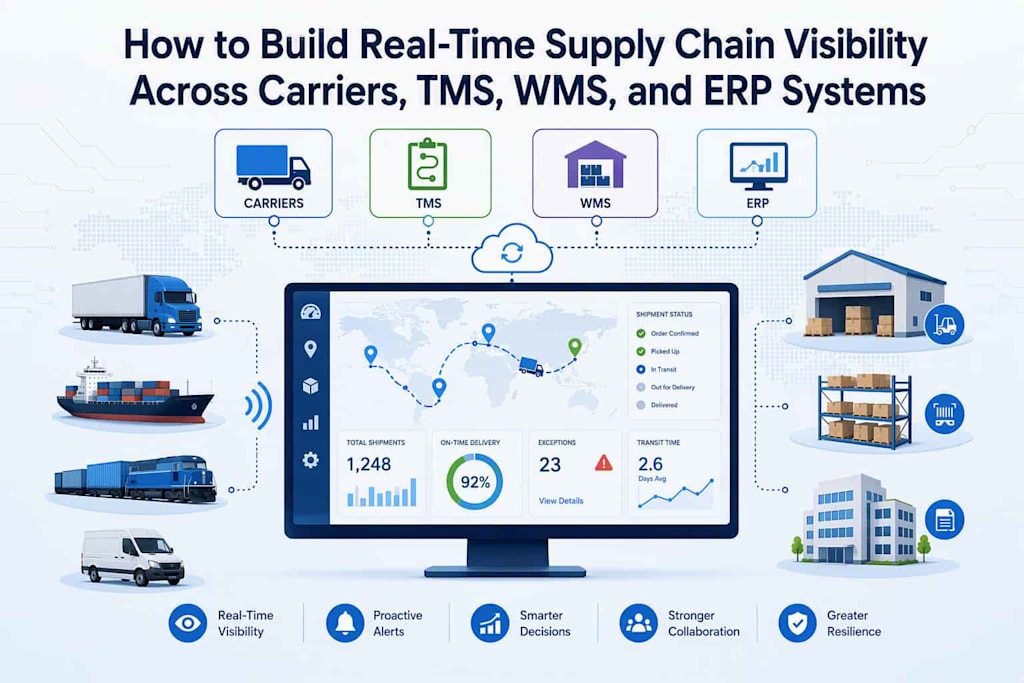
Once data from carriers, TMS, WMS, and ERP systems is normalized, it can be presented through a common visibility layer.
The interface should focus on information that helps users make decisions rather than simply displaying every available data point.
A logistics manager might need to see shipments currently in transit, delayed shipments, upcoming delivery commitments, and unresolved exceptions. A warehouse manager may need visibility into inbound loads and estimated arrival times. Customer service teams may need shipment status connected to specific customer orders.
Different users can therefore consume the same underlying event data through different views.
Maps, timelines, dashboards, alerts, and exception queues can all be useful, but they should support operational decisions rather than become visual features without a clear purpose.
Use Exception Management Instead of Constant Monitoring
Real-time visibility becomes significantly more useful when the system identifies situations that require attention.
Instead of expecting employees to continuously monitor thousands of shipments, the platform can generate alerts when predefined conditions occur.
Examples include a shipment missing a planned departure time, an estimated arrival falling outside a delivery window, a temperature-sensitive shipment exceeding a threshold, or a carrier failing to provide an expected status update.
Exception rules can become increasingly sophisticated as the organization gathers more data.
The key is to avoid excessive notifications. If employees receive alerts for every minor status change, important exceptions can become difficult to identify. Alerts should therefore be connected to meaningful operational thresholds.
Design for Data Quality and Ownership
Supply chain visibility is only as reliable as the information behind it.
Organizations should establish ownership for important data elements such as shipment identifiers, order numbers, carrier information, locations, expected delivery times, and inventory references.
Data quality checks can identify missing identifiers, inconsistent location codes, unexpected status sequences, or conflicting timestamps.
It is also useful to define which system is authoritative for each type of information. The ERP may own order information, the WMS may own warehouse execution events, and the TMS may own transportation planning.
This prevents integration projects from creating competing versions of the same business record.
Scale Gradually Across the Supply Chain
A visibility project does not have to connect every system and logistics provider simultaneously.
Organizations can begin with a specific transportation lane, group of carriers, warehouse network, or business process. Once the integration model is proven, additional sources can be added.
This incremental approach reduces implementation risk and allows teams to discover data-quality and process problems before expanding the platform.
Over time, the visibility layer can connect the moving parts of the supply chain into a more consistent operational picture, while the underlying systems continue to perform their specialized roles.
Conclusion
Real-time supply chain visibility is fundamentally an integration and data-management challenge. Carriers, TMS platforms, WMS applications, and ERP systems each provide valuable information, but that information becomes significantly more useful when events can be associated with the same shipments, orders, locations, and business processes.
A practical implementation starts with the events that matter, establishes a common data model, integrates systems selectively, handles unreliable data gracefully, and presents information through decision-oriented dashboards and alerts.
Organizations do not need to replace their existing logistics technology to achieve better visibility. By creating reliable connections between the systems already in use, they can build a more complete picture of shipment movement and respond to disruptions with greater speed and context.
About the Creator
Chudovo
Chudovo is a custom software development company, focused on complex systems implementation.
Enjoyed the story? Support the Creator.
Subscribe for free to receive all their stories in your feed.
Comments
There are no comments for this story
Be the first to respond and start the conversation.