
How To Design VR Training Scenarios That Produce Measurable Learning Outcomes
Build immersive VR experiences that improve skills, track learner progress, and deliver measurable business results.

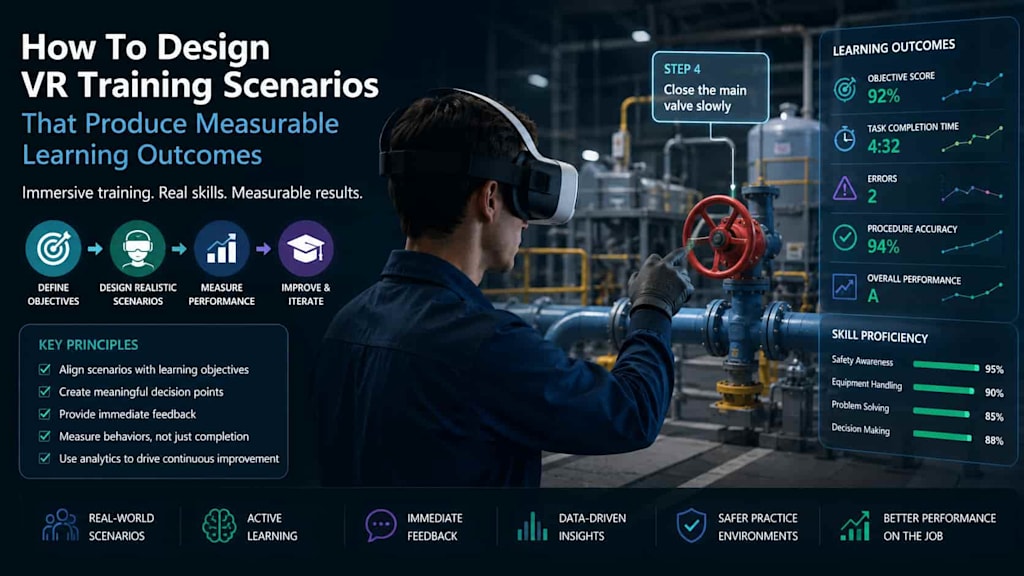
Virtual Reality (VR) has evolved from an emerging technology into a powerful tool for workforce development. Organizations across industries—including healthcare, manufacturing, aviation, logistics, construction, defense, and customer service—are investing in VR-based training to improve employee performance while reducing training costs and operational risks. However, simply placing learners in an immersive virtual environment does not guarantee effective education. The true value of VR training lies in its ability to produce measurable learning outcomes that translate into real-world performance improvements.
Well-designed VR training scenarios combine instructional design, realistic simulations, meaningful feedback, performance analytics, and continuous assessment. Rather than focusing solely on impressive graphics or immersive environments, successful projects prioritize learning objectives from the very beginning.
This article explores how organizations can design VR training scenarios that not only engage learners but also generate measurable, repeatable, and business-focused results.
Begin with Clear Learning Objectives
Every successful VR training program starts with clearly defined objectives. Before creating environments, animations, or interactions, organizations should determine exactly what learners are expected to know or accomplish after completing the training.
Strong learning objectives should be specific, measurable, achievable, relevant, and time-bound. Instead of vague goals like "understand safety procedures," define objectives such as:
Complete emergency shutdown procedures within five minutes.
Correctly identify workplace hazards with at least 95% accuracy.
Perform equipment maintenance without critical errors.
Successfully communicate with virtual customers during difficult situations.
Clear objectives guide every design decision throughout development.
Without measurable goals, it becomes impossible to determine whether the training is effective.
Focus on Real-World Performance
The ultimate purpose of VR training is improving performance outside the virtual environment.
Designers should analyze actual workplace activities before creating scenarios. This often involves interviewing experienced employees, observing daily operations, reviewing incident reports, and identifying common mistakes made by new staff.
The most valuable VR scenarios replicate situations employees genuinely encounter rather than fictional or exaggerated events.
For example:
Manufacturing workers troubleshoot machine failures.
Surgeons practice complex procedures.
Warehouse staff optimize picking operations.
Firefighters navigate hazardous environments.
Customer service representatives handle challenging conversations.
Authenticity increases learner engagement while improving knowledge transfer.
Break Complex Skills into Progressive Scenarios
Learning is most effective when complexity increases gradually.
Instead of overwhelming learners with complicated simulations immediately, divide training into multiple stages.
An effective progression may include:
Introduction to equipment and controls.
Guided practice with instructor assistance.
Independent execution of standard tasks.
Advanced scenarios involving unexpected events.
High-pressure simulations requiring quick decision-making.
Each stage builds confidence while reinforcing previously acquired knowledge.
Progressive learning also makes performance measurement more meaningful because instructors can identify exactly where learners struggle.
Create Meaningful Decision Points
VR excels at allowing learners to make decisions in realistic environments.
Rather than requiring users to simply follow instructions, scenarios should encourage critical thinking.
Examples include:
Selecting appropriate tools.
Prioritizing emergency responses.
Diagnosing equipment failures.
Communicating with virtual coworkers.
Managing limited resources.
Responding to safety hazards.
Every decision should produce logical consequences.
Correct decisions move the scenario forward.
Incorrect decisions should trigger realistic outcomes followed by educational feedback rather than immediate failure.
This approach promotes deeper understanding instead of simple memorization.
Incorporate Immediate Feedback
Traditional classroom training often delays feedback until quizzes or instructor reviews.
VR provides opportunities for continuous guidance.
Feedback may include:
Visual indicators
Audio instructions
Virtual mentors
Performance scores
Safety warnings
Context-sensitive hints
However, excessive guidance can reduce learning.
As learners gain experience, support should gradually decrease, encouraging independent problem-solving.
Adaptive feedback maintains engagement while preventing frustration.
Measure Behaviors Instead of Completion
Many training programs incorrectly measure success by completion rates alone.
Completing a simulation does not necessarily indicate competence.
Instead, evaluate measurable behaviors such as:
Task completion time
Error frequency
Accuracy
Decision quality
Procedural compliance
Communication effectiveness
Resource utilization
Safety performance
Behavioral analytics provide significantly more insight than simple pass/fail results.
Organizations can compare performance across multiple sessions to identify long-term improvement.
Design Scenarios with Assessment Built In
Assessment should not be treated as a separate activity conducted after training.
Instead, evaluation should be embedded naturally throughout the simulation.
For example:
A maintenance technician performing equipment inspections can be assessed continuously based on:
Inspection order
Missed defects
Tool selection
Safety compliance
Repair quality
The learner experiences uninterrupted immersion while the system collects detailed performance data in the background.
These integrated assessments provide richer insights than traditional written examinations.
Build Scalable Technical Foundations
Instructional quality depends partly on technical architecture.
As organizations expand training libraries, scalability becomes increasingly important.
Development teams should carefully consider the software architecture of VR simulators to support modular content, reusable interactions, centralized analytics, and simplified maintenance.
A scalable architecture allows developers to update training scenarios independently without affecting unrelated modules.
Reusable assets also reduce development costs while ensuring consistency across multiple simulations.
Planning architecture early prevents technical debt as training programs grow.
Support Multiple Learning Styles
Not every learner processes information in the same way.
Effective VR experiences combine multiple instructional techniques:
Observation
Hands-on interaction
Visual demonstrations
Guided practice
Independent experimentation
Reflection
Performance feedback
Some learners require repetition.
Others learn quickly through exploration.
Providing multiple paths toward mastery improves both engagement and long-term knowledge retention.
Accessibility options—including subtitles, adjustable difficulty levels, language support, and customizable controls—also broaden training effectiveness.
Collect Actionable Analytics
Modern VR systems can capture far more information than conventional learning environments.
Useful metrics include:
Session duration
Task completion sequence
Object interactions
Eye movement (when available)
Response times
Repeated mistakes
Help requests
Confidence scores
These insights enable instructors to identify patterns across individuals and entire organizations.
Analytics also help refine future training scenarios by revealing which activities consistently challenge learners.
Integrate Training into Organizational Workflows
VR training should not operate as an isolated technology.
Organizations achieve greater value when learning systems connect with existing operational platforms.
Successful VR simulators' integration with existing business systems enables synchronization with learning management systems (LMS), human resources software, maintenance platforms, certification databases, enterprise reporting tools, and analytics dashboards.
Such integrations automate learner enrollment, certification tracking, reporting, and performance management while reducing administrative effort.
Managers gain complete visibility into workforce readiness without manually consolidating information from multiple sources.
Continuously Improve Training Content
No VR training scenario should remain static.
Organizations should regularly evaluate:
Learner feedback
Instructor observations
Performance analytics
Operational changes
Equipment updates
Regulatory requirements
Continuous improvement ensures simulations remain relevant as workplace procedures evolve.
Version control, modular content management, and regular validation sessions help maintain consistency across updates.
This iterative approach transforms VR training into a living educational ecosystem.
Balance Realism with Practicality
Photorealistic graphics alone do not guarantee better learning outcomes.
In many cases, realistic interactions and accurate procedures matter more than visual perfection.
Development resources should prioritize:
Correct workflows
Natural interactions
Reliable physics
Responsive controls
Accurate equipment behavior
Consistent performance
A smooth experience running at high frame rates generally produces better learning than visually stunning environments suffering from lag or discomfort.
The goal is functional realism rather than cinematic presentation.
Collaborate Across Disciplines
Effective VR training requires expertise from multiple domains.
Project teams often include:
Subject matter experts
Instructional designers
UX specialists
3D artists
Software engineers
QA professionals
Data analysts
Learning specialists
Cross-functional collaboration ensures educational goals remain aligned with technical implementation throughout development.
Frequent reviews involving stakeholders prevent costly redesign later in the project.
Prepare for Long-Term Growth
Organizations frequently begin with a single VR training scenario before expanding into comprehensive training ecosystems.
Planning for future growth reduces redevelopment costs.
A comprehensive architectural guide for VR simulators should define reusable interaction frameworks, standardized assessment methods, analytics structures, asset management strategies, deployment workflows, and integration standards.
Establishing these guidelines early simplifies collaboration among development teams while maintaining consistency across future simulations.
Scalable planning also accelerates onboarding for new developers and instructional designers.
Select Technology That Supports Learning Goals
Technology decisions should always serve educational objectives rather than dictate them.
Hardware, engines, networking solutions, analytics platforms, and deployment methods should align with organizational requirements, learner populations, budget constraints, and maintenance capabilities.
When evaluating choosing the right tech stack for VR simulators, organizations should prioritize long-term maintainability, scalability, interoperability, developer expertise, and compatibility with existing enterprise systems instead of selecting technologies based solely on current popularity.
Thoughtful technology choices create stable foundations that support years of content development and continuous improvement.
Conclusion
Designing VR training scenarios that produce measurable learning outcomes requires much more than immersive visuals or advanced hardware. The most successful programs begin with clearly defined learning objectives, realistic workplace simulations, progressive skill development, meaningful decision-making, integrated assessments, and detailed performance analytics. Every element of the learner experience should contribute to measurable improvements that transfer directly to real-world job performance.
Equally important are the technical and organizational foundations supporting the training ecosystem. Scalable architecture, enterprise integration, reusable content, and continuous refinement ensure that VR programs remain effective as business needs evolve. By combining sound instructional design with thoughtful technical planning, organizations can create VR training experiences that not only engage learners but also deliver quantifiable business value, improve operational performance, and build a more capable workforce for the future.
About the Creator
Chudovo
Chudovo is a custom software development company, focused on complex systems implementation.
Enjoyed the story? Support the Creator.
Subscribe for free to receive all their stories in your feed.
Comments
There are no comments for this story
Be the first to respond and start the conversation.