
How to Choose the Right Tech Stack for Enterprise VR Training Simulators
Building scalable, secure, and future-ready immersive training platforms

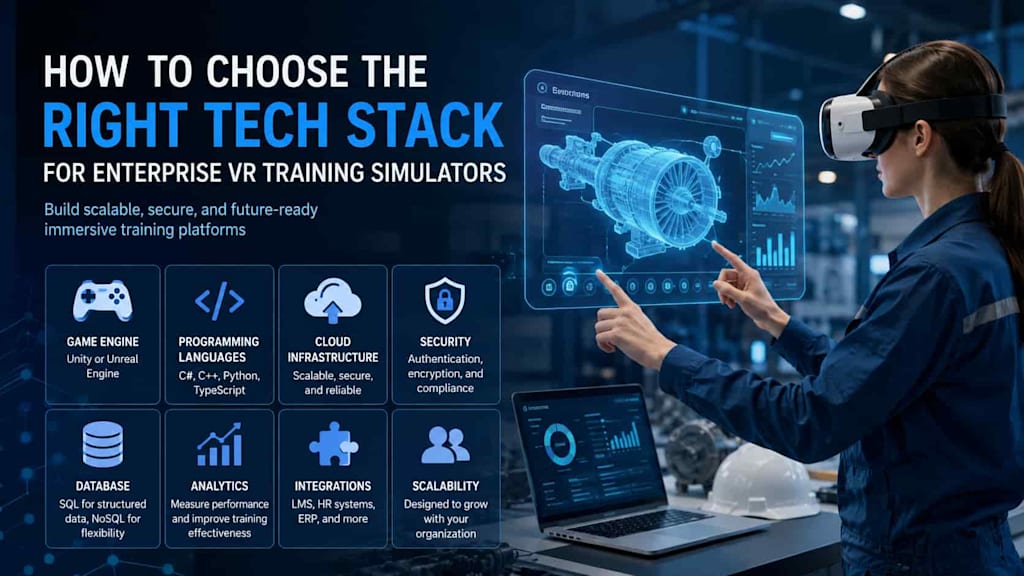
Selecting the right technology stack for enterprise virtual reality projects is one of the most important decisions organizations make before development begins. A well-planned stack influences not only application performance but also long-term maintenance, scalability, security, integration capabilities, and overall return on investment. Unlike consumer entertainment products, enterprise solutions must satisfy demanding business requirements, integrate with existing corporate systems, support multiple hardware platforms, and remain adaptable as technology evolves.
Organizations across manufacturing, healthcare, logistics, aviation, energy, construction, defense, and industrial engineering increasingly rely on immersive technologies to improve employee training. Interactive simulations reduce operational risks, accelerate learning, minimize equipment damage, and provide measurable performance data. However, these advantages only materialize when the underlying technical foundation is carefully designed.
Choosing technologies solely based on popularity or current trends often results in expensive redesigns later. Enterprise software typically remains in production for many years, requiring continuous updates, compatibility improvements, and integration with changing business environments. Therefore, technology selection should prioritize stability, flexibility, and long-term sustainability rather than short-term convenience.
Understanding Enterprise Requirements First
Before comparing programming languages, game engines, cloud platforms, or development frameworks, organizations should clearly define their business objectives.
Some companies need highly realistic simulations for hazardous industrial environments. Others prioritize collaborative learning sessions across multiple locations. Certain industries require strict regulatory compliance and comprehensive audit logs, while others emphasize rapid deployment and content creation.
Important planning questions include:
How many users will access the platform simultaneously?
Which VR headsets must be supported?
Will training occur online, offline, or both?
Is integration required with Learning Management Systems (LMS)?
Will analytics play a central role?
How often will training content change?
Are digital twins part of the long-term roadmap?
What cybersecurity requirements must be met?
Answering these questions early prevents costly architectural changes during development.
Choosing the Right Game Engine
The game engine forms the technological core of most immersive enterprise applications.
Two engines dominate professional development.
Unity remains extremely popular because of its extensive documentation, large developer community, cross-platform deployment capabilities, and rapid prototyping features. Many organizations appreciate its mature ecosystem, numerous plugins, and relatively accessible learning curve.
Unreal Engine excels in delivering photorealistic graphics and advanced rendering technologies. Companies building highly realistic industrial simulations often choose Unreal when visual fidelity directly impacts training effectiveness.
The decision depends on project priorities rather than engine popularity.
If realistic visualization is essential for safety-critical environments, Unreal may provide advantages. If faster iteration, broader platform support, and easier maintenance are primary goals, Unity often becomes the preferred choice.
Programming Languages That Support Long-Term Development
Programming languages influence development speed, maintainability, and hiring opportunities.
C# remains closely associated with Unity development and provides excellent productivity for enterprise applications.
C++ offers exceptional performance and deeper engine customization, making it attractive for complex Unreal Engine projects.
Python frequently appears in enterprise ecosystems for backend automation, machine learning pipelines, analytics, and data processing rather than core VR application development.
JavaScript and TypeScript also contribute to web dashboards, administrative portals, reporting systems, and cloud-based management interfaces.
Rather than relying on a single language, successful enterprise solutions often combine several technologies, each serving its specific purpose.
Cloud Infrastructure Matters
Modern enterprise training rarely operates as isolated desktop software.
Cloud infrastructure enables centralized content distribution, user authentication, analytics collection, asset management, and remote administration.
Organizations commonly evaluate factors such as:
Global availability
Disaster recovery
Data redundancy
Automatic scaling
Identity management
Monitoring tools
Cost optimization
Compliance certifications
Cloud-native architecture also simplifies software updates. Instead of manually updating every workstation, administrators can distribute new learning modules through centralized deployment pipelines.
Hybrid architectures may also be appropriate for organizations operating in environments with limited internet connectivity or strict data residency requirements.
Cross-Platform Compatibility
Enterprise environments rarely standardize on a single hardware vendor forever.
A technology stack should remain flexible enough to support future headset generations without requiring complete redevelopment.
Important compatibility considerations include:
Standalone headsets
PC-connected devices
Mixed reality hardware
Hand tracking
Eye tracking
Future wearable technologies
Adopting open standards where possible reduces vendor lock-in and protects long-term investments.
Hardware independence becomes increasingly valuable as the immersive technology market continues evolving.
Backend Architecture
Many immersive applications involve far more than rendering three-dimensional scenes.
A robust backend often manages:
User accounts
Authentication
Training records
Certification progress
Analytics
Session management
Multiplayer coordination
Content libraries
Administrative permissions
Microservices architecture has become increasingly common because individual services can evolve independently without affecting the entire platform.
Containerization further improves deployment consistency across testing, staging, and production environments.
Database Selection
Database technologies depend on organizational requirements rather than one-size-fits-all recommendations.
Relational databases remain excellent choices for structured employee records, certifications, scheduling, and compliance documentation.
NoSQL databases may better accommodate telemetry, event logs, interaction histories, and rapidly growing analytical datasets.
Many enterprise systems combine multiple database technologies to optimize performance across different workloads.
Choosing appropriate storage strategies early prevents scalability issues as user numbers increase.
Analytics and Performance Measurement
Training effectiveness should be measurable rather than assumed.
Comprehensive analytics allow organizations to evaluate employee progress and continuously improve learning materials.
Useful performance metrics include:
Completion rates
Task duration
Error frequency
Decision accuracy
Repeated mistakes
Reaction times
Knowledge retention
Session engagement
Advanced dashboards transform raw interaction data into actionable business insights.
Managers can identify common training weaknesses while instructional designers refine simulation scenarios based on objective evidence.
Artificial Intelligence Integration
Artificial intelligence is expanding enterprise learning capabilities beyond static scenarios.
AI-powered virtual instructors can adapt conversations according to learner performance.
Intelligent systems may personalize scenario difficulty, generate dynamic events, analyze behavioral patterns, and recommend individualized learning paths.
Speech recognition enables natural interaction with virtual environments.
Computer vision technologies increasingly assist in tracking user behavior and evaluating procedural accuracy.
When selecting a technology stack, organizations should consider whether future AI integration will become a strategic priority.
Building extensible architectures today simplifies adopting emerging AI capabilities tomorrow.
Security Cannot Be an Afterthought
Enterprise applications frequently process sensitive corporate information.
Security considerations should influence architecture from the earliest planning stages.
Important areas include:
Identity management
Multi-factor authentication
Encryption
Secure APIs
Role-based permissions
Audit logging
Network segmentation
Vulnerability management
Organizations operating in healthcare, finance, government, or defense sectors may also need industry-specific regulatory compliance.
Security should become an integrated architectural principle rather than an additional feature introduced near deployment.
Integration With Existing Enterprise Systems
Most organizations already operate numerous business platforms.
Immersive training applications often need to exchange information with:
Human Resources systems
Learning Management Systems
ERP software
Identity providers
Asset management platforms
Business intelligence tools
Digital twin environments
Well-designed REST APIs, GraphQL services, event-driven messaging, and standardized authentication protocols greatly simplify integration.
Ignoring interoperability frequently results in isolated systems that create unnecessary administrative work.
Scalability for Future Growth
Many organizations begin with pilot programs involving only a small number of employees.
Successful projects frequently expand to thousands of users across multiple offices or even global operations.
Technology choices should accommodate this growth without requiring complete redesign.
Scalable architecture includes:
Elastic cloud resources
Load balancing
Distributed databases
Modular services
Content delivery optimization
Automated deployment pipelines
Planning for growth early is generally less expensive than rebuilding infrastructure later.
Developer Ecosystem and Talent Availability
Technology selection also affects hiring and maintenance.
Widely adopted technologies usually provide:
Larger developer communities
Better documentation
More educational resources
Rich plugin ecosystems
Easier recruitment
Faster onboarding
Lower long-term maintenance costs
Choosing obscure technologies may initially appear innovative but often creates long-term staffing challenges.
Enterprise software commonly outlives individual development teams, making ecosystem maturity an important consideration.
Content Creation Pipeline
The technical stack extends beyond programming languages.
High-quality training requires efficient asset production workflows.
Organizations should evaluate compatibility with:
CAD software
BIM models
3D scanning
Photogrammetry
Motion capture
Animation tools
Audio production software
Automated asset conversion pipelines reduce manual effort and improve consistency across projects.
Large enterprises especially benefit from standardized workflows that multiple departments can reuse.
Testing and Quality Assurance
Enterprise software demands extensive testing before deployment.
Testing should cover:
Performance optimization
Device compatibility
User interaction
Networking
Security
Accessibility
Data synchronization
Failure recovery
Automated testing pipelines reduce regression risks as new features are introduced.
Performance profiling becomes particularly important because immersive applications must maintain high frame rates to ensure user comfort.
Long-Term Maintenance Strategy
Technology selection should support years of continuous improvement.
Organizations should establish plans for:
Software updates
Hardware compatibility
Dependency management
Security patching
Documentation
Monitoring
Backup strategies
Version control
Maintenance costs often exceed initial development expenses over a product's lifecycle.
Selecting stable, well-supported technologies minimizes operational risks while simplifying future enhancements.
Companies should also establish governance policies that define upgrade schedules, architecture reviews, coding standards, and documentation practices.
Balancing Innovation With Stability
Every emerging technology promises new capabilities.
However, enterprise environments require careful evaluation before adoption.
Decision-makers should distinguish between experimental features and production-ready technologies.
Innovative capabilities may provide competitive advantages, but excessive reliance on immature tools increases project risks.
Pilot projects offer valuable opportunities to evaluate new technologies before organization-wide deployment.
This balanced approach allows businesses to innovate while maintaining operational reliability.
A carefully designed technology roadmap ensures that future improvements can be introduced incrementally instead of requiring disruptive system replacements.
Whether building interactive industrial experiences, medical education platforms, collaborative engineering environments, or VR training simulators, selecting technologies that emphasize flexibility, interoperability, and maintainability creates a stronger foundation for long-term success.
Conclusion
Choosing the right tech stack for enterprise virtual reality solutions involves much more than selecting a game engine or programming language. It requires balancing performance, scalability, security, integration capabilities, developer availability, cloud infrastructure, analytics, and long-term maintenance. Every technology decision should support both current business objectives and future organizational growth.
Successful enterprise platforms are built on stable architectures that can evolve alongside changing hardware, software ecosystems, and business requirements. By carefully evaluating organizational needs before making technical decisions, companies can develop immersive training systems that remain reliable, adaptable, and cost-effective for many years while continuing to deliver measurable value to employees and the business as a whole.
About the Creator
Chudovo
Chudovo is a custom software development company, focused on complex systems implementation.
Enjoyed the story? Support the Creator.
Subscribe for free to receive all their stories in your feed.
Comments
There are no comments for this story
Be the first to respond and start the conversation.