
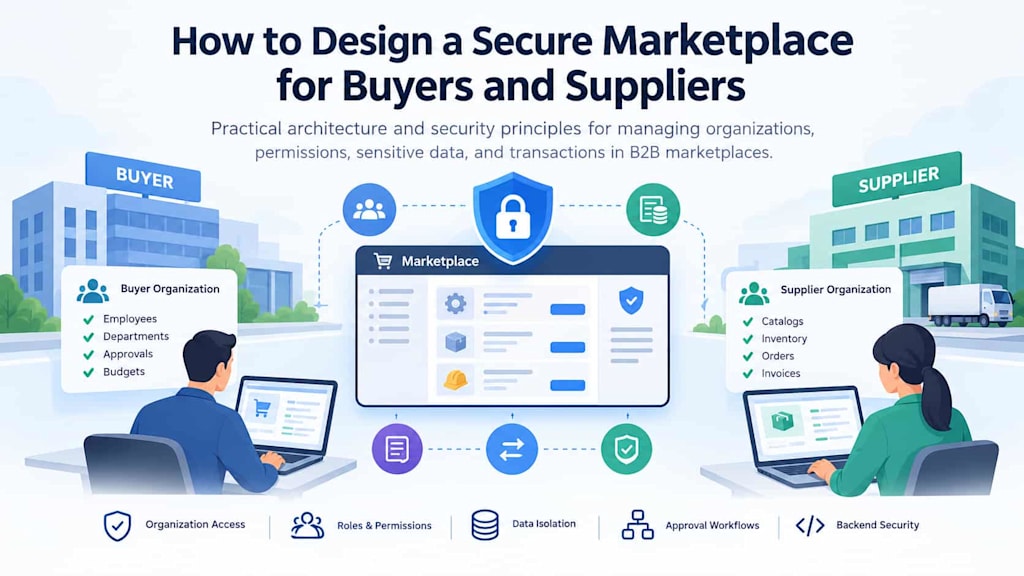
How to Design a Secure Marketplace for Buyers and Suppliers
Practical architecture and security principles for managing organizations, permissions, sensitive data, and transactions in B2B marketplaces.

Introduction
Building a marketplace where buyers and suppliers operate on the same platform introduces security challenges that go beyond standard user authentication. Buyers need access to product catalogs, negotiated prices, purchase orders, and invoices, while suppliers must manage their own products, inventory, customer relationships, and order fulfillment. Both sides interact with shared business processes, but they should not automatically gain access to each other’s internal information.
The challenge becomes more complex when companies have multiple employees, departments, purchasing rules, and approval requirements. A buyer may need to compare supplier offers without seeing another buyer’s negotiated pricing. A supplier may need to process an order without accessing the buyer’s internal budgets or unrelated transactions.
A secure marketplace must therefore distinguish between individual users, their organizations, their responsibilities, and the resources they are permitted to access. These boundaries should be part of the platform’s architecture from the beginning rather than added after the marketplace has grown.
Choose the Right Marketplace Model
The first architectural decision is understanding how the marketplace creates relationships between participants. A B2C marketplace typically connects individual consumers with products or services, whereas a B2B marketplace supports business accounts, purchasing teams, negotiated commercial terms, and potentially complex approval processes.
A multi-vendor marketplace adds another layer of complexity because multiple suppliers may maintain independent catalogs, prices, inventory, and fulfillment processes within a shared platform. A B2B marketplace can also combine centralized purchasing with supplier-specific storefronts, private catalogs, and contract-based pricing.
Choosing the right model for a marketplace means understanding these differences before deciding how to structure accounts, data, and permissions. For example, a marketplace that supports negotiated prices between specific companies needs a different visibility model from one where every registered customer sees the same public catalog.
These requirements influence several architectural components:
Identity management: Whether users belong to individual accounts, business organizations, or multiple organizations.
Catalog management: Whether products are public, supplier-specific, restricted to selected buyers, or available under commercial agreements.
Transaction management: How orders, payments, invoices, and fulfillment records are associated with participating companies.
Access control: Which users can view, create, approve, modify, or cancel business transactions.
When building marketplaces for different business models, developers should avoid assuming that one universal permission structure will fit every scenario. A flexible architecture can support different marketplace configurations without allowing one business model’s access rules to weaken another’s security.
Define Buyer and Supplier Organizations
Organizations should be first-class entities in the marketplace data model. A company is not simply a user profile with a business name attached. It represents a distinct security boundary that may contain multiple users, departments, locations, and commercial relationships.
A typical architecture includes organization records, user accounts, memberships, roles, and resources such as orders or catalogs. A membership connects a user to an organization and defines the context in which that user can operate. The same person might belong to more than one organization, such as a parent company and a subsidiary, without receiving identical permissions in both.
Buyer and supplier organizations should also have clearly defined responsibilities. Buyers manage purchasing activities, internal budgets, and approvals. Suppliers manage their own product information, stock availability, fulfillment, and relevant customer orders. Platform administrators maintain the marketplace itself but should not automatically receive unrestricted access to all business data.
A practical design should address several questions:
Can one user represent multiple legal entities?
Can an organization have multiple administrators?
Who can invite employees, remove memberships, or change permissions?
Are subsidiaries isolated from their parent organization or granted explicitly configured access?
What happens to active orders and historical records when a user leaves a company?
Membership changes should take effect promptly, including when access is revoked during an active session. The platform should retain transaction history and attribution even after a user’s membership ends.
Organizations may also require verification before they can purchase or sell. Depending on the marketplace, this might include business registration checks, supplier onboarding, tax information, or manual approval. These controls reduce fraudulent registrations and help establish which legal entity is responsible for a transaction.
Establish Roles and Permissions
A secure marketplace needs to distinguish between what a user can do and which resources they can access. Authentication establishes a user’s identity, while authorization determines whether a particular operation is allowed in a specific context.
Roles provide a convenient way to group permissions. For example, a buyer organization might have purchasing administrators, requesters, approvers, and finance personnel. A supplier organization might have catalog managers, sales representatives, fulfillment operators, and finance staff.
However, roles alone are not enough. Two users with the same role may have different access depending on their department, assigned locations, spending limits, or relationship to a particular order.
The central principle of defining who can access what is to evaluate permissions against both the requested action and the resource involved.
Consider a few common scenarios:
A buyer requester can create a purchase request but cannot approve their own request above a defined threshold.
A purchasing manager can approve orders within their assigned budget.
A supplier catalog manager can update product descriptions and availability but cannot view another supplier’s private catalog.
A supplier finance employee can access relevant invoices without receiving permission to change shipment details.
A marketplace support employee can investigate technical issues through controlled, auditable access.
Permissions should be assigned according to business responsibilities, following the principle of least privilege. Users should receive only the access needed to perform their duties.
The platform must also account for ownership and relationships. A supplier employee may access an order because their organization is the seller, while a buyer employee may access the same order because their organization placed it. Neither relationship should provide access to unrelated orders.
Separate Shared and Private Data
Data isolation is one of the most important architectural concerns in a multi-tenant marketplace. Multiple organizations use the same application, but their records must remain separated according to explicit access rules.
There are several ways to implement multi-tenancy. A shared database with organization identifiers is often cost-effective and straightforward to scale. Separate schemas can provide additional organizational separation, while dedicated databases may be appropriate for customers with strict contractual, regulatory, or operational requirements.
The right approach depends on the marketplace’s scale, compliance obligations, and isolation requirements. Regardless of the storage model, the application must enforce tenant boundaries consistently.
For a shared database, business records should carry the identifiers necessary to establish their ownership and relationships. An order might reference the buyer organization, supplier organization, and relevant commercial agreement. Authorization checks must verify those relationships before returning or modifying the record.
A common mistake is assuming that adding an organization_id column automatically provides security. It does not. If a backend endpoint accepts an arbitrary order identifier and retrieves the record without checking the requesting user’s permissions, a user may access another organization’s data.
Database constraints, scoped queries, and row-level security can provide additional safeguards. These mechanisms should complement application-level authorization rather than replace careful security design.
It is also important to distinguish shared data from private data. Product descriptions and publicly available specifications may be visible across the marketplace. Contract prices, negotiated discounts, internal purchase requests, invoices, and supplier performance reports may require restricted access.
Some information is shared only between particular organizations. A negotiated price, for example, might be visible to one buyer and its contracted supplier but hidden from other marketplace participants.
Controlling access across buyer and supplier organizations requires explicit rules for these relationships. The same order may legitimately be visible to both parties, but each side should see only the information relevant to its responsibilities.
Isolation must extend beyond primary database queries. Search indexes, cached responses, file downloads, analytics pipelines, background jobs, exports, and notification systems can all expose information if they ignore organization boundaries. Tenant identifiers and authorization context should be preserved throughout the entire data lifecycle.
Secure Ordering and Approval Workflows
Purchasing workflows introduce security requirements that cannot be addressed through ordinary read and write permissions alone. A user may be allowed to create an order but not authorize its purchase, increase its value, or mark it as paid.
Business rules should determine which actions are valid at each stage of a transaction. A typical process might move from a draft purchase request to submission, approval, order confirmation, fulfillment, and invoicing. Each transition should have clearly defined authorization requirements.
Approval thresholds are especially important in larger organizations. A requester might submit an order worth $2,000 without approval, while purchases above $10,000 require a department manager and larger transactions require finance approval. These values are illustrative and should reflect the organization's actual policies.
The system should evaluate approval requirements against trusted server-side data, including the order total, currency, organizational policy, and user’s current authority. It should not rely on a client application to declare that an order has already been approved.
Several additional controls improve workflow security:
Separation of duties: Prevent users from approving their own purchases when organizational policy requires independent approval.
State validation: Reject invalid transitions, such as shipping an order that has not been confirmed.
Concurrency control: Prevent simultaneous requests from bypassing approval limits or overwriting valid updates.
Change tracking: Record who changed an order, what changed, and when the action occurred.
Policy revalidation: Recheck relevant permissions and approval requirements when an order is submitted or modified.
For example, an order approved for $8,000 should not be editable to $15,000 without triggering the required additional approvals. Similarly, changing the supplier or payment terms may require renewed authorization even when the total price remains unchanged.
Sensitive actions should be designed to resist replay and race-condition attacks. Idempotency controls can prevent duplicate order submissions, while transaction boundaries and version checks can help ensure that concurrent updates do not invalidate approval decisions.
Enforce Security in the Backend
The frontend should make the platform easier to use, but it must never be the final authority on permissions. Hiding an administrative button or disabling an approval form does not prevent a user from sending a direct API request.
Every sensitive backend operation should verify the authenticated identity, relevant organization membership, required permission, resource relationships, and applicable business rules. Authorization should be checked for individual resources rather than inferred from a successful login or a generic role assignment.
For example, an API endpoint that returns an order should verify that the requester belongs to an authorized buyer or supplier organization associated with that order. An endpoint that changes the order should additionally confirm that the user can perform the requested action in the current order state.
Several common vulnerabilities deserve particular attention.
Insecure direct object references: Attackers change an order, invoice, or document identifier to retrieve another organization's records. Prevent this by applying authorization checks to every resource request.
Broken function-level authorization: An ordinary employee calls an administrative endpoint directly. Enforce permissions on the server for every privileged operation.
Mass assignment: An API accepts fields that users should not control, such as organization_id, approved_by, or payment status. Use explicit input schemas and allowlists of writable fields.
Cross-tenant data leakage: Search, reporting, caching, or export functionality returns records from multiple organizations without appropriate filtering. Apply consistent authorization rules across all data access paths.
Overly broad service permissions: Background workers or internal services can access every tenant’s data without a justified need. Restrict service identities and ensure jobs operate within an appropriate authorization context.
Marketplace security also depends on sound authentication, secure session management, rate limiting, input validation, and protection against common web vulnerabilities. Multi-factor authentication is particularly valuable for organization administrators and users who approve purchases or manage financial information.
Logging should capture important security events, including permission changes, failed authorization attempts, sensitive data exports, and approval decisions. Logs must be protected against tampering and should avoid unnecessarily storing passwords, access tokens, or sensitive commercial information.
Finally, security testing should reflect the marketplace’s real organizational structure. Automated tests should verify that users cannot access unrelated orders, manipulate tenant identifiers, bypass approvals, or perform administrative actions outside their assigned responsibilities. Testing should cover both expected access and explicitly forbidden access.
Conclusion
Designing a secure marketplace for buyers and suppliers requires more than adding authentication and assigning a few user roles. The platform must represent organizations accurately, define clear ownership of business resources, and enforce authorization across every interaction.
A strong architecture combines organization-aware identity management, least-privilege permissions, reliable tenant isolation, validated purchase workflows, and consistent backend authorization. It also accounts for less obvious exposure points, including search indexes, exports, cached data, integrations, and background processing.
These decisions should be established early and revisited as the marketplace expands. New suppliers, additional buyer organizations, more complex purchasing policies, and new integrations can introduce access paths that were not present in the original design.
Ultimately, security and scalability support the same goal: enabling businesses to collaborate through a shared platform without losing control over their data, responsibilities, or commercial relationships.
About the Creator
Chudovo
Chudovo is a custom software development company, focused on complex systems implementation.
Enjoyed the story? Support the Creator.
Subscribe for free to receive all their stories in your feed.
Comments
There are no comments for this story
Be the first to respond and start the conversation.