
How to Choose the Right Marketplace Business Model: B2B vs. B2C vs. Multi-Vendor
A practical guide to selecting the marketplace model that aligns with your customers, revenue strategy, and long-term growth goals.

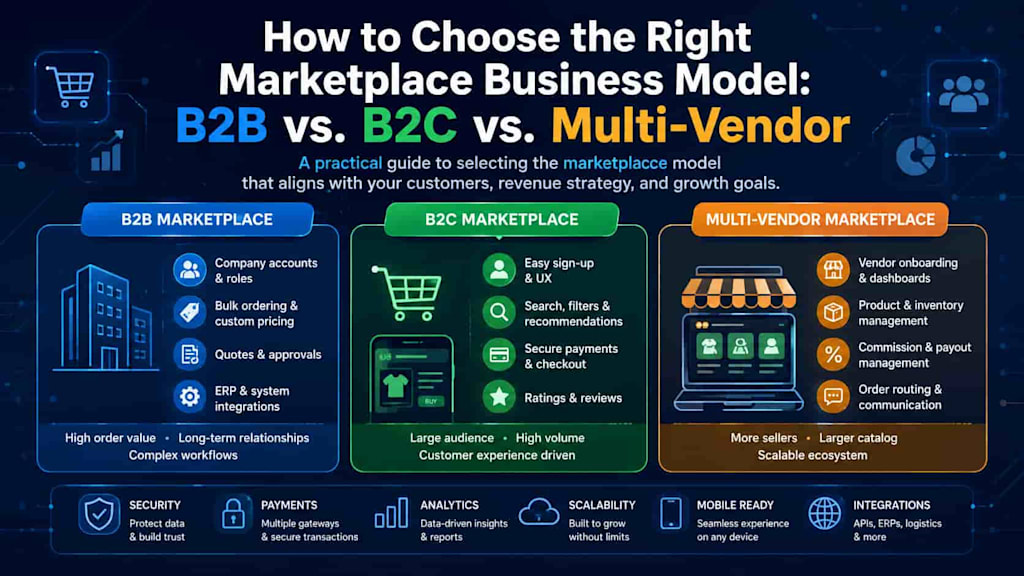
Online marketplaces have transformed the way businesses buy and sell products and services. From global eCommerce giants to niche industry platforms, marketplaces connect buyers and sellers while creating scalable digital ecosystems that generate recurring revenue. However, the success of a marketplace depends heavily on selecting the right business model before development begins.
The choice between a B2B marketplace, a B2C platform, or a multi-vendor marketplace affects every aspect of the project—from user experience and pricing strategies to payment processing, platform architecture, and marketing efforts. A model that works exceptionally well in one industry may be ineffective in another.
This article explores the characteristics of each marketplace model, compares their strengths and limitations, and outlines the key factors businesses should evaluate before making a development investment.
Why the Business Model Matters
A marketplace is more than an online store. It is a digital platform that facilitates transactions between multiple parties while managing listings, payments, communication, and trust.
Choosing the appropriate marketplace model influences:
Customer acquisition strategy
Revenue generation
Vendor onboarding
Pricing structure
Platform scalability
Compliance requirements
Feature prioritization
Marketing approach
Customer support processes
A clear business model also helps development teams design an architecture that can evolve as the platform grows.
Understanding B2B Marketplaces
Business-to-business (B2B) marketplaces connect companies rather than individual consumers. Buyers often include wholesalers, manufacturers, distributors, procurement departments, and enterprise organizations.
Unlike traditional online stores, B2B marketplaces typically involve larger transactions, negotiated pricing, customized contracts, and long-term business relationships.
Common Features
A B2B marketplace often includes:
Company accounts
Multi-user permissions
Custom pricing
Bulk ordering
Quote requests
Purchase approvals
Contract management
Invoice payments
ERP integration
Inventory synchronization
These platforms prioritize operational efficiency and streamlined procurement over impulse purchasing.
Advantages
B2B marketplaces offer several benefits:
Higher average order values
Long-term customer relationships
Recurring transactions
Predictable revenue
Strong customer retention
Deep enterprise integrations
Because businesses often reorder products regularly, customer lifetime value tends to be significantly higher than in consumer-focused marketplaces.
Challenges
Building a B2B marketplace introduces additional complexity.
Organizations often require:
Role-based access
Complex pricing rules
Credit terms
Tax handling
Procurement workflows
Multiple payment options
ERP connectivity
Development projects therefore require careful planning and scalable architecture.
Understanding B2C Marketplaces
Business-to-consumer marketplaces focus on individual shoppers purchasing products or services.
Examples include marketplaces for fashion, electronics, groceries, travel bookings, digital products, and local services.
Customer expectations differ considerably from enterprise buyers.
Typical Features
Consumer marketplaces generally include:
Fast registration
Product search
Personalized recommendations
Shopping cart
Online payments
Ratings and reviews
Order tracking
Wish lists
Mobile applications
Loyalty programs
User experience and convenience are major competitive advantages.
Benefits
B2C marketplaces can achieve rapid growth because they target significantly larger audiences.
Key advantages include:
Large customer base
Faster purchasing decisions
Easier onboarding
High transaction volume
Strong brand visibility
Viral marketing opportunities
Well-designed customer experiences often contribute directly to increased conversions.
Challenges
Consumer marketplaces face intense competition.
Common challenges include:
Customer acquisition costs
Price competition
Logistics management
Customer support
Fraud prevention
Product quality control
Seasonal demand fluctuations
Success often depends on continuous optimization of the shopping experience.
Understanding Multi-Vendor Marketplaces
A multi-vendor marketplace allows multiple independent sellers to offer products or services through a single platform.
The marketplace owner manages the ecosystem while vendors maintain their own catalogs, pricing, inventory, and fulfillment processes.
This model has become increasingly popular because it scales efficiently without requiring the marketplace operator to own inventory.
Core Features
A successful multi-vendor marketplace typically includes:
Vendor registration
Seller dashboards
Product management
Inventory management
Commission management
Order routing
Vendor analytics
Review systems
Messaging
Payment splitting
These features enable independent businesses to operate while maintaining a consistent customer experience.
Advantages
Multi-vendor platforms provide significant growth opportunities.
Benefits include:
Rapid catalog expansion
Lower inventory costs
Diverse product selection
Multiple revenue streams
Vendor competition
Increased customer choice
As more vendors join the platform, network effects often strengthen marketplace value.
Challenges
Managing multiple sellers introduces operational complexity.
Platform owners must address:
Vendor verification
Quality assurance
Commission calculations
Dispute resolution
Shipping coordination
Fraud prevention
Performance monitoring
Maintaining trust between buyers and sellers becomes essential.
Revenue Models
Selecting the marketplace type also influences monetization strategies.
Common revenue models include:
Sales commissions
Subscription plans
Vendor registration fees
Featured listings
Advertising
Transaction fees
Premium memberships
Value-added services
Many successful marketplaces combine several monetization methods rather than relying on a single revenue source.
Key Factors When Choosing a Marketplace Model
Every marketplace should be designed around business objectives rather than industry trends.
Important considerations include:
Target Audience
Understanding whether your users are businesses, consumers, or both significantly impacts platform design.
Business users prioritize efficiency and integrations, while consumers expect speed, simplicity, and engaging shopping experiences.
Average Transaction Value
High-value transactions often require additional workflows such as quotations, approvals, or financing options.
Lower-value purchases usually emphasize convenience and rapid checkout.
Product Complexity
Some products require detailed specifications, configuration options, or technical documentation.
Others can be purchased quickly with minimal information.
Vendor Relationships
If independent merchants are central to the platform, vendor management features become a critical investment.
Regulatory Requirements
Different industries introduce unique compliance obligations involving taxation, payments, privacy, consumer protection, and international trade.
Technology Considerations
Marketplace platforms require scalable and secure architectures capable of supporting continuous growth.
Modern solutions frequently include:
Cloud infrastructure
Microservices architecture
API-first development
Containerization
Automated deployment
Search engines
Recommendation systems
Analytics platforms
Payment gateways
Security monitoring
Scalability should be incorporated from the beginning rather than added later.
Essential Marketplace Features
Regardless of the business model, successful marketplaces share several core capabilities.
These typically include:
User authentication
Product catalog management
Search and filtering
Shopping cart
Secure payments
Notifications
Ratings and reviews
Messaging
Order management
Analytics dashboards
Mobile responsiveness
Administrative control panel
The specific implementation varies according to the chosen marketplace model.
User Experience as a Competitive Advantage
Even the most feature-rich marketplace will struggle if users find it difficult to navigate.
Successful platforms invest heavily in:
Simple onboarding
Intuitive navigation
Fast search
Personalized recommendations
Clear product information
Responsive design
Accessible interfaces
Quick checkout
Reducing friction throughout the customer journey directly contributes to higher conversion rates and improved customer satisfaction.
Planning for Future Growth
Many marketplace founders begin with a narrowly focused platform before expanding into additional services and regions.
Planning for future scalability includes considering:
International expansion
Multi-language support
Multi-currency payments
Regional tax compliance
AI-powered recommendations
Advanced analytics
Mobile applications
Third-party integrations
A flexible architecture allows businesses to introduce these capabilities without major redevelopment.
Organizations evaluating B2B/B2C marketplaces should also consider how future customer segments, evolving business strategies, and new revenue opportunities may influence platform requirements over time. Choosing a scalable model early helps minimize technical debt and supports sustainable long-term growth.
Conclusion
Choosing the right marketplace business model is one of the most important strategic decisions in any marketplace development project. B2B marketplaces excel at supporting complex procurement processes and long-term business relationships, while B2C marketplaces focus on delivering seamless shopping experiences for individual consumers. Multi-vendor marketplaces provide exceptional scalability by enabling multiple independent sellers to operate within a unified ecosystem.
The ideal choice depends on your target audience, product offerings, revenue strategy, operational complexity, and long-term business objectives. By carefully evaluating these factors before development begins, organizations can build a marketplace that not only meets current market demands but also remains flexible enough to adapt to future growth, technological innovation, and changing customer expectations.
About the Creator
Chudovo
Chudovo is a custom software development company, focused on complex systems implementation.
Enjoyed the story? Support the Creator.
Subscribe for free to receive all their stories in your feed.
Comments
There are no comments for this story
Be the first to respond and start the conversation.