
How to Compare Magento Migration Proposals Before Choosing a Vendor
A practical framework for evaluating migration scope, deliverables, contractual terms, vendor accountability, and project risks before committing to a development partner.


When a business decides to migrate its Magento store, receiving several proposals from software development vendors is usually a positive step. It creates an opportunity to compare approaches, assess expertise, and negotiate terms. However, the process can quickly become confusing when vendors offer significantly different prices, timelines, and project descriptions for what appears to be the same migration.
One vendor may propose a relatively straightforward project with a short timeline, while another recommends a longer engagement involving additional testing, business validation, and coordination with external systems. At first glance, the more expensive proposal may seem unnecessarily complicated, or the cheaper one may appear more attractive.
The problem is that proposals are not always based on identical assumptions. Some vendors include services that others treat as optional. Some define their responsibilities precisely, while others leave important decisions for later stages. A low initial price may reflect a narrower scope rather than better efficiency.
Businesses therefore need a structured approach to comparing Magento migration proposals. The objective is not simply to find the cheapest offer, but to understand what each vendor is promising, what the agreement protects, and which risks the company will ultimately have to manage itself.
Step 1. Establish a Common Scope for All Vendors
Before comparing proposals, businesses should establish a shared project scope. Without it, vendors may interpret the migration objectives differently, making their estimates and commitments difficult to evaluate.
A common scope does not need to be a detailed technical specification. It should describe the business expectations, project boundaries, and desired outcomes in enough detail for each vendor to prepare an informed proposal.
For example, a company might define the following expectations:
The migrated store should support the existing product catalog and customer-facing shopping experience.
Important business functionality must remain available after launch.
The project should include testing and business acceptance activities.
The vendor must coordinate with the company's internal team and relevant external service providers.
The project should include a defined launch support period.
Documentation and knowledge transfer must be provided before project closure.
These requirements create a common foundation without prescribing how vendors must implement them.
It is equally important to define what falls outside the project. If the company does not expect a redesign, additional marketplace functionality, or changes to internal business processes, these boundaries should be communicated clearly.
A consistent request for proposal (RFP) or project brief allows every vendor to respond to the same expectations. Businesses can then distinguish between differences in delivery approach and differences caused by vendors making different assumptions.
The scope should also identify the client's responsibilities. For example, the company may be expected to provide access to systems, approve designs, assign business stakeholders, or validate migrated information. If these responsibilities are not communicated upfront, vendors may include different assumptions about client availability and decision-making speed.
Step 2. Compare Deliverables, Not Just Prices
A significant price difference between two proposals does not necessarily indicate that one vendor is overcharging. The offers may contain different amounts of work, different levels of assurance, and different commitments.
When comparing Magento migration costs, decision-makers should examine what the quoted price actually covers rather than treating the final number as an isolated figure. A proposal with a lower price may exclude important services, leaving the client to pay for them separately or manage them internally.
For example, one vendor might include business acceptance testing, migration documentation, launch support, and formal approval milestones. Another might include only development activities and basic technical verification, leaving acceptance testing and post-launch assistance outside the agreement.
These differences can materially affect the commercial value of each offer.
Businesses should review the following deliverables:
Project documentation: Is the vendor providing clear documentation of the agreed scope, responsibilities, and completed work?
Testing and validation: Are testing activities included, and who is responsible for confirming that business requirements have been met?
Acceptance criteria: Does the proposal explain how deliverables will be reviewed and approved?
Launch support: Is post-launch assistance included, and for how long?
Knowledge transfer: Will the client's team receive the information needed to manage the store after the engagement ends?
Reporting: Will the vendor provide regular progress updates and communicate risks or delays?
The commercial differences between proposals may also reflect the vendor's assumptions about the business's existing environment, the number of services included, and the degree of responsibility accepted.
For companies that need additional context when reviewing estimates, the German-language resource Magento migration cost factors provides another perspective on the elements that can influence migration pricing.
A useful practice is to request that every vendor list included deliverables, excluded services, assumptions, and optional work separately. This makes it easier to determine whether a proposal is genuinely less expensive or simply less comprehensive.
Step 3. Evaluate Integration and Customization Responsibilities
Magento stores often depend on systems and functionality that extend beyond the storefront. The migration may involve existing business applications, custom checkout behavior, third-party extensions, and services maintained by different providers.
The most important question is not necessarily whether a vendor has experience with these components, but whether the proposal clearly establishes responsibility for them.
Consider an ERP system that manages inventory, pricing, and order processing. The migration vendor may be responsible for the Magento side of the integration, while another provider maintains the ERP. If both parties assume that the other is responsible for testing the complete exchange of information, problems may remain unresolved.
Similar challenges can occur with PIM systems, payment providers, shipping services, or third-party extensions. ERP and PIM integration risks should therefore be considered in the context of vendor accountability, communication, and agreed deliverables—not only technical compatibility.
Businesses should clarify:
Who reviews the existing integrations and confirms their migration scope?
Who coordinates with third-party providers when changes or issues arise?
Who is responsible for testing end-to-end business processes?
Who investigates problems when the source of an issue is unclear?
Are external vendor delays considered project risks, and how are they communicated?
Does the proposal include coordination activities, or are they billed separately?
Custom functionality deserves similar attention. Companies operating heavily customized Magento stores may have business-critical features that are poorly documented or understood only by the original developers.
A custom checkout rule, customer pricing arrangement, order approval workflow, or specialized shipping condition may appear minor in the proposal but can be essential to daily operations. Businesses should ask vendors how they will identify these dependencies, confirm which functionality is included, and handle features whose requirements remain uncertain.
The proposal should identify ownership of these responsibilities instead of using vague language such as “integration support” or “custom functionality review.” Clear accountability reduces the likelihood that unresolved issues will become disputes during the project.
Step 4. Compare Contract Models and Change Request Policies
Even a carefully prepared project brief cannot eliminate every uncertainty. New requirements may emerge, existing functionality may behave differently than expected, or business stakeholders may change priorities during the project.
The contract determines how these situations affect delivery, budget, and responsibilities.
Fixed-price contracts
A fixed-price agreement provides a defined price for an agreed scope of work. It can be useful when requirements, deliverables, and acceptance conditions are sufficiently clear.
However, fixed pricing does not automatically eliminate financial risk. If the scope is vague, vendors may protect themselves by excluding uncertain activities or treating additional work as a change request. The client may then face extra charges for requirements it assumed were included.
Businesses should review whether the agreement defines:
What is included in the original scope.
Which assumptions are used to establish the price.
How excluded activities are identified.
What constitutes a change in scope.
How additional work is priced and approved.
Time-and-materials contracts
Time-and-materials (T&M) agreements charge for actual work performed, usually according to agreed hourly or daily rates.
This model may provide greater flexibility when the project contains uncertainty or requirements are expected to evolve. It can also make budget control more difficult if work continues without sufficiently clear priorities, estimates, or approval mechanisms.
Businesses should confirm whether the vendor provides regular effort reporting, forecasts remaining work, identifies potential budget overruns, and requires approval before exceeding agreed financial limits.
Change request procedures
Regardless of contract model, a change request policy should be established before the project begins.
A useful process includes a written description of the requested change, an assessment of its impact on scope, timeline, and budget, and explicit approval before additional work starts.
For example, if the company requests a new checkout requirement after the original scope has been approved, the vendor should explain whether it is a genuine scope change, an overlooked requirement, or a correction to work that was already included.
This distinction matters because not every newly discovered issue should automatically become additional billable work.
The agreement should also specify who is authorized to approve changes. Without designated decision-makers, small requests may create delays, while informal approvals may result in disagreements about the final invoice.
Step 5. Identify Warning Signs in Migration Proposals
A proposal may look professional while leaving significant commercial or operational uncertainty unresolved. Businesses should pay attention to wording that sounds reassuring but does not establish measurable commitments.
Unclear exclusions
The proposal states that certain activities are excluded without explaining how those exclusions affect the overall project.
Vague deliverables
Descriptions such as “migration assistance,” “quality assurance,” or “launch support” lack a clear definition of the work to be completed.
Unrealistic timelines
The proposed schedule does not account for client reviews, external dependencies, approval periods, or testing activities.
Undefined responsibilities
The proposal does not identify who owns decisions, validates results, coordinates external providers, or resolves disputes over incomplete work.
Businesses should not simply reject a proposal because it contains these issues. Instead, they should request clarification and assess how the vendor responds.
Useful questions include:
Which specific deliverables are excluded from this proposal?
What would trigger additional charges?
How will the vendor demonstrate that each agreed deliverable is complete?
What happens if an external provider fails to respond on time?
Who is responsible for resolving issues discovered during acceptance testing?
What is included in the launch support period?
Can the vendor explain the proposed timeline and the assumptions behind it?
The quality of a vendor's answers can be as informative as the proposal itself. Clear, specific explanations indicate that the vendor understands the commercial boundaries of the engagement and is willing to make its commitments transparent.
Step 6. Make a Final Vendor Comparison
Once scope, deliverables, responsibilities, and contract terms have been reviewed, businesses can use a structured comparison framework to make a more informed decision.
Rather than giving the lowest price the greatest weight, evaluate each proposal across several categories. The scoring system below uses a five-point scale, where 1 represents poor or unclear and 5 represents strong, detailed, and well-defined.
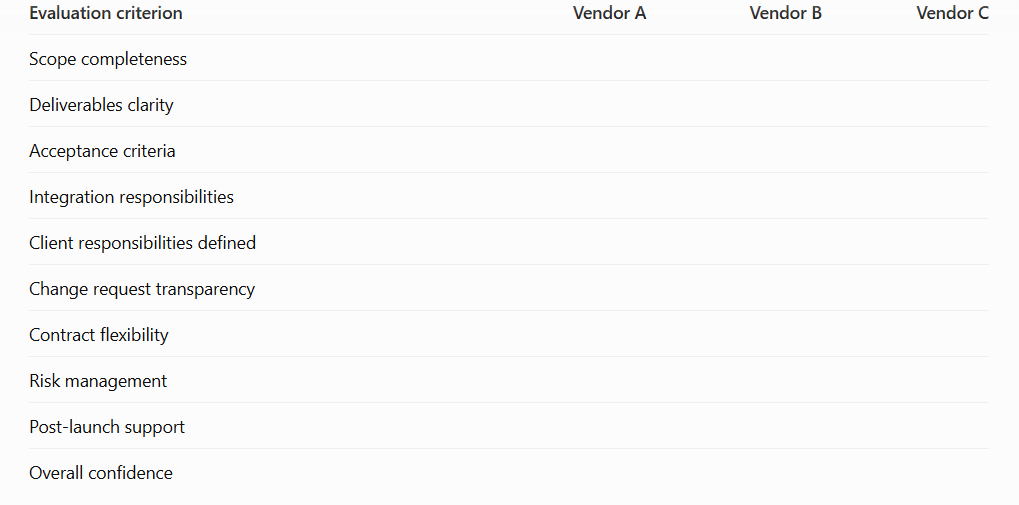
Suggested scoring: 1 = poor, 2 = weak, 3 = acceptable, 4 = strong, 5 = excellent.
Companies can add the proposed price and estimated timeline to the table, but these should be evaluated alongside the quality of each commitment.
For example, Vendor A might offer the lowest price but leave testing responsibilities and third-party coordination largely undefined. Vendor B might be more expensive but include clear acceptance criteria, named responsibilities, and a transparent change approval process. Vendor C might offer a flexible contract but provide less certainty regarding the final budget.
The final choice should reflect the business's priorities, risk tolerance, internal capabilities, and the importance of the migration to ongoing operations.
If a company has a capable internal team that can manage testing and external coordination, a narrower proposal may be reasonable. If internal resources are limited, a vendor offering stronger accountability and more comprehensive delivery support may provide better overall value.
Conclusion
Choosing a Magento migration vendor should not depend on the lowest price alone. A proposal is valuable when it clearly explains the project's scope, defines the expected deliverables, establishes responsibilities, and provides a practical framework for managing uncertainty.
Businesses should compare what vendors are actually committing to, rather than relying on similar project titles or headline prices. Contract models, change request procedures, acceptance criteria, and coordination responsibilities can have a substantial impact on the final experience.
The most reliable proposal is not necessarily the longest or the most expensive. It is the one that gives decision-makers the clearest understanding of what will be delivered, who is accountable, how changes will be handled, and which risks remain before the agreement is signed.
About the Creator
Chudovo
Chudovo is a custom software development company, focused on complex systems implementation.
Enjoyed the story? Support the Creator.
Subscribe for free to receive all their stories in your feed.
Comments
There are no comments for this story
Be the first to respond and start the conversation.