
How to Choose the Right Technology Stack for Enterprise Applications
A practical framework for selecting technologies that support business requirements, scalability, integration, and long-term software sustainability.

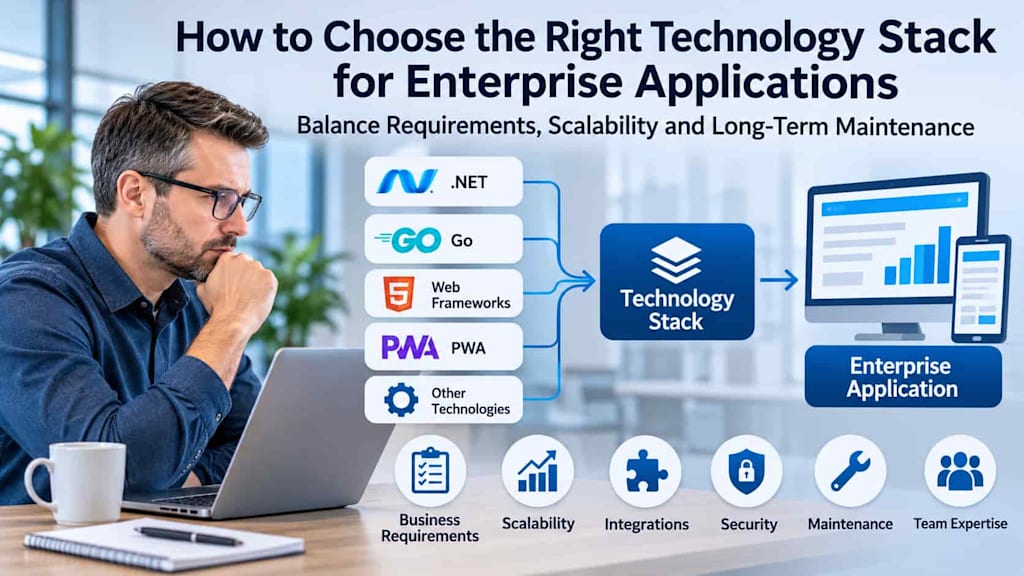
Choosing a technology stack for an enterprise application is a decision that can influence a company's operations, development costs, security, and ability to adapt for years. While modern frameworks and programming languages offer numerous possibilities, not every technology is equally suitable for a particular business environment. The right choice depends on the application's purpose, expected workload, existing infrastructure, development team's expertise, and future maintenance requirements.
Instead of following trends or selecting technologies based on popularity, organizations should approach technology stack selection as a strategic investment. A well-planned architecture makes software easier to extend, integrate, secure, and maintain as business requirements evolve.
Start with Business Requirements and Application Architecture
Before evaluating programming languages, frameworks, or infrastructure, businesses should establish what the application needs to accomplish. Enterprise software can range from internal workflow management systems and customer portals to financial platforms, data-intensive applications, and complex solutions connecting multiple departments.
Understanding different types of .NET applications can help organizations evaluate possible architectural approaches, including web-based platforms, desktop applications, cloud services, APIs, and mobile solutions. Each type has its own technical considerations regarding deployment, user access, performance, and integration.
For example, an internal management platform accessed by hundreds of employees may prioritize centralized authentication, role-based access, reporting, and integration with existing corporate systems. A customer-facing application may require high availability, responsive interfaces, fast loading times, and the ability to accommodate traffic fluctuations.
Requirements should also account for future expansion. Businesses need to consider whether the application may eventually support new regions, additional user groups, more complex workflows, or entirely new services. Establishing these expectations early helps prevent architectural decisions that become expensive limitations later.
Evaluate Backend Technologies Based on Workload
The backend is responsible for business logic, data processing, authentication, integrations, and communication between application components. Selecting backend technology requires evaluating performance, ecosystem maturity, available libraries, developer expertise, and operational requirements.
For organizations already working with Microsoft technologies, enterprise software built with .NET can provide a consistent development environment and access to a mature ecosystem of libraries, tooling, cloud services, and enterprise integration capabilities. It can be particularly suitable for business applications involving complex workflows, structured data, API development, and long-term maintenance.
However, .NET is not the only viable backend option. Go, Java, Node.js, Python, and other technologies may be appropriate depending on the application architecture and engineering requirements.
For instance, Go development for backend services can be attractive when teams need efficient concurrent processing, lightweight services, predictable performance, and relatively straightforward deployment. It may be a strong candidate for network-intensive services, distributed systems, and infrastructure-oriented components.
Backend selection should involve evaluating realistic workload scenarios rather than relying exclusively on benchmark results. Database interactions, external API calls, caching, business logic complexity, and deployment environments often have a greater influence on overall performance than the programming language alone.
Consider Scalability and Long-Term Maintenance
Enterprise applications rarely remain unchanged after launch. They accumulate new functionality, integrations, security requirements, and business rules. The technology stack must support these changes without making development increasingly complicated.
Scalability is not limited to handling more users. It also includes the ability to expand functionality, introduce new modules, improve infrastructure, and accommodate changing operational requirements. Organizations should determine whether the system needs vertical scaling, horizontal scaling, distributed services, or a simpler architecture that can evolve gradually.
Maintenance deserves equal attention. A technology may be technically impressive but difficult to support if its ecosystem is small, documentation is limited, or experienced developers are difficult to find. Businesses should examine release cycles, backward compatibility, dependency management, security updates, community activity, and vendor support.
A practical architecture should avoid unnecessary complexity. Microservices, event-driven systems, and containerized environments can offer flexibility, but they also introduce additional operational responsibilities. For many enterprise applications, a modular monolith may provide a better starting point, allowing teams to maintain clear boundaries while avoiding the overhead of managing numerous independent services.
Choose the Right Web Application Approach
Web applications are often the most practical way to deliver enterprise software across different devices and operating systems. Users can access centralized functionality through a browser without installing traditional desktop software, while organizations can simplify updates and deployment.
When custom web application development is being planned, businesses should consider user experience, accessibility, authentication, browser compatibility, data security, and the complexity of the interface. The architecture should reflect how employees, customers, and partners interact with the system rather than simply how developers prefer to build it.
Traditional server-rendered applications can work well for systems with forms, dashboards, reporting, and relatively straightforward interactions. Single-page applications (SPAs) may be more suitable when the interface requires frequent updates, complex interactions, rich client-side functionality, or a highly dynamic user experience.
The decision should also take into account network conditions, initial loading performance, browser resource consumption, and how much functionality needs to be available when connectivity is limited.
Assess Frontend Frameworks and User Experience
The frontend framework affects development productivity, interface consistency, application responsiveness, and the ability to maintain a growing collection of user-facing components. Enterprises should consider ecosystem maturity, accessibility support, testing tools, integration capabilities, and the availability of experienced developers.
When choosing a frontend framework for enterprise applications, organizations should evaluate whether it supports the complexity of their interfaces without introducing unnecessary dependencies or maintenance overhead. Frameworks such as Angular, React, and Vue offer different approaches to component architecture, application state, routing, and tooling.
Angular may appeal to organizations seeking an opinionated framework with a broad set of built-in capabilities. React offers a flexible component-based approach supported by a large ecosystem, while Vue provides an approachable framework with adaptable development patterns.
Beyond framework selection, enterprise interfaces need consistency. Design systems, reusable components, clear navigation, predictable validation, and accessibility standards can help improve usability across large applications. Frontend architecture should also enable teams to test and modify individual features without destabilizing unrelated functionality.
Understand the Role of Progressive Web Applications
A browser-based application does not necessarily have to behave like a traditional website. Progressive Web Apps (PWAs) combine web technologies with features that can provide a more app-like experience, including installation, caching, offline capabilities, and selected background functionality.
Progressive web application development may be useful for businesses whose employees or customers need convenient access to application functionality across smartphones, tablets, and desktop devices. PWAs can reduce the need to maintain separate applications for every platform, although their capabilities and limitations depend on browser support and operating system behavior.
For example, a field-service application might allow employees to access previously loaded work orders, record inspection results, or temporarily save information when connectivity is unreliable. Data can be synchronized when the connection becomes available, provided the application is designed to handle conflicts and synchronization failures.
PWAs are not a universal replacement for native mobile applications. Requirements involving advanced hardware integration, specialized background processes, strict platform-specific behavior, or demanding performance may justify native or cross-platform mobile development instead.
Plan Integrations, Security, and Data Management
Enterprise applications rarely operate in isolation. They often connect with ERP platforms, CRM systems, identity providers, payment services, reporting tools, internal databases, and third-party APIs.
Technology stack selection should consider how these integrations will be implemented and maintained. REST APIs, messaging systems, event-driven communication, and established authentication protocols can help create reliable connections between systems. The choice depends on the integration's complexity, data volume, latency requirements, and failure-handling needs.
Security must be incorporated into the architecture from the beginning. Businesses should evaluate identity management, authorization, encryption, secrets management, auditing, dependency vulnerabilities, and data protection requirements. A stack with mature security tooling and well-supported libraries can simplify these responsibilities, but implementation practices remain equally important.
Database selection should follow the application's data model and workload. Relational databases are often well suited to structured business information and transactional consistency. NoSQL databases may be useful for specific flexible-data or high-volume workloads. Some enterprise systems benefit from using multiple data technologies, but every additional database increases operational complexity.
Make Technology Decisions Based on the Entire Lifecycle
Technology stack selection should not end with development or deployment. Organizations need a realistic understanding of the total cost of ownership, including cloud or hosting expenses, licensing, monitoring, support, infrastructure management, testing, upgrades, and future development.
Teams should also assess their existing capabilities. A stack that aligns with current engineering expertise may reduce onboarding time and delivery risks. Alternatively, adopting a new technology may be justified when it offers meaningful long-term benefits, provided the organization invests in training, documentation, and operational readiness.
For companies building enterprise applications with ASP.NET, the framework can support web APIs, server-rendered applications, real-time features, and sophisticated enterprise workflows. Its suitability depends on the project's architecture, integration requirements, deployment environment, and the team's ability to maintain it over time.
The final decision should be based on a balanced assessment of technical fit, business value, delivery risk, and sustainability. Proof-of-concept projects, architecture reviews, and workload testing can help validate assumptions before committing to a major implementation.
Conclusion
Choosing the right technology stack for an enterprise application requires more than selecting a popular programming language or modern framework. Organizations need to evaluate business requirements, backend capabilities, frontend architecture, scalability, integrations, security, developer expertise, and long-term maintenance.
The most effective stack is the one that supports the application's current needs while leaving room for future development without unnecessary complexity. By comparing technologies against measurable requirements, validating critical assumptions, and considering the entire software lifecycle, businesses can make informed decisions that lead to reliable, maintainable, and adaptable enterprise solutions.
About the Creator
Chudovo
Chudovo is a custom software development company, focused on complex systems implementation.
Enjoyed the story? Support the Creator.
Subscribe for free to receive all their stories in your feed.
Comments
There are no comments for this story
Be the first to respond and start the conversation.