
How to Choose the Right Architecture for Smart Home Systems
A practical guide to building scalable, secure, and future-ready smart home ecosystems

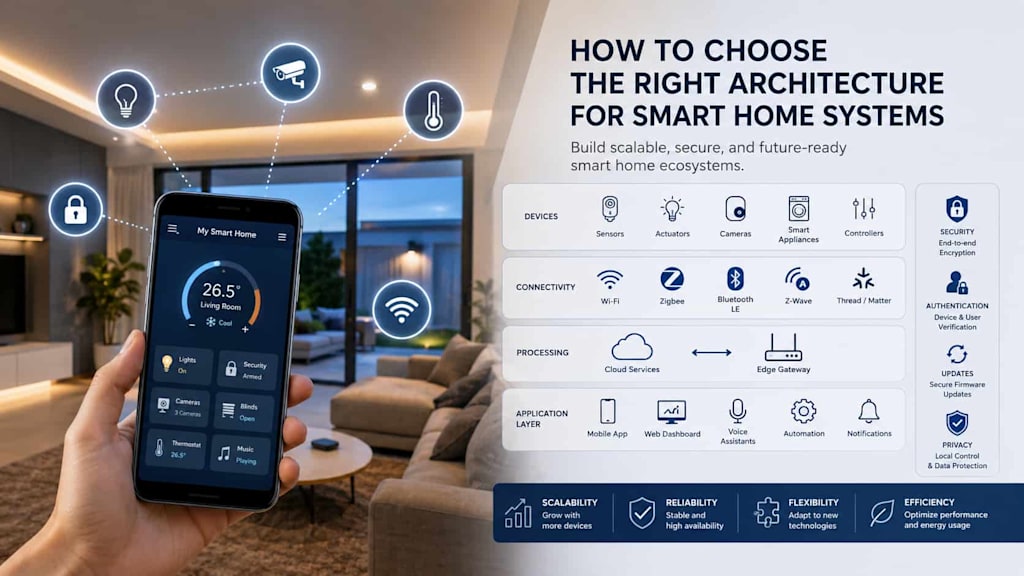
Smart home technology has evolved from simple connected devices into highly integrated ecosystems capable of automating lighting, climate control, security, entertainment, and energy management. As the market expands, businesses and developers face a critical challenge: choosing the right architecture for smart home systems.
The architecture of a smart home platform determines its scalability, security, reliability, and long-term adaptability. A poor architectural decision can result in compatibility issues, unstable performance, increased maintenance costs, and limited future growth. On the other hand, a well-designed architecture enables seamless device communication, efficient data processing, and smooth user experiences.
Today’s smart homes rely on increasingly complex networks of sensors, gateways, mobile applications, cloud services, and AI-driven automation. To manage this complexity effectively, organizations must understand the foundations of smart infrastructure and align technical choices with business goals, user expectations, and future expansion plans.
Understanding the Core Components of Smart Home Architecture
Before selecting a suitable architecture, it is important to understand the major components that make up a smart home ecosystem. These elements form the backbone of any connected environment and directly influence system performance.
At the device layer, sensors and actuators collect and execute data. Smart thermostats, cameras, lighting systems, motion detectors, and smart locks operate at this level. Device diversity creates integration challenges because manufacturers often use different protocols and standards.
The communication layer is responsible for transferring data between devices and central systems. Technologies such as Wi-Fi, Zigbee, Z-Wave, Bluetooth Low Energy, Matter, and Thread each offer different advantages depending on range, bandwidth, power efficiency, and interoperability requirements.
The processing layer handles data analysis, automation logic, and system orchestration. This layer can operate locally through edge computing or remotely through cloud services. Choosing between edge and cloud processing is one of the most important architectural decisions in smart home design.
Finally, the application layer delivers the user experience through mobile apps, dashboards, voice assistants, and automation interfaces. A poorly designed application layer can undermine even the most technically advanced backend infrastructure.
Modern developers increasingly focus on modularity and interoperability because smart home ecosystems must evolve continuously. This is where architecture patterns for modern software systems become highly relevant. Microservices, event-driven systems, and API-first approaches allow platforms to integrate new devices and services without major disruptions.
Choosing Between Centralized, Distributed, and Hybrid Architectures
One of the biggest decisions in smart home engineering is selecting the overall system architecture. The three dominant approaches are centralized, distributed, and hybrid architectures.
Centralized Architecture
In centralized systems, all devices communicate through a single hub or cloud platform. The hub manages automation rules, device coordination, and data processing.
Centralized architectures offer several advantages:
- Easier management and configuration
- Simplified software updates
- Unified security controls
- Lower initial development complexity
These systems are often suitable for smaller smart home deployments where device counts remain manageable.
However, centralized models also introduce risks. A single point of failure can affect the entire ecosystem. If the hub or cloud service becomes unavailable, many connected functions may stop working. Latency may also increase when systems depend heavily on remote cloud processing.
Distributed Architecture
Distributed architectures spread processing responsibilities across multiple devices or edge nodes. Smart devices can communicate directly with one another without relying entirely on a central controller.
This model provides several benefits:
- Improved reliability
- Faster local response times
- Better scalability
- Reduced cloud dependency
Distributed systems are particularly valuable in environments requiring real-time automation, such as security monitoring or energy optimization.
The downside is increased development complexity. Synchronizing devices, maintaining consistent updates, and securing decentralized networks require advanced engineering expertise.
Hybrid Architecture
Many organizations now adopt hybrid models that combine centralized cloud management with local edge processing. This approach balances scalability, responsiveness, and resilience.
For example, voice recognition and analytics may run in the cloud, while local automation routines continue functioning during internet outages. Hybrid systems are increasingly considered the most flexible solution for modern smart home environments.
The growing adoption of hybrid systems reflects broader trends for smart home IoT, especially as consumers demand greater reliability, lower latency, and enhanced privacy protections.
Scalability, Security, and Interoperability Considerations
Choosing the right architecture is not only about current functionality. Smart home systems must support future growth and adapt to rapidly changing technologies.
Scalability
Scalability determines how well the system can handle increasing numbers of devices, users, and automation rules. As smart homes evolve into connected smart buildings and smart cities, architectures must support thousands of simultaneous interactions.
Cloud-native infrastructure often improves scalability because resources can expand dynamically. Containerization and orchestration tools such as Kubernetes help manage distributed workloads efficiently.
Developers should also consider database scalability. Time-series databases are commonly used for IoT systems because they efficiently process large volumes of sensor data.
Security
Security is one of the most critical aspects of smart home architecture. Connected devices create multiple attack surfaces that cybercriminals may exploit.
A secure architecture should include:
- End-to-end encryption
- Device authentication
- Secure firmware updates
- Role-based access control
- Network segmentation
- Continuous monitoring
Edge computing can strengthen privacy by keeping sensitive data inside the local network instead of transmitting everything to external servers.
Security requirements also affect hardware decisions. Low-cost devices may lack sufficient processing power for advanced encryption or authentication mechanisms.
Organizations investing in smart home ecosystems increasingly treat cybersecurity as a core architectural requirement rather than an optional feature.
Interoperability
Interoperability ensures devices from different manufacturers can communicate effectively. This has historically been one of the largest challenges in smart home development.
The emergence of Matter and Thread standards has improved cross-platform compatibility, but integration complexity still exists. Open APIs and standardized communication protocols remain essential for long-term ecosystem flexibility.
Successful interoperability strategies rely heavily on the main habits of engineers who prioritize modular design, standardized interfaces, and extensive compatibility testing during development.
The Role of Edge Computing and Artificial Intelligence
The rapid expansion of IoT devices has increased demand for intelligent local processing. Edge computing and AI-driven automation are now transforming smart home architecture strategies.
Why Edge Computing Matters
Traditional cloud-centric architectures often struggle with latency-sensitive tasks. For example, security cameras requiring immediate threat detection cannot depend entirely on remote cloud processing.
Edge computing moves processing closer to the devices themselves. This improves:
- Response times
- Reliability
- Bandwidth efficiency
- Privacy protection
Edge gateways can process sensor data locally while only sending summarized insights to the cloud. This architecture significantly reduces network congestion.
In energy management systems, edge computing enables real-time optimization of heating, cooling, and electricity usage without continuous cloud communication.
Artificial Intelligence in Smart Homes
AI is becoming central to smart home functionality. Machine learning models can analyze user behavior, automate routines, detect anomalies, and improve energy efficiency.
AI-driven systems can:
- Predict occupancy patterns
- Optimize energy consumption
- Detect unusual device activity
- Enhance voice assistant accuracy
- Personalize automation settings
However, AI integration also affects architectural decisions. Training AI models often requires cloud-scale resources, while inference may occur locally at the edge.
Architects must carefully balance cloud and edge workloads to achieve both efficiency and performance.
As smart homes become more intelligent, many organizations view these systems as part of broader digital transformation initiatives that connect residential technology with healthcare, sustainability, and urban infrastructure.
How to Align Architecture with Business and User Needs
Technical excellence alone does not guarantee project success. The ideal smart home architecture must also align with business objectives and end-user expectations.
A startup creating affordable consumer devices may prioritize rapid deployment and cloud scalability. In contrast, enterprise-grade smart building systems may focus more heavily on reliability, security, and compliance.
User expectations also vary significantly. Some consumers prioritize privacy and prefer local processing. Others value convenience and cloud-based AI services.
To choose the right architecture effectively, organizations should evaluate:
- Expected device volume
- Real-time processing needs
- Security requirements
- Internet dependency tolerance
- Maintenance capabilities
- Budget constraints
- Future expansion plans
Architectural flexibility is especially important because smart home technology evolves rapidly. Systems designed around modular principles can integrate future devices and protocols more easily.
Long-term maintenance should never be underestimated. A highly sophisticated architecture may create operational burdens if the organization lacks sufficient engineering expertise to maintain it.
The most successful smart home platforms are usually those that balance innovation with operational simplicity. Scalability, interoperability, and resilience should be considered from the earliest design stages rather than added later as corrective measures.
Conclusion
Choosing the right architecture for smart home systems requires careful evaluation of technical, operational, and business factors. There is no universal solution that fits every use case. Centralized architectures may suit smaller deployments, distributed systems provide greater resilience, and hybrid models often deliver the best balance of flexibility and performance.
Modern smart home ecosystems must support scalability, strong security, seamless interoperability, and intelligent automation. The increasing importance of edge computing, AI, and open communication standards continues to reshape architectural best practices across the industry.
Organizations that invest time in understanding system requirements, future scalability, and user expectations are far more likely to build successful smart home platforms that remain competitive over the long term. By selecting the appropriate architectural approach early in development, businesses can reduce future costs, improve user satisfaction, and create smarter, more adaptive connected environments.
About the Creator
Markus Koch
I am a professional IT consultant with 5+ years of experience.
Enjoyed the story? Support the Creator.
Subscribe for free to receive all their stories in your feed.
Comments
There are no comments for this story
Be the first to respond and start the conversation.