
How to Choose the Right Architecture for an Enterprise VoIP Platform
A practical guide to designing a scalable, secure, and reliable VoIP architecture for enterprise communications.

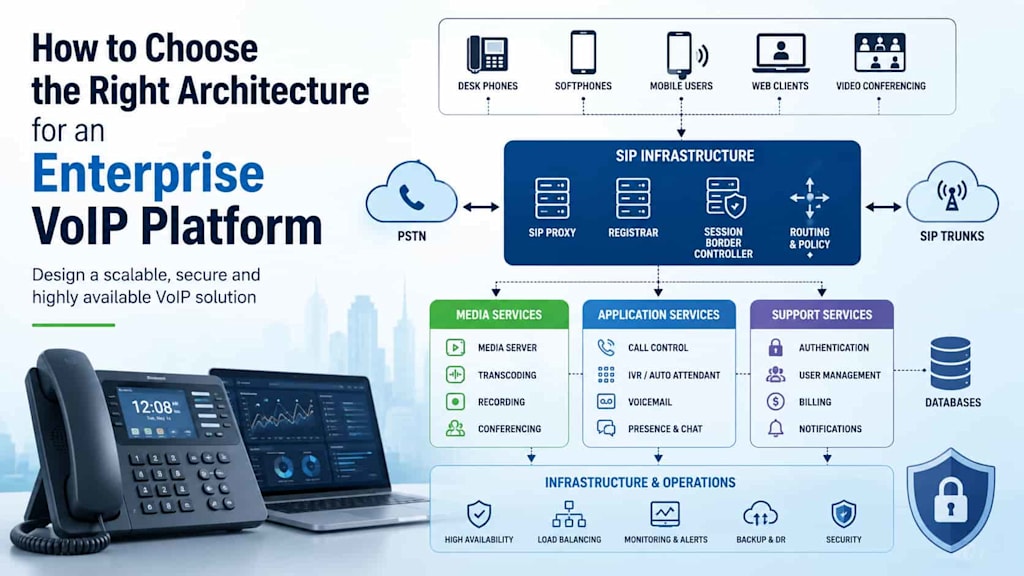
Enterprise VoIP platforms have evolved far beyond basic internet-based calling. Modern systems support thousands of users, multiple locations, video conferencing, messaging, call recording, contact centers, analytics, mobile applications, and integrations with business software. As the number of requirements grows, architecture becomes one of the most important factors determining whether the platform will remain reliable and manageable over time.
Choosing the right architecture is not simply a matter of selecting a programming language or SIP server. It requires a clear understanding of traffic patterns, availability requirements, security, integration needs, scalability, and operational capabilities. A well-designed architecture allows organizations to add functionality without constantly rebuilding the underlying platform.
Start With Business and Communication Requirements
The first step is to define what the VoIP platform actually needs to accomplish. Technical decisions made before understanding business requirements can result in unnecessary complexity or costly limitations later.
An enterprise platform may need to support internal extensions, external PSTN calls, SIP trunking, conferencing, call queues, IVR systems, voicemail, call recording, CRM integration, mobile clients, WebRTC, or unified communications. Each requirement can influence the architecture.
For example, a company with several hundred employees in one office may not need the same architecture as a multinational organization operating contact centers across multiple continents. The latter may require geographically distributed services, regional SIP gateways, redundant databases, traffic management, and disaster recovery.
It is also important to estimate expected call volume. Consider not only the number of registered users but also concurrent calls, peak traffic, codec requirements, signaling volume, and media bandwidth. These metrics provide a much more realistic basis for architectural decisions.
Choose Between Monolithic and Distributed Architectures
A traditional VoIP platform can be designed as a relatively centralized system where signaling, business logic, media handling, and supporting services operate closely together. This approach can be easier to deploy and maintain when requirements are limited.
However, enterprise environments often benefit from a more distributed architecture. Different responsibilities can be separated into services responsible for SIP signaling, media processing, authentication, billing, call routing, analytics, notifications, and integrations.
Microservices are particularly useful when individual components need to scale independently. For instance, a call-recording service may require significant storage capacity while an authentication service may require comparatively little computing power.
At the same time, microservices should not be adopted simply because they are fashionable. Excessive service fragmentation introduces network communication overhead, deployment complexity, monitoring requirements, and additional failure points.
The architecture should therefore reflect actual operational requirements rather than following a predetermined technology trend.
Design the SIP and Media Layers Carefully
The communications layer is the foundation of an enterprise VoIP system. SIP handles signaling, while RTP and related technologies typically transport voice and other real-time media.
A reliable SIP infrastructure should be designed around redundancy, predictable routing, traffic management, and failure recovery. SIP proxies, registrars, session border controllers, media servers, and gateways should have clearly defined responsibilities.
One important architectural principle is to separate signaling from media whenever practical. Signaling components can manage registration, routing, authentication, and session establishment, while dedicated media components handle RTP streams, transcoding, conferencing, recording, or interactive voice applications.
Session Border Controllers can also play an important role at network boundaries. They can help manage SIP interoperability, topology hiding, security policies, NAT traversal, and traffic control.
The architecture should additionally account for codec selection. Transcoding can consume substantial CPU resources, particularly at scale. Avoiding unnecessary transcoding can improve both performance and infrastructure costs.
Evaluate Open-Source Components Strategically
Open-source technologies can significantly reduce licensing costs and provide extensive flexibility. However, assembling an enterprise VoIP platform from open-source components requires careful architectural planning.
When choosing the right open-source stack for enterprise VoIP development, organizations should evaluate more than feature availability. Licensing, community activity, documentation, security practices, long-term maintenance, integration capabilities, and availability of commercial support should all be considered.
A possible architecture could combine an open-source SIP engine with separate media services, databases, message brokers, monitoring tools, and API services. The advantage is flexibility: each component can be selected according to a specific technical requirement.
However, organizations should avoid creating an ecosystem of too many unrelated technologies. Every additional component becomes another dependency that must be secured, upgraded, monitored, backed up, and supported.
The goal should be a coherent open-source tech stack for VoIP rather than a collection of individually attractive tools.
Build for High Availability From the Beginning
Enterprise communications often require near-continuous availability. A short outage can disrupt customer support, sales operations, emergency communication, or contact-center activity.
High availability should therefore be part of the initial architecture rather than something added after deployment.
Critical services should have redundant instances, while load balancing can distribute requests across available nodes. Databases may require replication, and important configuration data should be backed up automatically.
Geographic redundancy can be appropriate for organizations where communications must continue even if an entire data center becomes unavailable.
Failover mechanisms should also be tested regularly. Having redundant servers is not enough if the system cannot automatically detect failures and route traffic to healthy components.
Monitoring is equally important. Infrastructure teams should track SIP registration failures, call setup time, packet loss, jitter, latency, CPU utilization, memory consumption, RTP problems, and service availability.
Make Security an Architectural Requirement
VoIP platforms face many of the same security challenges as other internet-facing applications, but real-time communications introduce additional considerations.
SIP accounts can be targeted for credential attacks, while poorly protected systems can be abused for toll fraud. RTP traffic can potentially expose conversations if encryption is not implemented appropriately.
Security architecture should therefore include strong authentication, access controls, encrypted signaling where appropriate, secure media transport, rate limiting, fraud detection, network segmentation, and detailed logging.
Session Border Controllers can help protect the communication boundary, while firewalls and carefully designed network policies can restrict unnecessary access.
Security should also extend to APIs and administrative interfaces. Enterprise VoIP platforms increasingly expose REST APIs, WebSocket connections, mobile services, and integrations with CRM and collaboration systems. Each interface creates another potential attack surface.
Plan APIs and Business Integrations
A modern VoIP platform rarely operates in isolation. Enterprises commonly integrate communications with CRM, ERP, help-desk, workforce-management, identity-management, and collaboration platforms.
For this reason, the architecture should expose well-defined APIs instead of forcing external systems to interact directly with internal VoIP components.
Event-driven architecture can also be useful. Events such as call started, call answered, call completed, recording created, or agent status changed can be distributed through a message broker and consumed by independent services.
This approach reduces tight coupling and makes it easier to introduce new integrations without modifying the core communications engine.
Consider Legacy Migration and Future Growth
Many enterprises already have PBX systems, proprietary telephony platforms, or older VoIP deployments. Replacing everything simultaneously can create unnecessary operational risk.
A gradual strategy for migrating legacy systems to modern VoIP platforms can allow organizations to move users, locations, or services in stages. SIP gateways and interoperability layers can help connect old and new environments during the transition.
Architecture should also anticipate future growth. Consider whether the platform can accommodate additional users, regions, communication channels, AI-powered features, analytics, and new customer-facing applications.
A scalable architecture does not necessarily mean deploying hundreds of servers from day one. It means creating clear scaling boundaries so that infrastructure can expand as demand increases.
Conclusion
Choosing an architecture for an enterprise VoIP platform requires balancing scalability, reliability, security, maintainability, and business requirements. There is no universal architecture that works for every organization.
The strongest approach begins with communication requirements and traffic patterns, then defines the SIP and media layers, supporting services, data architecture, APIs, security controls, and operational processes. Open-source technologies can provide an excellent foundation, but they should be selected as parts of a coherent architecture rather than as isolated components.
Most importantly, enterprise VoIP architecture should be designed for change. Organizations will add users, locations, integrations, communication channels, and new functionality over time. An architecture built around clear service boundaries, redundancy, observability, security, and controlled scalability gives the platform the flexibility needed to evolve without sacrificing reliability.
About the Creator
Chudovo
Chudovo is a custom software development company, focused on complex systems implementation.
Enjoyed the story? Support the Creator.
Subscribe for free to receive all their stories in your feed.
Comments
There are no comments for this story
Be the first to respond and start the conversation.